
The logistics industry is evolving faster than ever, with on-demand courier delivery app development reshaping how goods are transported, tracked, and delivered. From startups to enterprise logistics companies, the demand for courier delivery app development services has skyrocketed in 2025 due to rising eCommerce adoption, customer expectations for same-day delivery, and innovations like AI, IoT, and drone integration.
This comprehensive guide to courier delivery app development will walk you through the features, process, cost, monetization, and best practices—so you can build an app that’s scalable, profitable, and future-ready.
Why Courier Delivery App Development Matters in 2025?
The global courier and parcel delivery market is projected to grow at 9–10% CAGR between 2025 and 2030. Fast delivery is no longer considered a luxury; it has become a basic expectation. From groceries and medicines to electronics, people demand real-time tracking, instant updates, and eco-friendly logistics.
For businesses, this shift opens opportunities to:
- Expand into on-demand delivery services.
- Improve customer loyalty with transparent tracking.
- Reduce costs via AI-powered courier delivery app development that optimizes routes and delivery times.
Simply put: courier apps are no longer optional—they’re essential.
Key Business Models in Courier Delivery App Development
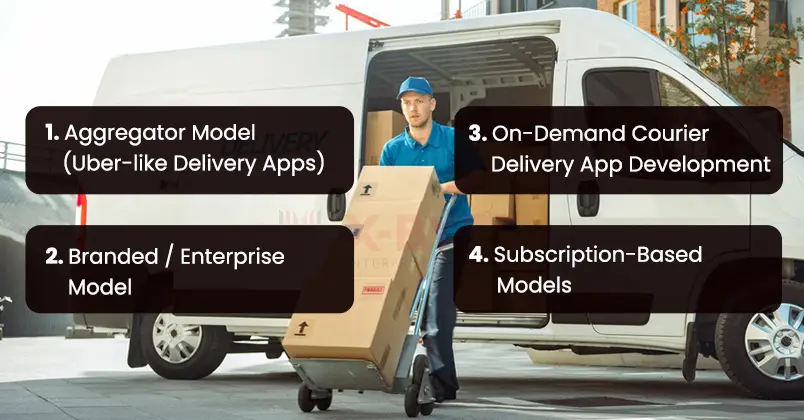
Before investing in development, businesses must choose the right pickup and delivery app development model:
- Aggregator Model (Uber-like Delivery Apps): Connects users with independent couriers or delivery service providers.
- Branded / Enterprise Model: Businesses create their own app for managing in-house deliveries.
- On-Demand Courier Delivery App Development: Customers can instantly request same-day or scheduled deliveries.
- Subscription-Based Models: Businesses or individuals pay a recurring fee for premium or unlimited delivery services.
The right model depends on your audience, scalability goals, and monetization strategy.
Must-Have Features in Courier Delivery App Development
A competitive courier app should deliver a seamless experience for customers, couriers, and admins.
User Panel
- Real-time order placement & scheduling
- GPS tracking & delivery status updates
- Multiple payment options (UPI, wallets, cards)
- Ratings & reviews for service feedback
Courier/Driver Panel
- AI-powered route optimization
- Earnings dashboard & delivery history
- Navigation with traffic updates
- Digital proof of delivery (e-signatures, photos)
Admin Panel
- Order & fleet management
- Analytics dashboard with performance reports
- Automated commission & payouts
- Customer support integration
Advanced Features (2025)
- AI-powered delivery predictions (faster ETAs).
- IoT-enabled tracking sensors for fragile goods.
- Drone & autonomous vehicle integrations.
- Eco-routing algorithms for fuel efficiency.
By integrating advanced tech, you move beyond basic functionality and ensure your app stays future-proof.
Step-by-Step Courier Delivery App Development Process
Creating a robust delivery app requires a structured process:
- Market Research & Competitor Analysis – Identify customer pain points, analyze successful apps like Amazon Flex or Roadie.
- App Design & UX/UI – Build intuitive interfaces; prioritize easy booking, live tracking, and clear navigation.
- App Development – Develop front-end (Flutter, React Native), back-end (Node.js, Python), APIs for maps & payments.
- Testing & QA – Ensure performance under real-world conditions (high traffic, poor network).
- Launch & Optimization – Publish the app on Google Play and Apple App Store, and apply ASO techniques to improve visibility.
- Maintenance & Scaling – Release updates, add new features, and expand for multiple regions.
This courier delivery app development process ensures quality, scalability, and reliability.
Technology Stack for Building a Courier Delivery App
- Frontend: React Native, Flutter
- Backend: Node.js, Python, Java, PHP
- Database: PostgreSQL, MongoDB, Firebase
- Cloud Hosting: AWS, Azure, Google Cloud
- Mapping & Navigation: Google Maps, Mapbox, OpenStreetMap
- AI & ML: Predictive analytics, route optimization, fraud detection
Selecting the right tech stack plays a vital role in ensuring app speed, scalability, and budget efficiency.
Cost of Courier Delivery App Development in 2025
Courier delivery app development service costs are determined by elements like feature set, scalability, target platforms, and region of development.
- MVP / Basic Version: $20,000 – $40,000
- Mid-Range Apps (multi-feature): $40,000 – $80,000
- Enterprise-grade (AI-powered, IoT-enabled): $100,000+
Additional factors affecting cost:
- Native (iOS/Android) vs Cross-platform
- Third-party API integrations (payment, maps, logistics tools)
Security & compliance standards
Monetization Strategies for Courier Apps
A courier delivery app can generate revenue through:
- Commission per order (Uber-like model).
- Subscription/Membership fees (frequent users, businesses).
- In-app ads & partnerships.
Value-added services (insurance, priority deliveries, eco-friendly delivery fees).
Best Practices & Mistakes to Avoid in Courier Delivery App Development
Ready to build your own courier delivery app?
Connect with our experts today and get a tailored development roadmap for your business.
Best Practices:
- Build scalable architecture to handle peak demands.
- Offer real-time tracking with push notifications.
- Integrate multiple payment options for convenience.
- Use data analytics for continuous improvement.
Mistakes to Avoid:
- Ignoring user experience (UX/UI) → leads to churn.
- Weak data security & compliance (GDPR, HIPAA for medical deliveries).
- Overlooking driver-friendly features (navigation, earnings transparency).
Case Studies: Successful Courier Delivery Apps in 2025
- Amazon Flex – crowdsourced delivery model for flexible workforce.
- Roadie – “on-the-way” delivery system leveraging gig workers.
- DHL Express – investing in AI-powered courier delivery app development for faster international logistics.
- Glovo – Europe’s leading hyperlocal delivery with groceries, food, and parcels.
These examples highlight different business models and innovations shaping the market.
Future Trends in Courier Delivery App Development
- AI-powered logistics for predictive delivery times.
- Drones & autonomous vehicles for last-mile efficiency.
- Blockchain for secure, transparent payment tracking.
- Sustainability-first delivery apps promoting electric vehicles and eco-friendly packaging.
Companies embracing these trends will gain a competitive edge in the market.
Looking for reliable courier delivery app development services?
Book a free consultation and discover how we can bring your app idea to life.
Conclusion: Building the Future of Courier Delivery Apps
Courier delivery app development in 2025 is about more than just tracking packages—it’s about creating scalable, AI-powered, and customer-centric solutions that drive business growth.
If you’re planning to build a courier delivery app, now is the perfect time to invest in AI-powered app development with advanced features and a future-ready roadmap.
Looking for an expert courier delivery app development company?
Contact us today to get a free consultation and custom estimate.
FAQ
How long does it take to build a courier delivery app?
Typically 3–6 months, depending on complexity and features.
How much does courier delivery app development cost in 2025?
Between $20,000 and $100,000+, depending on features, platform, and region.
What are the essential features of a courier app?
Real-time tracking, secure payments, courier dashboard, analytics, and AI-powered route optimization.
Which technologies are best for courier app development?
Flutter/React Native for front-end, Node.js/Python for back-end, and AWS/Google Cloud for hosting.