
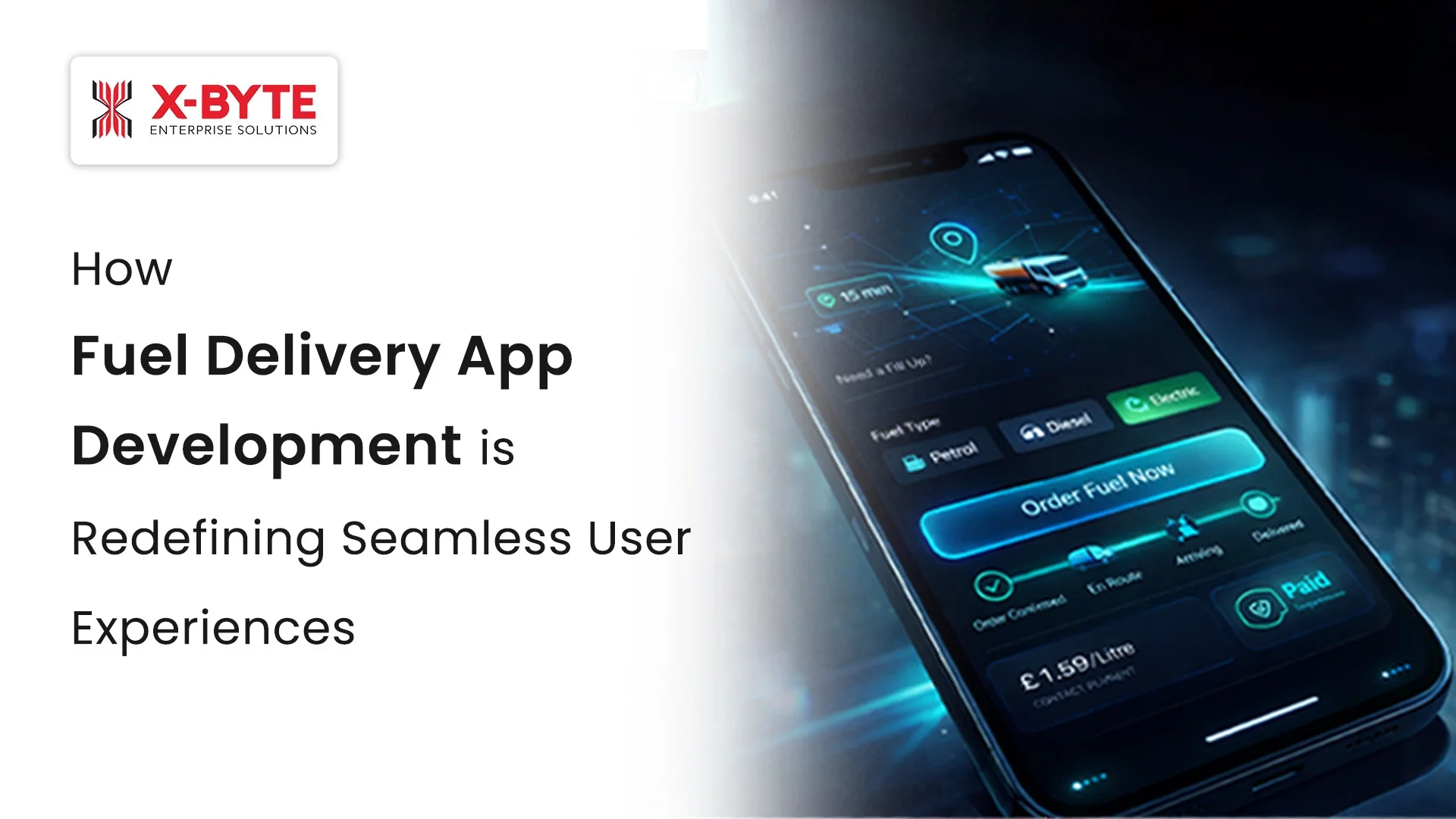
Key Highlights:
- Fuel delivery apps are transforming traditional fuel logistics into on-demand services by eliminating the 100-year-old habit of driving to gas stations
- AI-powered fuel delivery app solutions with IoT fuel monitoring and predictive scheduling separate market leaders from failures
- Fuel delivery app development cost ranges from $40K for basic MVPs to $150K+ for enterprise platforms
- Choosing the right fuel delivery app development company matters more than budget
Introduction
You’re considering building a fuel delivery app. Smart move, the market’s racing to grow to USD 11,927.6 million by 2035, with a compound annual growth rate (CAGR) of 7.4%, as per a report from Future Marketing Insights.
Fuel delivery app development is fundamentally changing how customers think about refueling.
But here’s what separates the winners from the six-figure failures: understanding that seamless experiences aren’t built from features. They’re built on eliminating every reason not to use your service.
So how build a fuel delivery app that people actually trust and use repeatedly?
The answer isn’t technology. It’s trust wrapped in convenience, delivered through an experience so effortless it feels like magic.
That’s what seamless really means in fuel delivery. No more features. Not shinier interfaces. Just the complete absence of friction between “I need fuel,” and my tank is full.
If you want to deliver exactly that to your end users, then keep on reading to know about the market dynamics and how to build a fuel delivery app that your users love.
What is Fuel Delivery App Development?
Fuel delivery app development is building a system that brings fuel to your customer’s location, so they never have to drive to a gas station.
Simple concept. Complex execution.
You’re not just building an app. You’re coordinating three moving parts simultaneously: a customer who needs fuel, a driver who carries it, and a business backend that makes sure the right amount of the right fuel reaches the right vehicle, safely, legally, and on time.
Each of these needs its own interface:
- Customers place orders, share their location, pick fuel type, and pay – all from their phone.
- Drivers get optimized routes, delivery instructions, and real-time updates through their own app.
- You (the business owner) monitor every delivery, manage your fleet, control pricing, and track performance from a central dashboard.
GPS tracking, route optimization, and mobile payments aren’t features you add on top. They’re what make the whole operation possible.
But, Why the Need of On-Demand Fuel Delivery App?
The fuel station model hasn’t meaningfully changed in decades. Customers still drive to fuel. They wait. They pay. They leave.
That friction is your business opportunity. The businesses entering now, with the right product, will be extremely difficult to displace once customer habits form around their platform.
Here’s why this is the right time to build:
- The behavior shift is already happening. Consumers have been trained by Uber, Amazon, and Swiggy to expect everything on demand. Fuel is simply the next category. You’re not convincing people to adopt a new habit; you’re applying an existing one to a new problem.
- Fleet operators are actively looking for this. Logistics companies, construction firms, and delivery businesses spend significant time and money managing fuel manually, fuel cards, multiple station visits, and messy reconciliation. A well-built fuel delivery app development solves all of that in one product. This is a high-value B2B customer base that pays consistently and stays long-term.
- The competition is still thin. Unlike food delivery or ride-hailing, an on-demand fuel delivery app hasn’t been won yet in most geographies. The dominant player in your city or region probably doesn’t exist yet.
- Recurring revenue is built into the model. People need fuel regularly. Unlike most on-demand categories, where retention is a constant battle, refueling is a non-negotiable, repeat-purchase behavior. Build trust once, and customers come back on their own.
- Margins improve with scale. As your order volume grows, your route optimization gets smarter, your cost-per-delivery drops, and your operational efficiency compounds. The unit economics get better the bigger you get, not worse.
Also, check out our blog on Mobile App Development for more insights on building impactful apps.
How to Build a Fuel Delivery App in 2026?
Most fuel delivery apps fail for the same reason most restaurants fail, not because the product is bad, but because the foundation wasn’t built for scale. That’s why choosing the right fuel delivery app development company from the beginning becomes a critical decision for long-term success.
Building for 2026 and beyond means making decisions today that your future self won’t have to undo under pressure. Working with an experienced team like Techanic Infotech can help businesses create scalable and future-ready solutions. Here’s how to build a fuel delivery app.
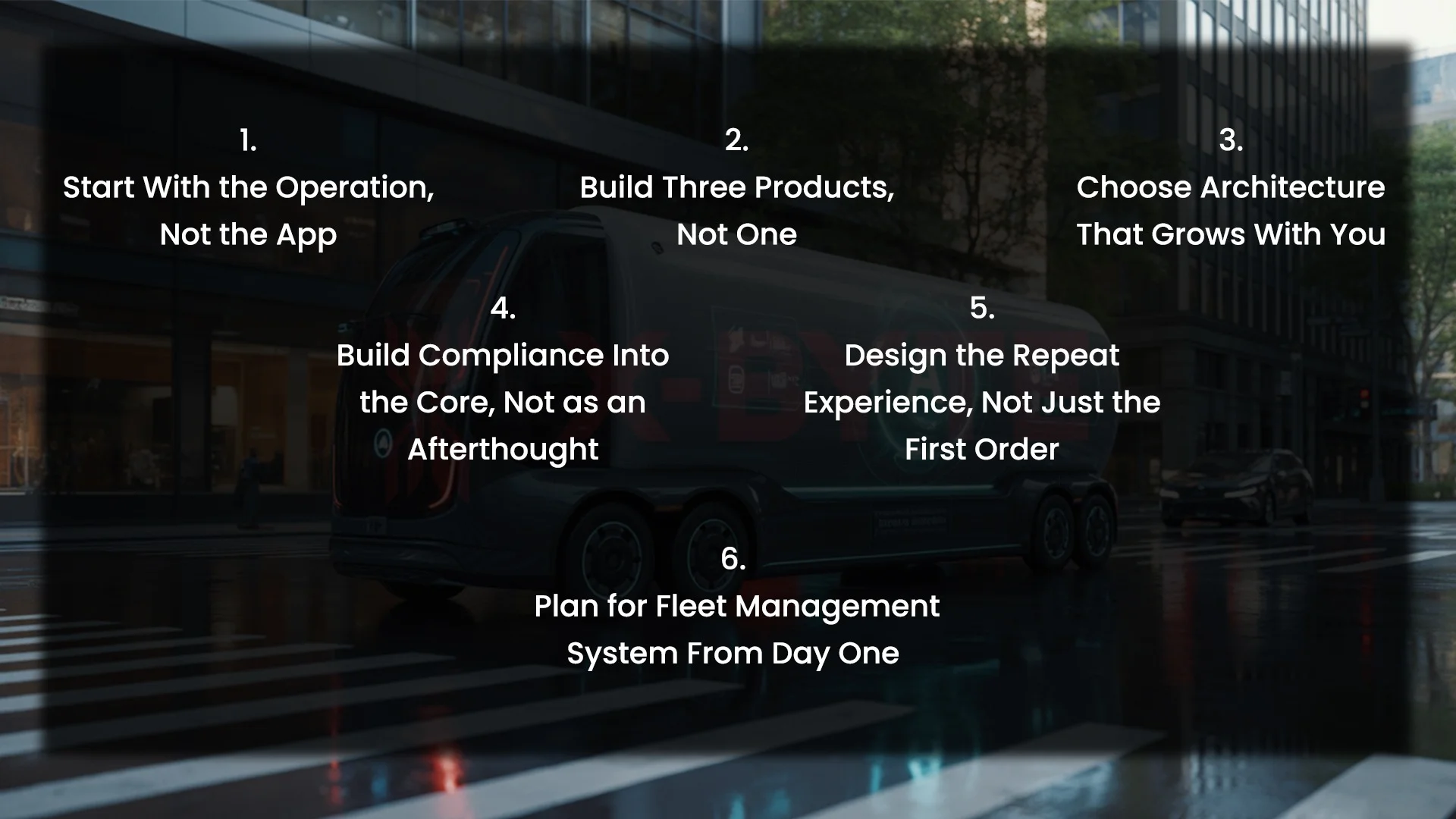
1. Start With the Operation, Not the App
Before wireframes, before tech stack discussions, before you talk to a single developer, map your operation on paper.
- How are you sourcing fuel?
- Who are your suppliers?
- What’s your delivery radius?
- Are you serving consumers, fleet operators, or both?
- How many tankers are you starting with?
These aren’t business plan questions. They’re app architecture questions. The entire system, how orders are routed, how drivers are dispatched, how pricing is calculated, is built around the answers.
2. Build Three Products, Not One
A fuel delivery app is not one app. It’s three, and each one needs to be treated as a distinct product with its own user and its own job to do.
The customer app has one job: to make ordering so simple it feels like nothing. Every extra tap is a conversion you’re losing.
The driver app has one job: make delivery execution effortless. The app should reduce their cognitive load, not add to it.
The admin dashboard has one job: give you complete operational visibility. If you can’t see what’s happening in your business in real time, you can’t fix what’s breaking.
3. Choose Architecture That Grows With You
This is where most early-stage builds make their costliest mistake.
A monolithic architecture, where everything is built as one large system, is faster and cheaper to build initially. It’s also a ceiling. When you want to add a new city, a new fuel type, or a new customer segment, you’re rebuilding rather than extending.
Build on a cloud-based architecture with a modular, API-first design from day one. This means your payment system, your GPS tracking system, your route optimization engine, and your notification system all operate as independent components that talk to each other.
4. Build Compliance Into the Core, Not as an Afterthought
This is the part most app development conversations skip entirely, and it’s the part that gets fuel delivery businesses shut down.
Fuel is a regulated commodity. Depending on where you operate, you’re dealing with hazardous material transport licenses, fire safety certifications, environmental spill reporting, and digital delivery documentation requirements.
Your app needs to generate compliant delivery records automatically, store them accessibly, and produce them on demand. Integrate your compliance workflows into the driver app so documentation happens as part of the delivery process, not as a separate manual task that gets skipped under pressure.
5. Design the Repeat Experience, Not Just the First Order
Acquisition is expensive. Retention is where the business model actually works.
Most apps obsess over the first-order experience and neglect everything that happens after. That’s backwards. The most important step in a fuel delivery app isn’t the first delivery, it’s the third, because that’s when a user becomes a habit.
Design specifically for repeat usage. Smart reorder flows that remember vehicle, location, and fuel preference. Timely notifications based on the customer’s actual refueling pattern.
When a customer reorders in under 30 seconds because your app remembered everything about their last order, that’s not good UX, that’s a retention engine.
6. Plan for Fleet Management System From Day One
If you’re starting with two tankers, you might think fleet management is a future problem. It isn’t.
The data you collect from day one, including delivery times, route efficiency, fuel consumption per trip, and driver performance, becomes your most valuable operational asset as you scale. If your system isn’t capturing and organizing it properly from the beginning, you’ll be making expansion decisions blindly.
A proper fleet management system also integrates with your IoT fuel monitoring, giving you live tanker levels, automated low-fuel alerts, and delivery quantity verification. That last one matters more than it sounds: the ability to digitally confirm exactly how much fuel was delivered, to which vehicle, at what time, is both a customer trust mechanism and a fraud prevention layer.
How AI is Transforming Fuel Delivery Apps?
Most fuel delivery apps today do one thing: connect a customer request to a driver. That’s logistics coordination, not intelligence.
The apps that will dominate the next five years are doing something fundamentally different: they’re learning from every delivery, every route, every customer pattern, and using that data to make better decisions automatically.
That’s where AI enters the picture. And for business owners building in this space right now, it’s the single biggest competitive lever available.
Here’s where AI is actually creating impact:
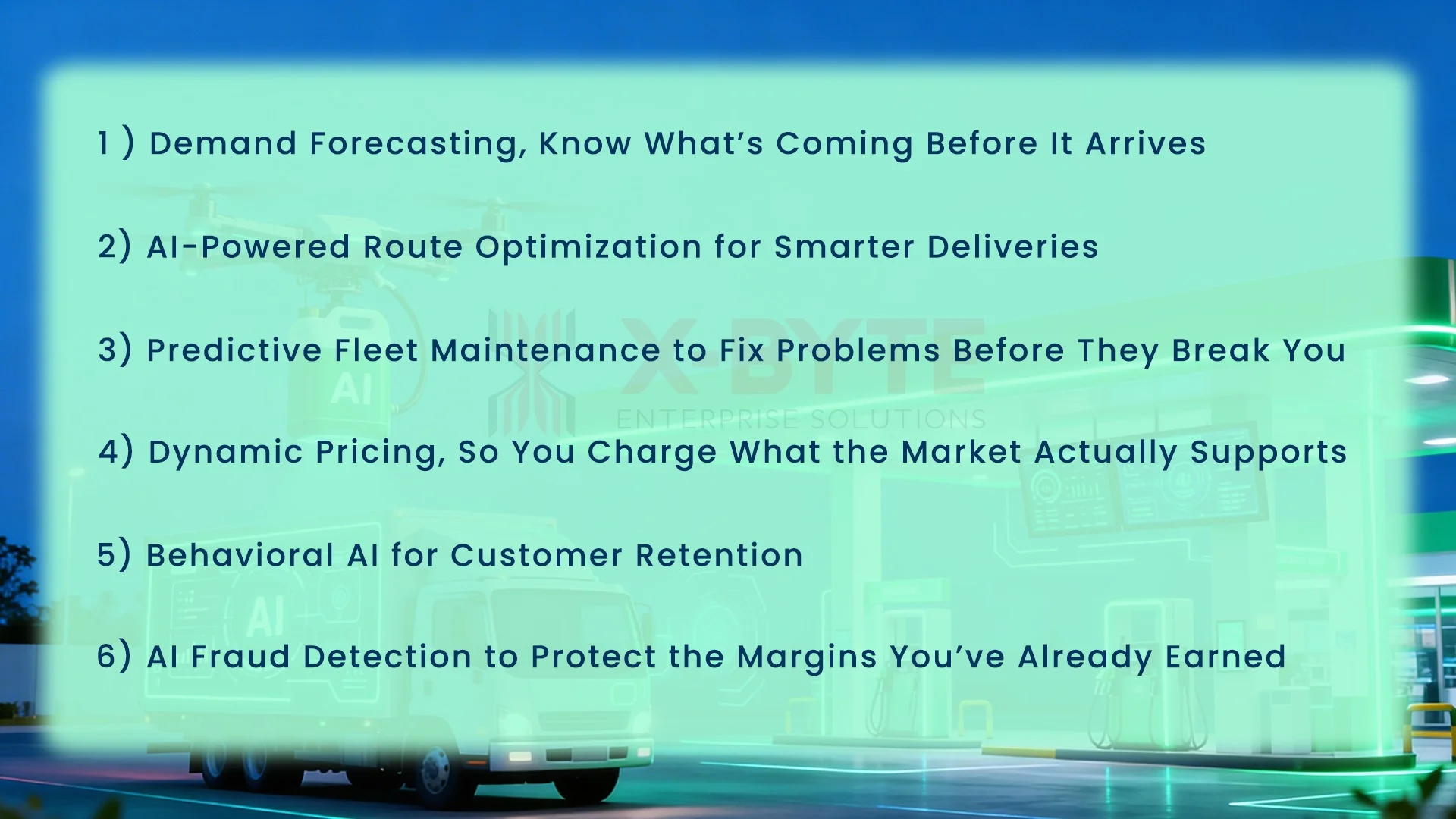
1. Demand Forecasting, Know What’s Coming Before It Arrives
Most fuel delivery operations run on gut feeling. You look at yesterday’s orders, make a call on how many tankers to deploy, and hope it works out. AI replaces that guesswork with pattern recognition, analyzing historical orders, weather, local events, and fuel price shifts to predict demand before it hits.
What this means for your business:
- Deploy the right number of drivers before demand spikes, not after
- Reduce idle tankers on slow days, cutting unnecessary operational costs
- Never miss a high-demand window because you were understaffed
- Make smarter inventory decisions based on forecasted volume, not instinct
2. AI-Powered Route Optimization for Smarter Deliveries
Basic route optimization finds the shortest path. AI-powered route optimization algorithms learn from every completed delivery and continuously improve, accounting for traffic patterns, neighborhood access issues, driver strengths, and live tanker levels pulled from your IoT fuel monitoring system.
What this means for your business:
- Lower cost-per-delivery as routes improve over time without manual intervention
- Drivers spend less time on the road and complete more deliveries per shift
- Tankers are never dispatched on routes they can’t complete with current fuel levels
- Operational efficiency compounds automatically, delivery by delivery
3. Predictive Fleet Maintenance to Fix Problems Before They Break You
A tanker breaking down mid-delivery doesn’t just cost you that order; it costs you everything behind it. AI monitors engine data, mileage patterns, and fuel consumption anomalies through your fleet management system and flags issues before they become failures.
What this means for your business:
- Schedule maintenance around your operation, not around emergencies
- Avoid the cascading cost of mid-delivery breakdowns during peak hours
- Extend tanker lifespan through timely, data-driven maintenance decisions
- Reduce unplanned downtime that directly impacts customer retention rate
4. Dynamic Pricing, So You Charge What the Market Actually Supports
Static pricing means you’re either leaving margin on the table during high-demand windows or underpricing during slow periods. AI adjusts pricing in real time based on current fuel costs, demand levels, route complexity, and order volume within the limits you set.
What this means for your business:
- Maximize revenue during peak demand without manual price adjustments
- Offer volume-based pricing to fleet customers automatically, improving loyalty
- Protect margins when fuel market costs rise, without constant manual oversight
- Stay competitive during slow periods without permanently cutting your rates
5. Behavioral AI for Customer Retention
This is where AI has the most direct impact on your customer retention rate. Instead of sending generic promotional notifications to everyone, AI builds individual behavioral models, learning each customer’s refueling pattern, timing triggers, and communication preferences, then reaches out at exactly the right moment.
What this means for your business:
- Retain more customers without increasing your marketing spend
- Notifications that feel like a helpful reminder, not a promotional blast
- Reorder rates improve because the app anticipates need rather than waiting for it
- Turn one-time users into habitual customers faster, reducing acquisition cost over time
6. AI Fraud Detection to Protect the Margins You’ve Already Earned
Fuel delivery has a specific fraud risk that most founders don’t see until it’s already cost them money, discrepancies between fuel reported as delivered and fuel actually dispensed. AI cross-references IoT fuel monitoring sensor data, GPS tracking system records, and reported delivery quantities automatically, flagging anomalies in real time.
What this means for your business:
- Catch delivery quantity discrepancies before they become a pattern
- Detect GPS anomalies that indicate a delivery wasn’t completed as reported
- Identify promotional abuse across customer accounts automatically
- Protect operational margin without manually auditing every transaction
The businesses that do this will have a compounding operational and retention advantage over every competitor who treats AI as a phase-two problem. In a market still being defined, that gap becomes very difficult to close.
Key Features of On-Demand Fuel Delivery Apps!
A fuel delivery app is only as good as the experience it creates for the three people who use it every single day: your customer who needs fuel, your driver who delivers it, and you who runs the operation behind it.
Here are the crucial ones that you should have in your app:
A Customer-Side Features of On-Demand Fuel Delivery Apps
Your customer has one standard: every other on-demand app they already use. If ordering fuel takes more effort than ordering food, you’ve already lost them.
- Smart location detection – Auto-detects delivery location via GPS; customers save multiple addresses for home, office, or fleet yards without re-entering details every time
- Vehicle & fuel preference memory – Saves vehicle type, fuel grade, and tank size so repeat orders are pre-filled and confirmed in seconds, not re-entered from scratch
- Real-time delivery tracking – Live driver location with a specific, narrowing ETA, not a vague time window, but a minute-level update that eliminates the where is my order anxiety entirely
- Flexible scheduling – Order now for immediate delivery or schedule in advance for fleet operators managing predictable refueling cycles
- Multiple fuel type selection – Petrol, diesel, premium grades, clearly listed with current pricing, so customers always know exactly what they’re paying before they confirm
- One-tap reorder – Repeat the last order in a single tap with vehicle, location, tank size, fuel type, and payment all pre-loaded. This is the feature that builds the habit
- Mobile payment integration – Supports cards, wallets, UPI, and fleet accounts with stored payment methods; no re-entry, no friction at checkout
- Proactive notifications – Delivery confirmations, driver assignment alerts, ETA updates, and behavioral nudges based on the customer’s actual refueling pattern, not generic promotional blasts
- In-app support – Live chat or callback option for order issues without leaving the app – because the moment a customer opens a browser to find your support number, you’ve already failed them
Driver-Side Features of On-Demand Fuel Delivery Apps
Your driver is operating a tanker carrying a hazardous material under time pressure. This is not the context for a minimal, gesture-heavy interface. Every driver-side feature exists to answer one question before the driver has to ask it: what do I do next?
- Instant dispatch notifications – New orders are pushed immediately with full delivery details of customer location, fuel type, quantity, and any access instructions, so drivers act without waiting
- Optimized navigation – Built-in routing via route optimization algorithms that account for real traffic, access restrictions, and multi-stop sequencing; drivers follow the smartest path, not just the shortest one
- Automated compliance documentation – Delivery records are generated automatically as a byproduct of completing the delivery flow, timestamped, GPS-stamped, and stored without any separate manual entry from the driver
- Exception handling flows – Customer not present, wrong vehicle at location, access issue, every real-world delivery problem has a mapped resolution path inside the app, not a dead-end “call support” instruction
- Earnings & delivery summary – Drivers see completed deliveries, distance covered, and earnings in real time, with transparency that directly impacts driver satisfaction and retention
- In-app communication – Direct contact with dispatch and customers through the app without sharing personal numbers, keeping communication documented and professional
- Shift management – Drivers’ log availability, start and end shifts, and track active hours, feeds directly into dispatch logic so the system always knows who’s actually available
Admin-Side Features of On-Demand Fuel Delivery Apps
If you can’t see everything happening in your operation in real time, you can’t fix what’s breaking until it’s already broken.
- Dynamic pricing controls – Adjust fuel pricing by zone, time of day, fuel type, or customer segment instantly without touching the codebase; your pricing service responds to market conditions as fast as the market moves
- Driver performance analytics – Delivery completion rates, average delivery time, route adherence, and customer ratings per driver, the data you need to coach, reward, and build a high-performing team
- Compliance documentation access – Every delivery record stored, searchable, and exportable on demand; when a regulator asks for documentation, you produce it in minutes, not days
- Fleet management system integration – Tanker health data, maintenance schedules, IoT fuel monitoring alerts, and vehicle utilization rates in one place, so fleet decisions are made on data, not instinct
- Customer data & retention analytics – Order frequency, reorder rates, churn signals, and customer lifetime value per segment, the metrics that tell you whether your customer retention rate is growing or quietly declining
- Zone & radius management – Define, adjust, and activate delivery zones without a developer; expand to a new area or pull back from an underperforming one in real time
- Promotional & loyalty controls – Create, deploy, and measure offers for specific customer segments, fleet operators, high-frequency users, or lapsed customers with full visibility into what’s actually driving reorders
- Revenue & operational reporting – Daily, weekly, and monthly breakdowns of revenue, cost-per-delivery, fuel volume, and operational efficiency metrics, the numbers that tell you whether the business is actually working
Tech Stack / Architecture
When evaluating fuel delivery app development cost, most business owners focus on fuel delivery app features. But here’s what actually determines whether your on-demand fuel delivery app scales or crumbles under pressure: your tech-stack.
The architecture needs to handle three critical challenges simultaneously:
- real-time coordination between customers and drivers,
- seamless integration with payment and fuel management systems,
- and the intelligence layer that makes everything feel effortless.
Here’s the proven tech stack that powers successful fuel delivery platforms:
Modern Fuel Delivery App Development Tech Stack
| Component | Technology | Why It Matters |
| Mobile Apps (iOS/Android) | React Native / Flutter | Single codebase reduces fuel delivery app development cost by 40% and helps with faster execution |
| Backend Framework | Node.js / Python (Django/FastAPI) | Handles real-time requests, supports GPS tracking systems and live updates with minimal latency |
| Database – Primary | PostgreSQL / MongoDB | PostgreSQL for transactional data (orders, payments), MongoDB for IoT fuel monitoring sensor data and logs |
| Database – Cache | Redis | Powers real-time delivery tracking with sub-second response times, reduces server load by 60% |
| Cloud Infrastructure | AWS / Google Cloud / Azure | Cloud-based architecture ensures 99.9% uptime, auto-scales, and supports operational efficiency |
| Real-Time Communication | WebSockets / Firebase | Enables live driver-customer coordination and instant status updates |
| Maps & Navigation | Google Maps API / Mapbox | Core to route optimization algorithms, ETA accuracy, and driver navigation for efficient deliveries |
| Payment Processing | Stripe / PayPal / Razorpay | Secure mobile payment integration with PCI compliance, supports fleet billing, and corporate accounts |
| Push Notifications | Firebase Cloud Messaging / OneSignal | Drives customer retention rate through timely delivery updates, promotional triggers, and re-engagement campaigns |
| AI/ML Engine | TensorFlow / PyTorch / AWS SageMaker | Powers AI-powered fuel delivery app solutions: demand prediction, dynamic pricing, route optimization |
| Analytics & Monitoring | Google Analytics / Mixpanel / Segment | Tracks customer retention rate, identifies friction points, and measures operational efficiency metrics |
| IoT Integration | MQTT / AWS IoT Core | Connects IoT fuel monitoring devices, tank sensors, and vehicle diagnostics for predictive refueling |
| API Gateway | Kong / AWS API Gateway | Manages API integration with fuel suppliers, fleet management systems, and third-party services securely |
| DevOps & CI/CD | Docker / Kubernetes / Jenkins | Enables rapid deployment and zero-downtime updates for fleet management |
| File Storage | AWS S3 / Google Cloud Storage | Stores delivery proofs, invoices, compliance documents, and app assets with enterprise-grade security |
| Authentication | OAuth 2.0 / JWT / Firebase Auth | Secure login for customers, drivers, and admins; supports corporate SSO for fleet management clients |
How Much Does it Cost to Build a Fuel Delivery App?
The fuel delivery app development cost typically ranges from $15,000 to $150,000+, depending on the complexity of fuel delivery app features, the architecture you build on, and the development team you choose.
Here’s a clear breakdown of what each investment level actually gets you.
| App Tier | Cost Range | What’s Included | Best For |
| Basic Fuel Delivery App | $15,000 – $30,000 | Customer ordering, driver dispatch, basic GPS tracking system, manual admin controls, standard payment integration | Early-stage startups validating the model in a single city with a limited tanker fleet |
| Mid-Level App | $30,000 – $70,000 | All basic fuel delivery app features + real-time delivery tracking, route optimization algorithms, automated compliance documentation, fleet management system, advanced admin dashboard, reorder flows | Growing operations serving both consumers and fleet customers, ready to scale beyond version one |
| Advanced AI-Powered App | $70,000 – $150,000+ | All mid-level fuel delivery app features + AI demand forecasting, dynamic pricing engine, behavioral retention AI, predictive fleet maintenance, IoT fuel monitoring integration, multi-city cloud-based architecture, full API integration layer | Established or well-funded operations built for rapid scale, multiple cities, and enterprise fleet contracts |
The right tier of fuel delivery app development cost isn’t about ambition; it’s about where your operation actually is. Build what your business needs now, on an architecture that grows into what it needs later.
Final Thoughts
Here’s what separates fuel delivery apps that scale from those that don’t: the decisions you make before writing a single line of code.
- The architecture you choose today determines whether you’re serving 1,000 users or 100,000.
- The fuel delivery app features you prioritize reveal whether you understand your customers or you’re guessing.
- The partner you work with either accelerates your timeline or becomes your biggest regret.
There’s no shortcut around this. Building an AI-powered fuel delivery platform that actually retains users requires getting a thousand small decisions right, the kind that only come from experience solving these exact problems.
At X-Byte Solutions, a leading fuel delivery app development company, this is what we do. Not selling you features. Not inflating timelines. Just helping businesses build fuel delivery mobile app solutions that work. If you’re exploring this space seriously, we should talk.
The market opportunity is clear. What you do with it comes down to execution. Book a free consultation with our experts today.