
Key Highlights:
- 80% of fitness apps lose their entire active user base within 90 days because businesses rush into AI fitness app development without getting the basics right.
- A truly intelligent fitness app is built on an adaptive training engine, computer vision movement analysis, a biometric data processing pipeline, a churn prediction model, and a unified cross-platform AI layer.
- The cost of AI fitness app development in 2026 ranges from $20,000 for a basic build to $500,000+ for an enterprise-level platform, and the region you hire AI fitness app developers from can reduce that cost by up to 60%.
Introduction
The global fitness apps market is anticipated to surge from $12.1 billion in 2024 to $25.8 billion by 2030. Double growth in a span of a few years.
Not because the market is bad. Because the product decisions were.
80% of fitness apps lose their entire active user base within 90 days. Not because of bad marketing, but because businesses rush into AI fitness app development without getting the basics right. Wrong features. Wrong partner. Wrong priorities.
- No machine learning in fitness apps.
- No meaningful wearable fitness app integration.
- No smart fitness app features that actually retain users.
Just a good-looking product with nothing intelligent underneath.
If you want to take a different route and build a truly AI-powered fitness app that lasts, this blog will show you exactly how.
What is AI fitness app development?
AI fitness app development is the process of building a truly personalized fitness application that learns from user data and improves over time. Every workout completed, every session skipped, every heart rate spike, every sleep pattern, the app processes all of it and makes smarter decisions over time.
Unlike traditional fitness apps that follow fixed logic, the same plan, the same suggestions, and the same notifications for everyone, an AI fitness app studies how a specific user trains, recovers, and behaves, and continuously adapts to them. The longer someone uses it, the better it gets.
In practice, this means:
- A personalized fitness app that rewrites a user’s workout plan based on yesterday’s performance, not a static template set on day one
- An AI personal trainer app experience that coaches users in real-time using computer vision to detect form and prevent injury
- Wearable fitness app integration that pulls live heart rate, sleep, and recovery data to inform what the app recommends next
- Machine learning models that predict when a user is likely to drop off and intervene before they do
At its core, AI fitness app development is an entirely different product philosophy where the app gets smarter the more it’s used, and where user retention is built into the intelligence, not bolted on through notifications.
Why are traditional fitness apps failing?
The numbers don’t lie. 77% of fitness app users abandon the app within the first week. By day 30, that number climbs to 95%. Billions are being spent on fitness app development, and yet the retention problem keeps getting worse.
The reason isn’t the market, it’s the product. Traditional fitness apps were built for the average user. The problem is, in 2026, users don’t want average. They want truly intelligent and personalized.
Here’s exactly where they’re falling apart:
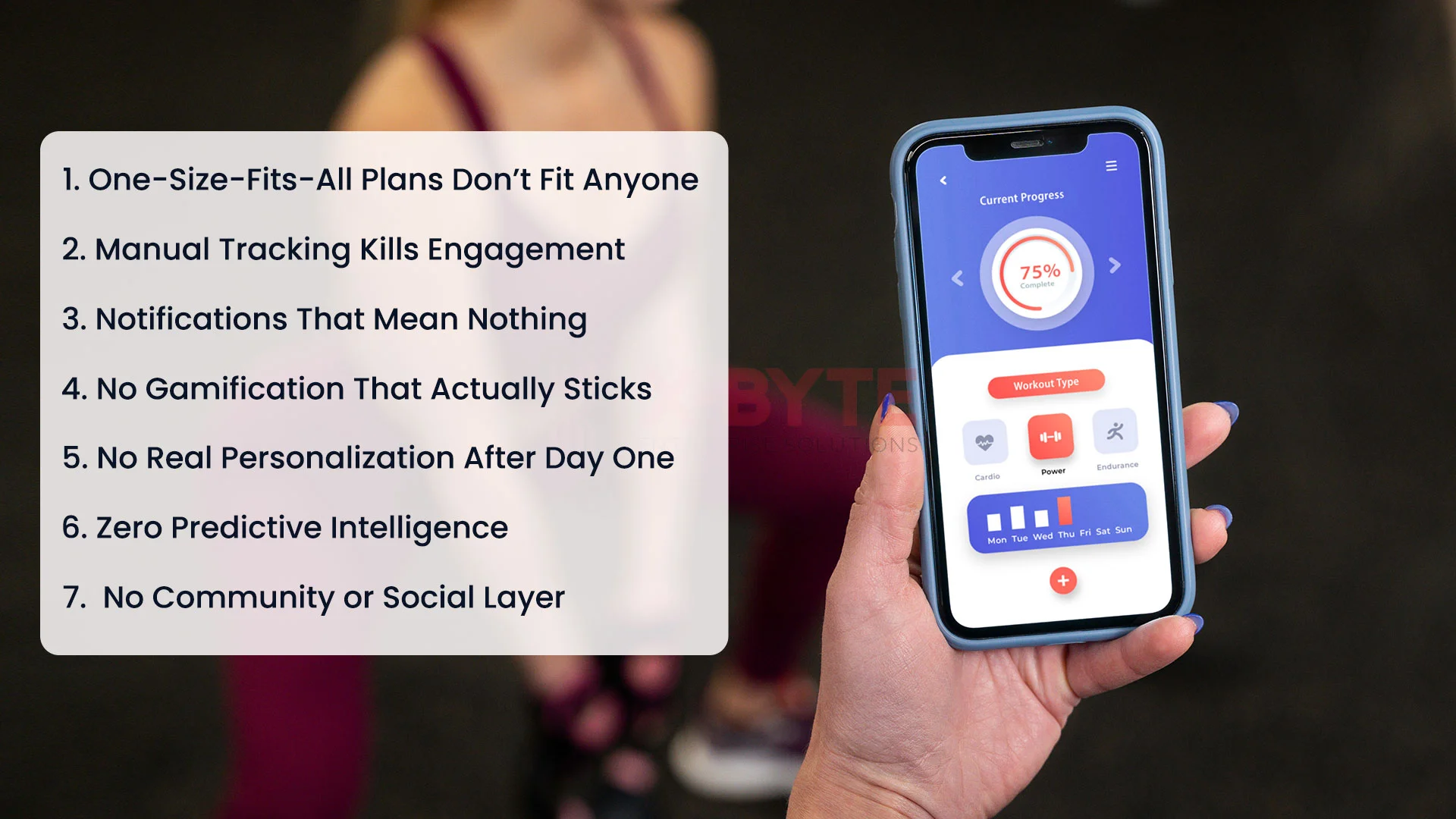
1. One-Size-Fits-All Plans Don’t Fit Anyone:
Traditional fitness apps hand every user the same workout template based on a basic onboarding quiz. A 40-year-old recovering from a knee injury and a 25-year-old training for a marathon get the same beginner push day. Here’s no adaptation, no learning, no nuance. But modern customers can understand the difference between the basic and personalized.
2. Manual Tracking Kills Engagement
MyFitnessPal had over 200 million registered users at its peak. Yet engagement collapsed because the app demanded users log every meal, every rep, every calorie, manually. Every single day. The moment it started feeling like homework, retention dropped. People don’t quit fitness. They quit the effort of tracking it.
3. Notifications That Mean Nothing:
Sending a “Time to work out!” notification at 7 AM to someone who just finished a night shift isn’t personalization; it’s just another reminder that they will skip. Traditional apps have no context. No wearable fitness app integration, no behavioral data, no understanding of the user’s schedule or energy levels. They just push, and hence the lesser retention.
4. No Gamification That Actually Sticks
Fitness apps leveraging gamification techniques report a 60% increase in user retention. Yet most traditional apps offer a streak counter and call it done. Research shows gamification can boost user engagement by up to 150% compared to non-gamified environments. The gap between what’s possible and what’s being built is massive.
5. No Real Personalization After Day One
Most traditional apps personalize once, at signup. After that, the experience is identical for everyone. No adjustment based on progress, no change based on missed sessions, no response to plateaus. Users who hit a wall get the same plan they started with. That’s not a fitness app. That’s a PDF with a timer.
6. Zero Predictive Intelligence
Traditional apps react. They don’t predict. By the time a user has already decided to quit, the app has no idea it’s happening. Machine learning in fitness apps exists precisely to solve this, identifying drop-off patterns before they happen and intervening with the right nudge at the right time. Without it, churn is invisible until it’s already done.
7. No Community or Social Layer
78% of top fitness apps use social influences as a core gamification element, yet most traditional apps treat fitness as a solo activity. No challenges, no accountability partners, no community. Users exercising in isolation have no external motivation to return when their internal motivation dips, and it always does.
The result? A market full of apps that look great on the App Store and disappear from home screens within a month. That gap, between what traditional apps offer and what users actually need, is exactly where the AI fitness app development opportunity lives.
How AI Can Turn Things Around, Use Cases + REAL Examples
Every problem traditional fitness apps have, AI directly solves. Here’s how it’s already happening in the real world:
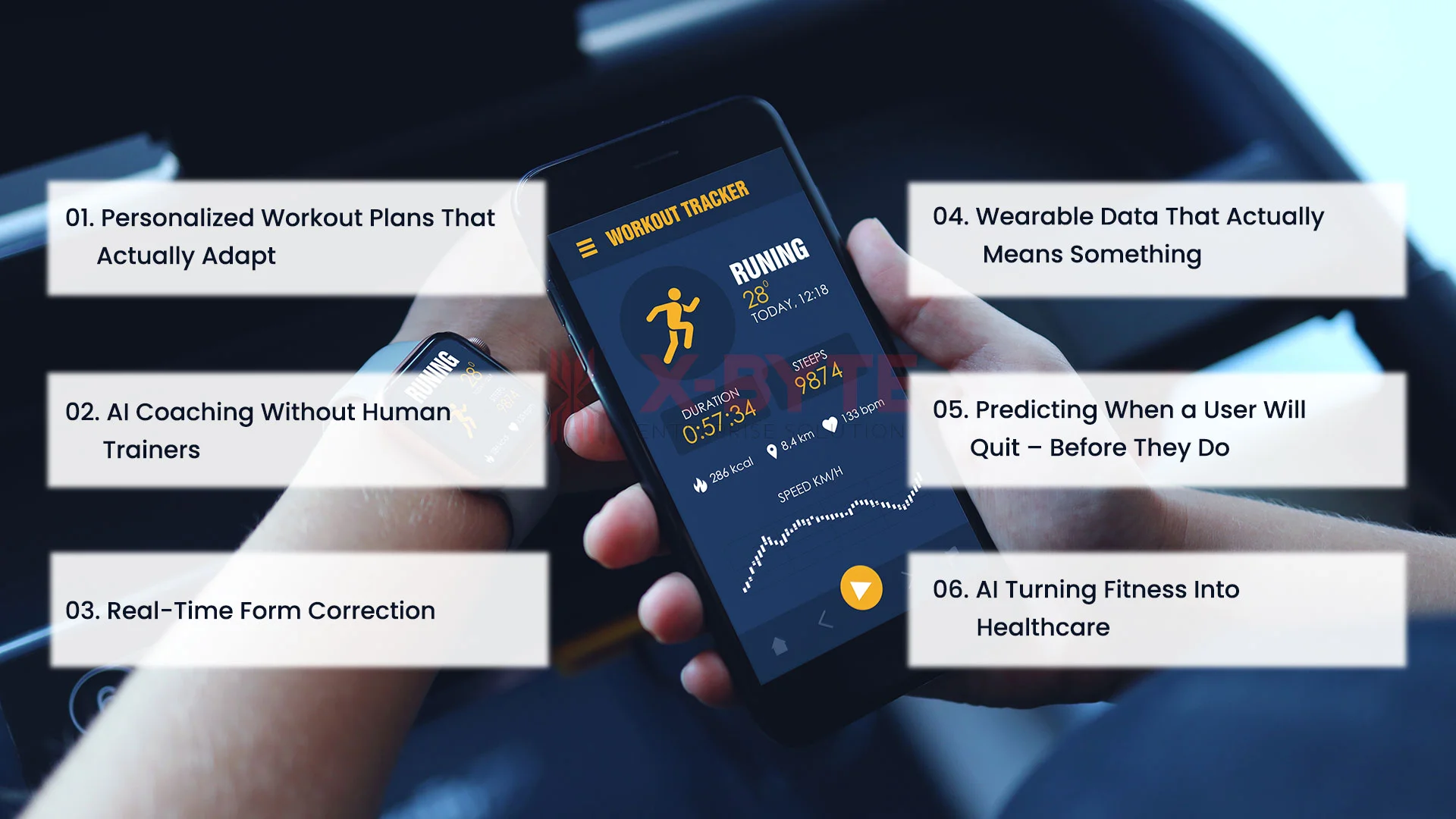
1. Personalized Workout Plans That Actually Adapt
A user misses three workouts in a row. Instead of sending a generic reminder, the AI checks their sleep data, identifies fatigue as the reason, and automatically reduces workout intensity for the next session. The plan adjusts to the user and alerts them with the adjusted plan. Not just generic push reminders.
Real Example: Fitbod is a US-based AI strength training app, popular among gym-goers and home workout enthusiasts with over 15 million downloads and 2.5 million active users worldwide. Users collectively lifted 260 billion pounds, up 30% year over year.
The result of real AI at work: Fitbod users recorded consistent double-digit strength gains across key compound lifts like Bench Press, Squat, and Deadlift, driven entirely by its adaptive programming engine.
2. AI Coaching Without Human Trainers
A user finishes a tough leg day and asks the app, Should I train tomorrow or rest? Instead of a generic answer, the AI pulls their heart rate data, sleep quality, and workout history, and gives a specific, personalized recommendation without human involvement
Real Example: Freeletics, another AI app with around 60 million active users, has built an AI coach trained on the data of all these people. It answers real coaching questions, recovery, form, and motivation at any hour, for any user. The result? Close to $900,000 in monthly revenue, built almost entirely on AI coaching.
3. Real-Time Form Correction
A user is doing squats at home. The app’s camera watches their movement, detects that their knees are caving inward, and gives a real-time audio correction before they complete the rep. No gym. No trainer. No injury.
Real Example – GOFA: GOFA uses 3D motion tracking and machine learning to deliver live feedback during workouts. Its mirror function captures movements via camera and provides real-time on-screen form correction without a trainer, also no risk of injury.
4. Wearable Data That Actually Means Something
A user slept for five hours and has low heart rate variability. Instead of pushing a high-intensity workout, the AI reads that data from their wearable and automatically swaps it for a recovery session. The app made the right call without the user having to say a word or pushing the user to a high-intensity workout that will push them off.
Real Example, WHOOP & Apple Fitness+: WHOOP is a Boston-based screenless wearable fitness tracker, popular among elite athletes like Cristiano Ronaldo, LeBron James, and Michael Phelps. It measures heart rate variability, resting heart rate, sleep, and respiratory rate to create a daily recovery score and guide users.
Its annual revenue has exceeded $260 million, 50% of members use the device daily after 18+ months, with 70% of users who actively engage with its AI-driven features.
5. Predicting When a User Will Quit – Before They Do
The AI notices a user has been opening the app less frequently, skipping the harder workouts, and completing sessions 40% shorter than usual. It flags this as a churn risk and automatically sends a re-engagement nudge with a lighter, more achievable workout, three days before the user would have deleted the app.
Real Example: In September 2023, WHOOP launched WHOOP Coach, powered by OpenAI, offering conversational health and fitness coaching that responds to individual biometric patterns in real time.Supporting this, a 2025 clinical study found that AI-driven personalization in fitness apps delivers 50% higher retention ratescompared to apps without it. The system doesn’t wait for disengagement. It steps in at exactly the right moment, and it works.
6. AI Turning Fitness Into Healthcare
Use Case: A user’s resting heart rate has been gradually increasing over two weeks. The app flags it, suggests they consult a doctor, and adjusts their workout intensity downward in the meantime. The app isn’t just tracking fitness anymore, it’s monitoring health. That’s a fundamentally different and more valuable product.
Real Example – Google + Fitbit: In 2024, Google integrated AI into Fitbit to analyze health metrics from smartphones and wearables and deliver personalized health insights.This is the clearest signal that AI healthcare app development and fitness are converging, and that the biggest players are already treating them as one category.
AI fitness app features list you should add!
1. Adaptive Training Engine
This is the core of your product. A machine learning model that rebuilds workout programming after every single session based on individual user data, performance output, recovery signals, and session history. Without this, you don’t have an AI fitness app development product. You have a workout library.
Why it matters for your business: This is what drives retention. Users who feel the personalized fitness app is getting smarter stay longer.
2. Computer Vision Movement Analysis
Built on pose estimation models like MediaPipe or OpenPose, this feature uses the device camera to track body landmarks, calculate joint angles, and flag movement errors in real time. This is what separates your product from every generic fitness app development company out there.
Why it matters for your business: Form correction is a premium smart fitness app feature that users will pay for. It’s also your biggest differentiator in a crowded market.
3. Biometric Data Processing Pipeline
An integration layer that pulls raw data from Apple HealthKit, Google Fit, WHOOP, Garmin, and Fitbit, normalizes it, and feeds it directly into your recommendation engine. This is what makes wearable fitness app integration actually intelligent.
Why it matters for your business: Users with wearables are your highest-value segment. Building a real fitness app with wearable integration properly increases both retention and average revenue per user.
4. NLP-Based Conversational Coaching
A natural language processing layer that remembers full user context across sessions, injuries, performance history, behavioral patterns, and responds with coaching that’s specific to that user at that exact moment. This is your AI personal trainer app development experience at scale.
Why it matters for your business: This replaces the need for human coaches at scale. One AI-powered fitness app layer serves millions of users simultaneously without adding headcount or cost.
5. Dynamic Nutrition Algorithm
It is among the best smart fitness app features to offer a truly personalized fitness app experience. It acts like a macro calculation engine that adjusts nutritional targets daily, based on activity output, biometric inputs, and goal tracking rather than static formulas set at onboarding.
Why it matters for your business: Nutrition is a natural upsell layer. Users who engage with both fitness and nutrition features in your AI fitness app show significantly higher lifetime value.
6. Federated Learning for Data Privacy
A model architecture that trains on user data across devices without raw health data ever leaving the user’s device. Critical for any AI healthcare app development compliance requirements, HIPAA, GDPR, and beyond.
Why it matters for your business: Health data regulations are tightening globally. Building with federated learning from day one protects your AI fitness app development legally and builds user trust simultaneously.
7. Predictive Performance Modelling
A regression model that forecasts where a user is headed, projected strength gains, estimated goal achievement dates, and plateau detection based on current training velocity. It is yet another powerful AI-based fitness app feature for long-term user engagement.
Why it matters for your business: Predictive insights give users a reason to keep showing up. It turns short-term motivation into long-term commitment inside your smart fitness app.
8. Unified Cross-Platform AI Layer
A single AI model that operates consistently across iOS, Android, smartwatch, and tablet is a non-negotiable requirement when you hire AI fitness app developers. Data captured on one device immediately informs decisions on another. One continuous learning system, not fragmented data across platforms.
Why it matters for your business: Users switch devices constantly. A fragmented experience is a churn trigger. A unified AI fitness app layer is a retention mechanism.
Tech stack (ML, APIs, wearables)
The technology decisions you make at the architecture stage, which ML frameworks you use, which wearable APIs you integrate, and how you handle real-time data processing directly determine how intelligent your product actually feels to the user.
Here’s a complete breakdown of what goes into a production-ready AI fitness app development stack in 2026:
| Category | Technology / Tool | Purpose |
| Mobile Frontend | React Native, Flutter | Cross-platform iOS & Android development |
| Backend | Node.js, Python (Django/FastAPI) | Server-side logic, API management |
| ML Framework | TensorFlow, PyTorch, Scikit-learn | Building and training AI/ML models |
| Computer Vision | MediaPipe, OpenPose, OpenCV | Real-time form correction and movement analysis |
| NLP / Conversational AI | OpenAI API, Dialogflow, Rasa | AI personal trainer app coaching layer |
| Wearable Integration | Apple HealthKit, Google Fit, Fitbit API, Garmin Connect, WHOOP API | Wearable fitness app integration and biometric data sync |
| Cloud Infrastructure | AWS, Google Cloud, Azure | Scalable backend hosting and ML model deployment |
| Real-Time Data Processing | Apache Kafka, Firebase | Live biometric data streaming and processing |
| Database | PostgreSQL, MongoDB, Firebase Firestore | User data storage and management |
| Data Privacy / Federated Learning | PySyft, TensorFlow Federated | HIPAA & GDPR compliant model training |
| Predictive Analytics | Python (Pandas, NumPy), BigQuery | Churn prediction and performance modelling |
| Push Notifications | Firebase Cloud Messaging (FCM), APNs | Smart, behavior-triggered notifications |
| Authentication & Security | Auth0, Firebase Auth, OAuth 2.0 | Secure user login and health data protection |
| Payment Gateway | Stripe, RevenueCat | In-app subscriptions and purchases |
| DevOps & CI/CD | Docker, Kubernetes, GitHub Actions | Deployment, scaling, and continuous delivery |
Cost of AI Fitness App Development 2026
The cost of AI fitness app development typically ranges from $50,000 to over $300,000.
A basic personalized fitness app with templated AI features sits at the lower end. A full-scale AI-powered fitness app development product with real machine learning in fitness apps, wearable fitness app integration, and a conversational AI personal trainer app experience costs more.
Here’s the complete AI fitness app development cost breakdown:
| App Type | Features Included | Estimated Cost | Timeline |
| Basic AI Fitness App | Workout tracking, push notifications, basic AI recommendations, and user profiles | $20,000 – $50,000 | 2–4 months |
| Mid-Level AI Fitness App | Personalized workout plans, nutrition tracking, wearable integration, and basic NLP coaching | $50,000 – $150,000 | 4–7 months |
| Advanced AI Fitness App | Real-time form correction, adaptive ML engine, full wearable integration, churn prediction, conversational AI coach | $150,000 – $300,000 | 7–12 months |
| Enterprise-Level Platform | All advanced features + live classes, marketplace, multi-platform AI layer, federated learning, HIPAA/GDPR compliance | $300,000 – $500,000+ | 12–18 months |
Note: The region you hire AI fitness app developers from will significantly impact your total budget without necessarily impacting quality.
Future Trends of AI-Powered Fitness App Development
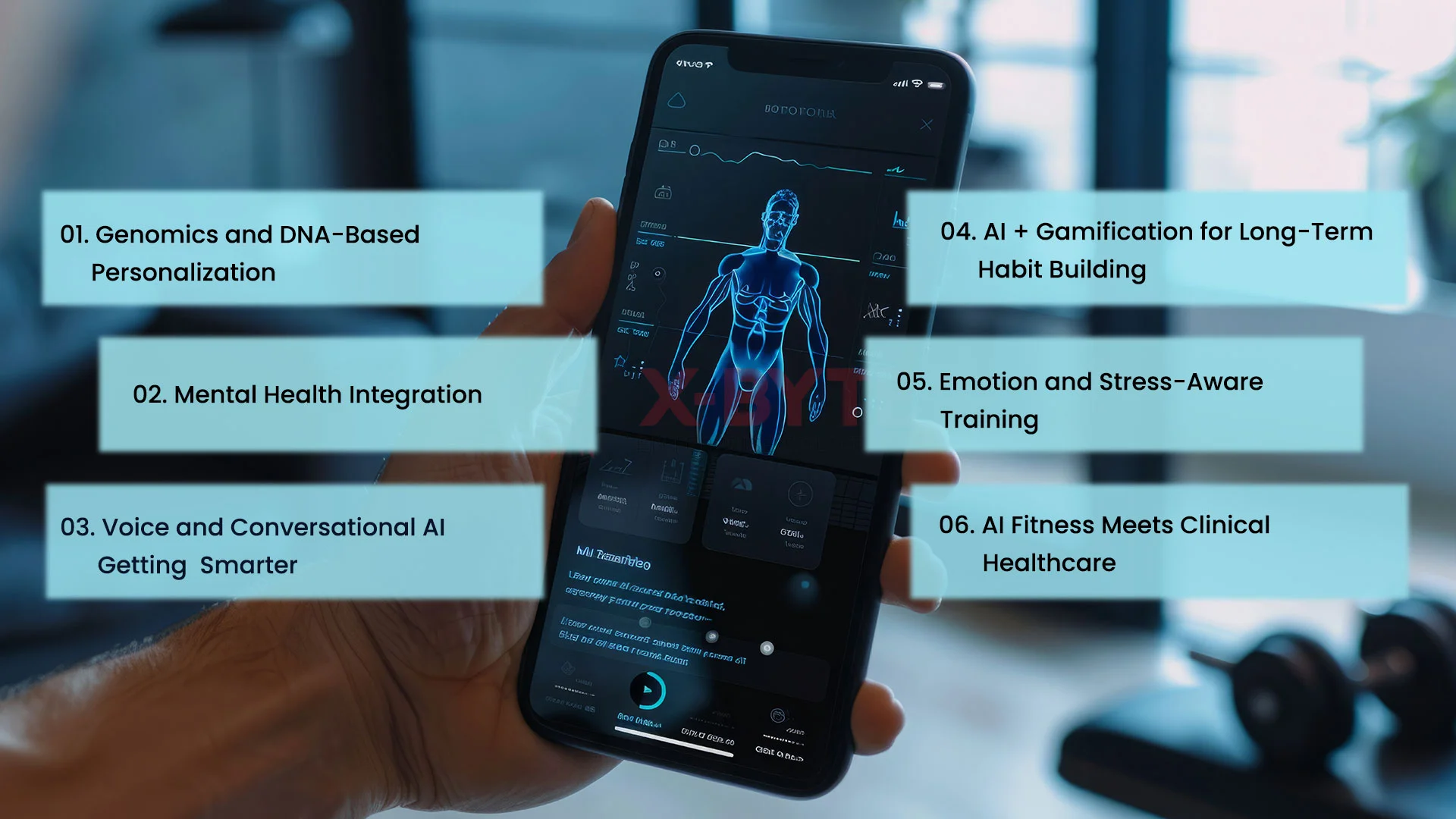
1. Genomics and DNA-Based Personalization
The next frontier of personalized fitness app development goes beyond behavior data. AI will soon build training and nutrition plans around a user’s genetic profile, identifying predispositions to certain injuries, optimal recovery times, and ideal training styles based on DNA. This isn’t science fiction. The data infrastructure to support it is already being built.
2. Mental Health Integration
AI apps can now detect stress or low moods through voice tone or typing patterns and respond by swapping an intense workout for a recovery or mindfulness session. The best AI-powered fitness apps in 2026 don’t just train the body. They monitor the mind and give blended responses.
3. Voice and Conversational AI Getting Smarter
By 2028, voice assistants are expected to sync with a user’s entire life, from their fridge to their work calendar, to help balance stress and fitness in real time. Conversational AI inside AI personal trainer app experiences will stop feeling like a feature and start feeling like a real coach.
4. AI + Gamification for Long-Term Habit Building
New research shows it takes 68 to 78 days to make a fitness routine stick.AI-driven habit stacking, where the app intelligently links new behaviors to existing ones, is becoming a core retention mechanic in smart fitness app development. Not streaks. Not badges. Behavioral science is built into the product.
5. Emotion and Stress-Aware Training
Future AI fitness apps will read emotional and physiological stress signals – through voice tone, typing patterns, and biometric inputs – and dynamically adjust training intensity accordingly. A user under extreme work stress gets a deload week automatically. The app stops treating fitness as isolated from the rest of a user’s life.
6. AI Fitness Meets Clinical Healthcare
What the AI healthcare app development space is currently missing are dedicated programs for elderly users and people with chronic medical conditions. The next wave of AI-powered fitness app development will bridge that gap, building products that sit between consumer fitness and clinical care, opening an entirely new and largely untapped market segment.
Choose the Right Fitness App Development Company
By this point, you know what separates a real AI fitness app from a glorified step counter. You know what features matter, what the build actually costs, and where most business owners lose their edge before they even launch.
The last decision, and honestly, the most important one, is who you build it with.
A good fitness app development company isn’t just a vendor. They’re the people who will tell you when your feature list is too ambitious for your budget, when your MVP is too thin to retain users, and when a technical decision you’re excited about will cost you six months of rework down the line. That kind of honesty is rare. And it’s worth more than any technology stack.