Key Highlights:
- AI-Powered Route Optimization replaces static planning with intelligent decision-making, using real-time data, predictive modeling, and geospatial analysis to improve delivery performance.
- Artificial Intelligence in Logistics helps reduce operational costs, especially through fuel cost reduction, improved fleet utilization, and smarter route sequencing.
- Strategic implementation and system integration ensure AI route planning aligns with business goals, scales with growth, and delivers measurable ROI.
If you are running or managing a business and have to deal with logistics and deliveries, then you have probably felt this already: deliveries are getting more expensive, timelines are getting tighter, and customers are less forgiving.
These aren’t just operational headaches; they’re profit leaks that add up fast, and most business owners don’t see the full picture until it’s already hit the bottom line.
The hard truth is that manual route planning, no matter how experienced your team is, can’t process enough variables fast enough to keep up with real-world delivery demands.
But, AI-Powered Route Optimization fixes this.
It analyzes your routes, your stops, and your fleet and automatically builds the most efficient path forward. Less fuel. Fewer delays. More deliveries are completed on time, every day.
By combining Artificial Intelligence in Logistics, predictive modeling, and geospatial analysis, businesses can move beyond static route optimization software and adopt smarter, data-driven decisions. Instead of simply finding the shortest path, AI Route Planning continuously analyzes traffic patterns, delivery density, and historical performance to improve delivery efficiency, strengthen last-mile efficiency, and enable real fuel cost reduction.
Let’s dig in and find out how AI-Powered Route Optimization can transform logistics in your business.
What is AI-Powered Route Optimization?
At its core, AI-Powered Route Optimization is software that thinks. Not in the way a GPS thinks, giving you one path from A to B, but in the way an experienced operations director thinks, except faster, more accurate, and working around the clock without fatigue or error.
1. Here’s the simplest way to understand it:
Traditional routing tools take your stops and calculate a route based on distance. That’s it. They don’t account for traffic patterns at 2 pm on a Tuesday, a driver who has a vehicle weight limit, a customer who only accepts deliveries before noon, or a road closure that just happened 20 minutes ago.
2. What It Considers That Humans Can’t?
When your team plans routes manually, they’re typically juggling 5–10 variables at best. An AI-Powered Route Optimization system processes hundreds simultaneously, including:
- Live and historical traffic conditions
- Delivery time windows per customer
- Vehicle load capacity and fuel efficiency
- Driver hours and scheduling constraints
- Weather and road disruptions
- ETA prediction accuracy per stop
The result is a route plan that a human dispatcher would need hours to build, generated in seconds, and built to perform under real-world conditions.
Benefits of AI-Powered Route Optimization for Your Business
Adopting AI Route Planning isn’t a technology upgrade for the sake of it. Every benefit ties directly to something business owners care about: lower costs, faster deliveries, and an operation that runs without constant firefighting.
Here’s what the data and real-world results show:
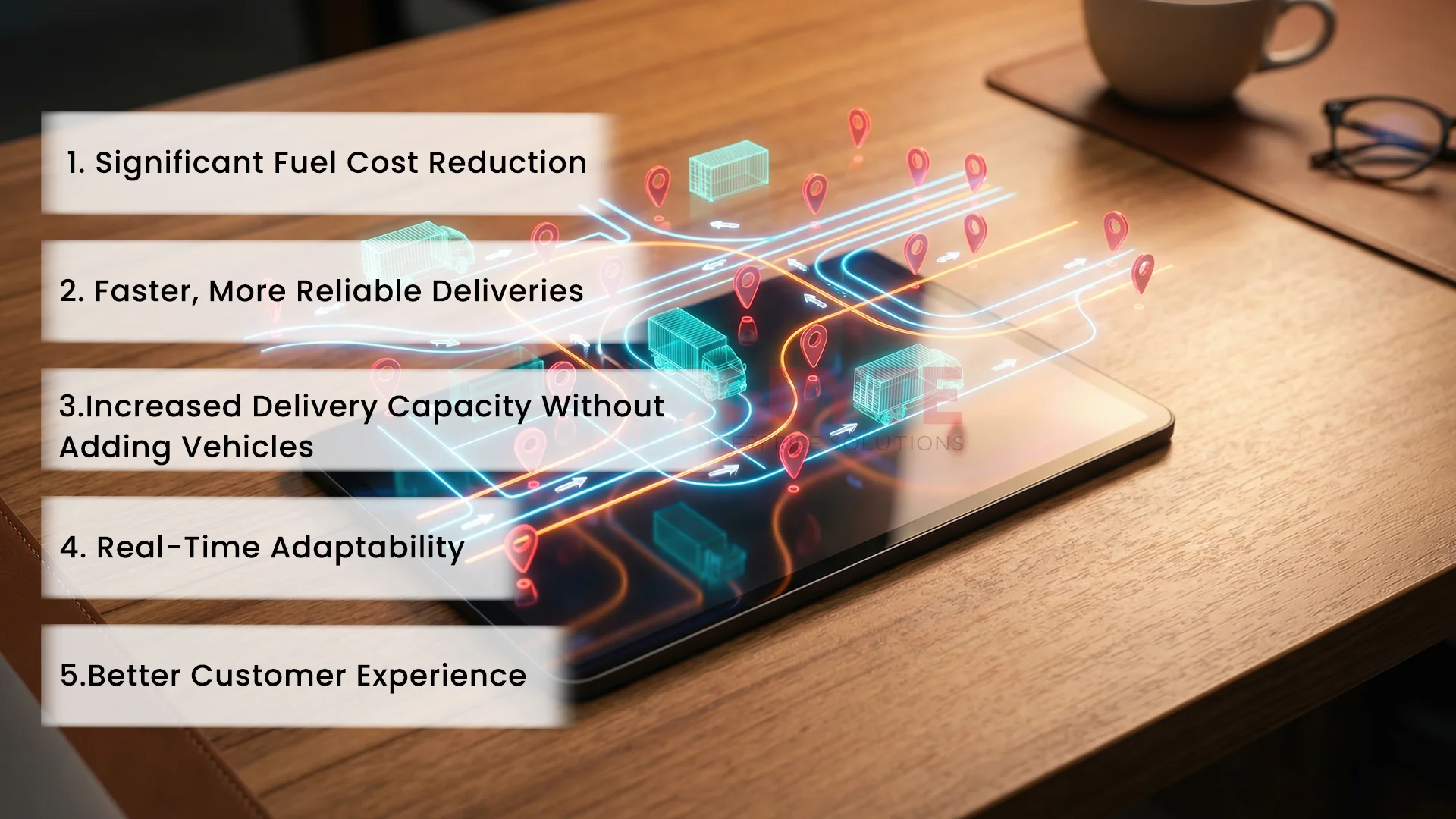
1. Significant Fuel Cost Reduction
Fuel is one of the largest controllable expenses in any delivery operation. According to the American Transportation Research Institute (ATRI), fuel costs represent nearly 24% of total trucking operational costs. Even a 10% reduction in fuel spend translates into tens of thousands of dollars saved annually.
Businesses implementing Delivery Optimization AI consistently report fuel savings of 15–30% within the first operational quarter. When routes are shorter, smarter, and dynamically adjusted in real time, fuel consumption drops. not occasionally, but structurally, every single day.
2. Faster, More Reliable Deliveries
Late deliveries don’t just frustrate customers; they cost you their repeat business. Smart Delivery Systems powered by AI use ETA prediction and live traffic intelligence to keep drivers on schedule.
A study by McKinsey & Company found that companies using Artificial Intelligence in Logistics improved their on-time delivery rates by up to 20% compared to operations relying on manual or static routing tools. It translates to fewer refunds, fewer complaints, and more customers who come back.
3. Increased Delivery Capacity Without Adding Vehicles
One of the most overlooked benefits of AI-Powered Route Optimization is what it unlocks without any additional investment. When every vehicle runs an optimized route, you effectively increase the number of stops each driver can complete per shift.
According to Capgemini Research Institute, organizations using AI Logistics tools increased delivery capacity by up to 35% without adding a single vehicle to their fleet. For business owners facing scaling pressure, this is one of the highest-ROI moves available.
4. Real-Time Adaptability
Static routing tools break the moment something unexpected happens: a road closure, a last-minute order, or a driver running behind schedule. Delivery Optimization AI doesn’t break. It adapts.
Using live geospatial analysis and continuous data processing, AI systems re-route in real time, absorbing disruptions without cascading delays across the rest of the day’s schedule. This level of delivery efficiency is simply not achievable with manual planning, regardless of how skilled your team is.
5. Better Customer Experience
In a world where customers track their orders to the minute, delivery accuracy is a brand statement. PwC’s Global Consumer Insights Survey found that 73% of consumers say delivery experience directly influences their decision to buy from a business again. Getting this right isn’t a nice-to-have; it’s a retention strategy.
Smart Delivery Systems with accurate ETA prediction keep customers informed automatically, reducing inbound, increasing satisfaction scores, and building the kind of reliability that earns long-term loyalty.

How to Implement AI Route Optimization in Your Business?
Knowing the benefits is one thing. Actually making the shift without disrupting your current operation, overspending on the wrong tool, or losing weeks to a complicated setup is where most businesses get stuck.
The good news is that implementation doesn’t have to be complicated. But it does have to be strategic.
Here’s a proven, step-by-step approach to navigate the transition.
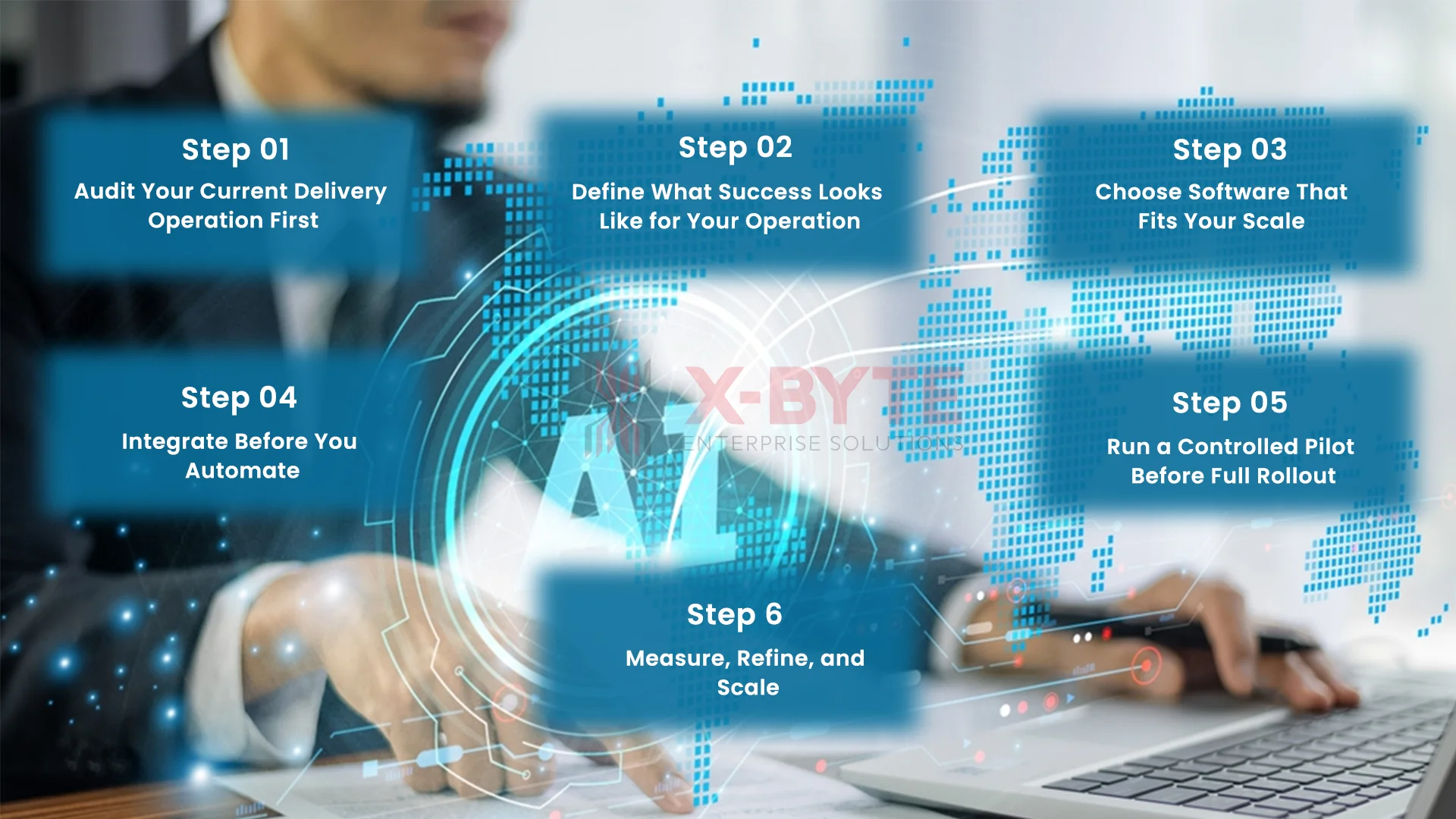
Step 1: Audit Your Current Delivery Operation First
Before evaluating any Route Optimization Software, get clear on where your operation actually stands today.
Pull data on:
- Average fuel spend per vehicle per month
- On-time delivery rates over the last 90 days
- Driver overtime hours
- Number of failed or rescheduled deliveries
- Average stops completed per shift
This baseline isn’t just useful for comparison later; it tells you exactly where your biggest cost leaks are and which problems the AI system needs to solve first.
Step 2: Define What Success Looks Like for Your Operation
AI-Powered Route Optimization can solve multiple problems simultaneously, but not every business has the same priority.
- A regional manufacturer prioritizes vehicle load efficiency and fuel cost reduction.
- An eCommerce brand prioritizes last-mile accuracy and ETA prediction.
- A retail operation prioritizes time-window compliance and driver scheduling.
Before selecting any Smart Delivery System, define your top two or three success metrics. This shapes everything, which features matter, which integrations you need, and how you’ll measure ROI after go-live.
Here’s what we do at X-Byte Enterprise Solution: We always ask clients: What does a successful first 90 days look like to you? That single question prevents a lot of expensive misalignments between what the software does and what the business actually needs.
Step 3: Choose Software That Fits Your Scale
This is where many businesses make a costly mistake, selecting an enterprise-grade platform built for 500-vehicle fleets when they’re running 15. Or choosing an entry-level tool that looks affordable today but can’t scale with their operation next year.
Non-negotiable core capabilities:
- Real-time route adjustment using live traffic and geospatial analysis
- ETA prediction accuracy with customer notification capability
- Predictive modeling that improves performance over time
- Multi-stop, multi-vehicle optimization in a single planning cycle
- Integration with your existing systems
Red flags to avoid:
- No free trial or pilot period
- Pricing models that charge per vehicle with no flexibility
- Limited customer support
- No reporting or data visibility into route performance
Delivery Optimization AI should make your operation simpler, not add a new layer of complexity.
Expert Tip from the X-Byte Team: At our AI development company, we always recommend clients test software under their actual conditions, their routes, their stop volumes, and their edge cases. A demo environment will always look clean. Your operation won’t. Make sure the tool performs in the real world, not just in a sales presentation.
Step 4: Integrate Before You Automate
One of the most overlooked steps in implementing AI Logistics software is integration. The system is only as powerful as the data it receives, and if it’s not connected to your order management system, inventory platform, or dispatch tools, it’s working with incomplete information.
Before going live, ensure your Route Optimization Software is properly integrated with your existing business tools.
Quick-Tip: Machine Learning for Logistics gets smarter with more data. A well-integrated system from day one builds a richer operational dataset faster, which means better route recommendations sooner.
Step 5: Run a Controlled Pilot Before Full Rollout
Don’t flip the switch on your entire fleet on day one. Run a structured pilot, two to four weeks, a defined subset of your routes, with clear performance benchmarks tracked daily.
Measure your pilot against the baseline data from Step 1. Look for movement in:
- Fuel consumption per route
- On-time delivery percentage
- Miles driven versus stops completed
- Driver hours and overtime
A well-run pilot does two things simultaneously: it validates the technology under your specific conditions, and it builds internal buy-in from the drivers and dispatchers who will use it daily. People adopt what they trust. Let the results build that trust before scaling.
If you’re at any stage of this journey and want a clear-eyed assessment of where your operation stands and what the right next step looks like, connect with our experts at X-Byte Enterprise Solution.
Step 6: Measure, Refine, and Scale
AI-Powered Route Optimization isn’t a set-and-forget system. The real power of Machine Learning for Logistics is that performance compounds over time, but only if you’re actively reviewing the data and refining your inputs.
Set a monthly review cadence with your operations team. Analyze:
- Which route types are performing best and why
- Where Last-Mile Efficiency gaps still exist
- How ETA prediction accuracy is trending
- Whether new delivery zones or order volumes require route restructuring
As your data set grows, your system’s recommendations improve. As your recommendations improve, your costs drop and your delivery performance strengthens, giving you a compounding advantage.
| Tool | Best For | Why It Stands Out | Pricing | User Rating |
| Onfleet | Mid-size delivery operations | End-to-end delivery management with real-time tracking, proof of delivery, and customer notifications. Clean interface with strong analytics. | From $550/mo | ⭐ 4.6/5 (Capterra) |
| Circuit for Teams | Small to mid-size businesses | Simple to set up, easy for drivers to use. Strong on last-mile delivery management with real-time route adjustment. | From $250/mo | ⭐ 4.5/5 (G2) |
| Routific | Local and regional delivery businesses | User-friendly, reliable route planning with solid time windows and driver schedule management. Great for businesses new to Delivery Optimization AI. | From $49/vehicle/mo | ⭐ 4.5/5 (Capterra) |
| NextBillion.ai | Scaling businesses with complex routing needs | Powerful AI Route Planning engine that learns from historical fleet data and re-optimizes in real time. Strong API integration with existing systems. | Custom pricing | ⭐ 4.7/5 (G2) |
| Samsara | Fleet-heavy operations needing full visibility | Combines route optimization with real-time GPS tracking, AI dash cams, and driver safety tools. Ideal for businesses that need Last-Mile Efficiency and fleet monitoring in one platform. | Custom pricing | ⭐ 4.5/5 (G2) |
| FarEye | Enterprise and high-volume delivery operations | AI-driven predictive analytics, dynamic rerouting, and deep integration with supply chain systems. Used by HelloFresh, TATA Steel, and Amway. | Custom pricing | ⭐ 4.4/5 (Gartner) |
| Badger Maps | Field sales and service teams | Combines route optimization with CRM integration and territory mapping. Field teams report driving 20% less and saving 8 hours per week on average. | From $58/mo | ⭐ 4.6/5 (G2) |
| DispatchTrack | Businesses prioritizing delivery accuracy | AI-powered ETA prediction with a reported 98% on-time delivery rate. Strong focus on customer experience alongside Fuel Cost Reduction. | Custom pricing | ⭐ 4.7/5 (Capterra) |
If you need assistance choosing the right tool, keep reading.
Don’t choose based on brand recognition or the longest feature list. Choose based on three things:
- Your fleet size. Tools like Circuit and Routific are built for smaller, leaner operations. NextBillion.ai, FarEye, and Samsara are built to handle complexity at scale.
- Your biggest pain point. If fuel costs are your primary concern, DispatchTrack and NextBillion.ai are built around cost reduction. If driver management is the issue, Samsara gives you visibility and safety tools alongside routing.
- Your integration needs. If you’re already running an ERP, TMS, or order management system, make sure the tool connects to it cleanly before committing to anything.
Expert Tip from the X-Byte Team: Before you sign anything, run your actual routes through the system. Real-world testing is the only honest benchmark.
Not sure which tool fits your specific operation? At X-Byte Enterprise Solution, we’ve helped businesses cut through the noise and identify the right fit based on fleet size, budget, and what your operation actually needs to perform better.
Common Mistakes Businesses Make When Adopting AI Route Optimization
The technology isn’t the problem. How businesses approach it usually is. Here are the most common mistakes and what they actually cost you.
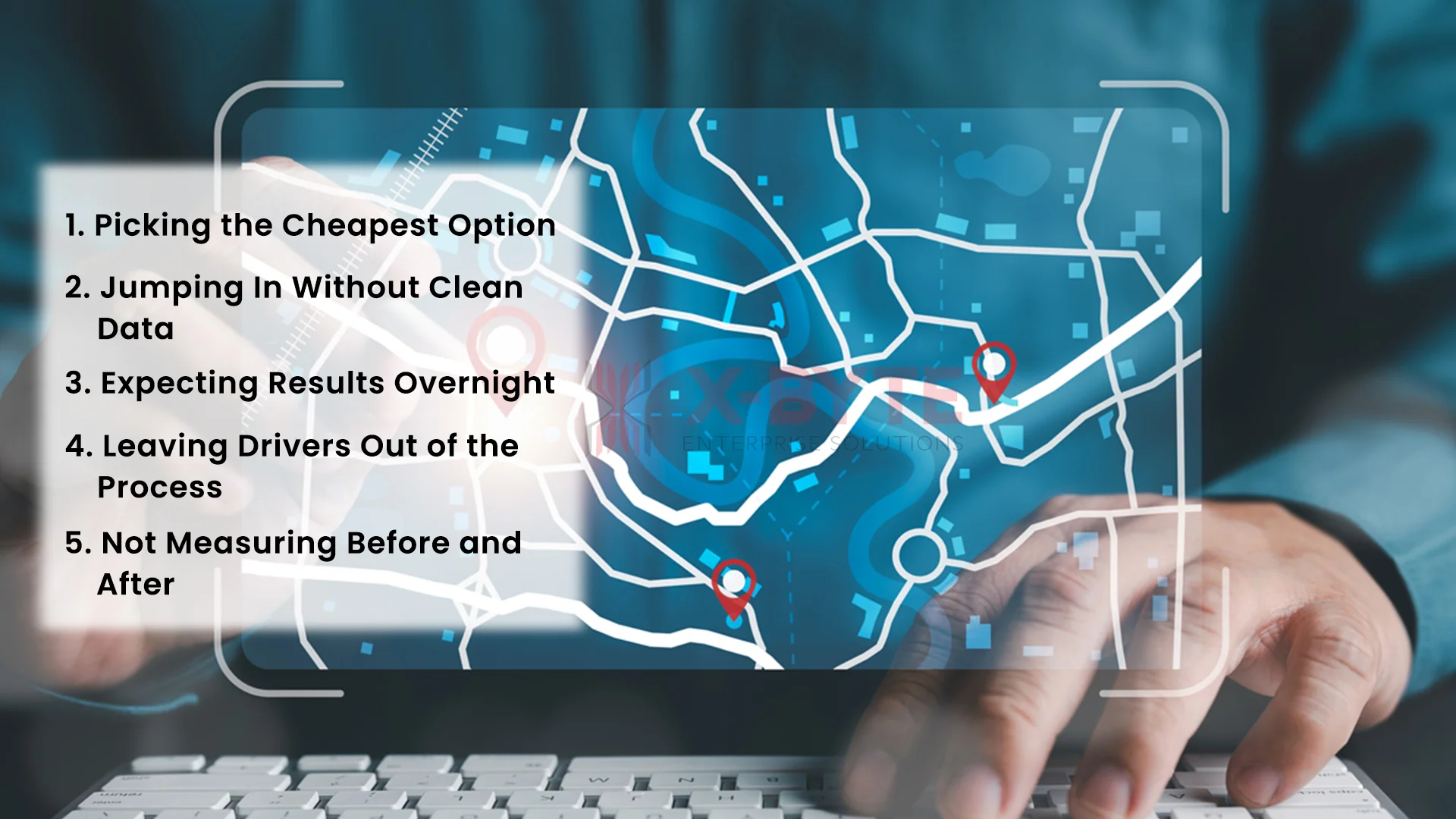
1. Picking the Cheapest Option
It’s tempting to go with the lowest-priced tool, especially when you’re not sure how much value you’ll get. But what seems cost-effective now will become your liability later and will end up costing more. Because, the most budget routing tools aren’t truly powered by AI, they’re basic GPS tools with a modern label slapped on them.
You end up paying for something that doesn’t actually solve the problem.
2. Jumping In Without Clean Data
AI learns from your delivery data, your addresses, your time windows, and your order volumes. If that data is messy, incomplete, or scattered across different systems, the software will build routes based on wrong information.
Before you touch any software, get your delivery data in order. It sounds basic, but it is actually very crucial. Most businesses skip it and pay for it later.
3. Expecting Results Overnight
AI-Powered Route Optimization gets smarter the more it runs. The first week won’t look like week eight. Businesses that judge the system too early, before it’s had time to learn their routes and patterns, often walk away from something that was about to start working.
4. Leaving Drivers Out of the Process
This one is underestimated. When drivers don’t understand why routes have changed or feel like a system is working against them rather than for them, adoption suffers. They find workarounds. They ignore suggestions. The software runs, but nobody trusts it.
Bring your drivers into the process early. Show them how it works. Let them see that it makes their day easier, not just the business more profitable.
5. Not Measuring Before and After
If you don’t track your fuel costs, delivery times, and missed deliveries before you implement, you’ll have no way of knowing what improved after. The results are there, but without a baseline, you can’t see them, prove them internally, or make the case to invest further.
Conclusion
Reading about AI-Powered Route Optimization is the easy part. The harder part is execution and transformation, often supported by the right logistics software development.
Although the shift doesn’t have to be overwhelming. It starts with one honest audit, one clear priority, and one decision to stop accepting preventable inefficiency as a normal cost of doing business.
The businesses that move first don’t just save money. They build an operational advantage that gets harder to close the longer competitors wait.