
Key Highlights
- AI is transforming mobile app development by enabling apps to predict, detect, and automatically fix issues.
- Self-healing mobile apps use AI and ML to monitor performance in real time, diagnose errors, and recover from crashes without user intervention.
- As businesses embrace AI-driven app development, self-healing capabilities will become essential for reducing downtime, improving app reliability, and building user trust.
Introduction
Today’s users expect perfection, zero downtime, instant responses, and seamless performance. But behind the scenes, even the most polished apps face errors, crashes, and unpredictable user behavior.
What if your mobile app could heal itself before you even realize something went wrong? Imagine an app that not only detects bugs but fixes them on its own, an app that learns, adapts, and evolves with every user interaction.
Sounds futuristic? Not anymore.
Welcome to the new age of AI in mobile app development, where apps are getting a brain of their own. It brings the promise of self-healing mobile apps that monitor themselves, predict failures, and take corrective action automatically.
According to Gitnux, over 60% of mobile apps now use some form of AI or machine learning, signaling that the future of apps is intelligent, adaptive, and self-sustaining.
Want to know more? Let’s dive in and explore how AI-based mobile applications are changing the game, what “self-healing” really means in practice, and how you can leverage how to use AI in mobile app development for your next project.
Understanding AI in Mobile App Development
AI-driven mobile app development is exactly what it sounds like: using artificial intelligence to make apps smarter, faster, and more intuitive. However, it’s not just about adding chatbots or voice recognition; it’s about teaching apps to think, learn, and make decisions independently.
In simple terms, it means building apps that can analyze user behavior, predict what a user might need next, and even optimize themselves without constant human intervention.
What Are Self-Healing Mobile Apps?
Self-healing mobile apps are exactly what their name suggests: apps that can detect, diagnose, and fix issues on their own without human intervention. It is constantly scanning for signs of trouble, learning from past issues, and automatically healing itself to ensure a flawless, uninterrupted experience.
Self-healing apps are giving rise to a new generation of apps that don’t just react to problems; they anticipate and resolve them before users even notice.
It’s the evolution from maintenance-heavy software to intelligent, self-sustaining digital systems built for reliability and performance.

Core Capabilities of a Self-Healing System
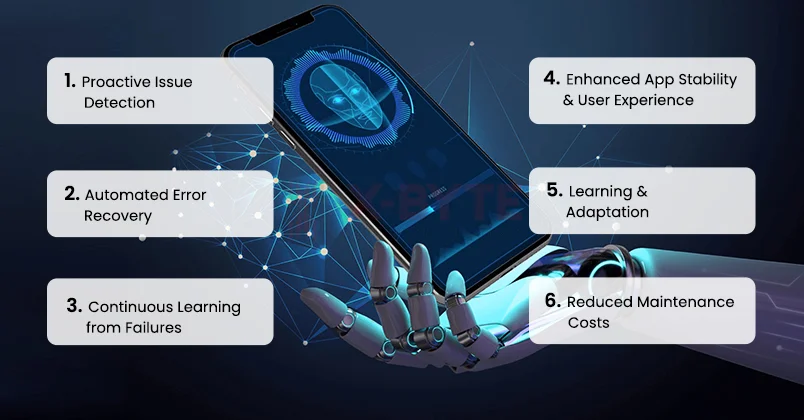
1. Proactive Issue Detection
Traditional apps wait until something breaks. Self-healing apps, powered by AI and ML in mobile app development, identify performance bottlenecks, bugs, and crashes before they affect users. AI continuously analyzes data patterns to spot early warning signs, like rising memory usage or API delays, and takes action instantly.
2. Automated Error Recovery
One of the biggest advantages of AI integration in mobile apps is that it enables automatic recovery. Instead of depending on manual patches or developer intervention, AI can restart a failing process, reroute a request, or roll back to a stable version, minimizing downtime and improving user trust.
3. Continuous Learning from Failures
Self-healing apps don’t just fix issues; they learn from them. Through AI-powered mobile app development, every detected anomaly becomes a lesson. Over time, the app refines its response strategies, improving its ability to handle future issues autonomously.
4. Enhanced App Stability and User Experience
By predicting and repairing problems in real time, AI-based mobile applications ensure smoother performance and fewer interruptions. The result? Happier users, higher retention, and better app ratings because reliability has now become part of the user experience.
5. Learning and Adaptation
Every incident becomes a new data point. Over time, AI-based mobile applications learn from past issues, refining their prediction models and improving their ability to prevent similar problems in the future.
6. Reduced Maintenance Costs
Since self-healing apps handle minor fixes on their own, developers spend less time chasing bugs and more time innovating. This automation drastically reduces maintenance overhead and accelerates deployment cycles.
Common Failures Self-Healing Apps Can Address
Self-healing mobile apps are designed to tackle the kinds of issues that usually frustrate both users and developers, but they do it quietly, automatically, and intelligently. Here are some of the most common failures self-healing mobile apps can address:
1. App Crashes and Freezes
App crashes and freezes are one of the most common mobile issues and is often happen due to memory leaks, faulty code, or incompatible updates. With AI and ML in mobile app development, self-healing systems can detect the root cause, restart the affected process, or roll back to a stable state, all in real time.
2. Performance Degradation
When apps start to slow down due to resource overuse, AI-powered mobile app development helps detect early signs of lag and automatically optimize resource allocation, like freeing up memory or balancing server loads to restore speed and performance.
3. Network and Connectivity Issues
Self-healing apps can identify when connectivity drops, queue requests locally, and retry operations automatically when the connection is restored. This ensures smoother experiences even in unstable network environments.
4. API or Backend Failures
If an API endpoint fails or returns an error, AI integration in mobile apps enables automatic rerouting to backup servers, alternative endpoints, or cached data, keeping the app functional even when external systems go down.
5. Configuration Errors
Incorrect configurations can cause unexpected crashes or slowdowns. AI-powered systems can detect mismatched configurations, revert to previous working setups, or apply the best-known configuration automatically.
6. Data Corruption or Sync Errors
In cases where data fails to sync properly between devices or servers, AI can identify discrepancies and trigger data reconciliation processes to restore accuracy, preventing user-facing issues.
7. Security and Authentication Glitches
When login or token issues occur, AI-based mobile applications can refresh credentials, initiate secure reauthentication, or apply alternate authentication methods automatically, ensuring uninterrupted access without compromising security.
Why Mobile Apps Need Self-Healing Capabilities Today?
Users won’t wait for apps to fail: Today’s users expect smooth, instant experiences. If an app crashes or slows down even once, they’re quick to uninstall. That’s why self-healing mobile apps are no longer optional, they’re essential to keep users happy and loyal.
Apps are getting more complex: With multiple integrations, APIs, and real-time data flows, even a small glitch can trigger a chain reaction. AI-powered mobile applications can detect these issues early and fix them before they impact performance.
AI for app crash prediction is a game-changer: Instead of waiting for a crash to happen, AI predicts it. These systems monitor performance metrics, memory usage, and user interactions to spot red flags and prevent downtime before users even notice.
Boosts user trust and brand reputation: Apps that rarely crash or lag make users feel confident—and that translates into better reviews, higher retention, and stronger brand credibility.
Lower costs, higher reliability: When apps heal themselves, developers spend less time firefighting bugs and more time improving features. This cuts maintenance costs and builds long-term reliability.
It’s about survival in a competitive market: In an app ecosystem flooded with choices, users won’t tolerate technical issues. Self-healing mobile apps ensure you stay ahead, offering seamless experiences that keep users coming back.
How AI Enables Self-Healing in Mobile Apps?
Ever wondered how apps manage to detect issues, fix bugs, and stay reliable without a human ever touching the code? The secret lies in advanced AI models that work behind the scenes. Let’s break down how they do it.
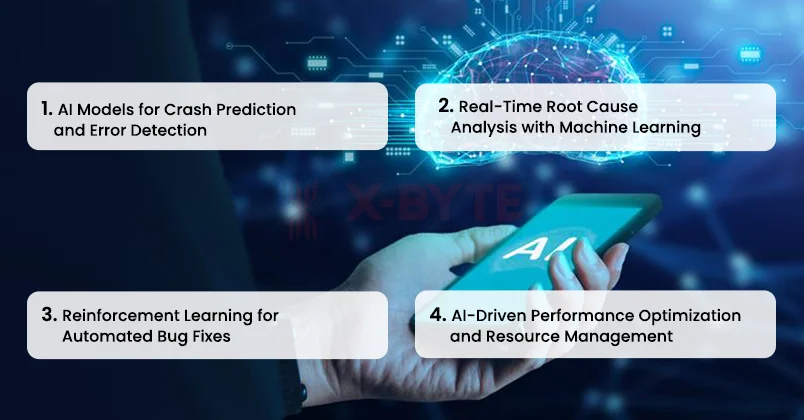
1. AI Models for Crash Prediction and Error Detection
This is where prevention begins. AI models study the app’s past behavior to recognize what usually happens before an app crashes.
How it works:
- The app constantly collects data such as CPU load, memory usage, or failed API requests.
- Machine learning models (like Random Forests or Neural Networks) analyze this data and spot early signs of trouble, for example, if memory usage keeps increasing abnormally.
- Once a potential crash pattern is detected, the app takes proactive actions, such as clearing cache, restarting unstable components, or reducing background activity to prevent failure.
2. Real-Time Root Cause Analysis with Machine Learning
When a problem does occur, AI steps in to figure out what caused it, instantly.
How it works:
- Every app generates logs and error messages. Machine learning models read these logs (often using Natural Language Processing or clustering algorithms) to understand the error context.
- The system looks for patterns or connections, for example, this crash always happens when the payment API fails.
- Using this insight, it pinpoints the exact function or module that triggered the issue.
So instead of developers manually scanning thousands of lines of code, AI performs a real-time root cause analysis, helping fix bugs faster and more accurately.
3. Reinforcement Learning for Automated Bug Fixes
Once the AI knows what’s wrong, the next step is learning how to fix it. That’s where Reinforcement Learning comes in.
How it works:
- The AI model is trained in a safe testing environment where it simulates errors and experiments with different fixes, like resetting a process, reloading data, or reconfiguring resources.
- Every time it picks a successful fix, it’s rewarded; when it fails, it’s penalized.
- Over time, it learns which solutions work best for different types of issues.
When deployed, the same AI can automatically apply these fixes in real-world scenarios, powering AI for bug detection and auto-repair in live apps.
4. AI-Driven Performance Optimization and Resource Management
Beyond fixing bugs, AI helps apps stay smooth and fast all the time. It learns how to manage resources efficiently, like balancing memory, battery, and network usage.
How it works:
- AI tracks live metrics such as frame rates, data loads, and device temperature.
- If it detects that performance is slowing down, it adjusts settings in real time, like pausing non-critical background tasks or optimizing data requests.
- Over time, it learns what optimal performance looks like for each device and usage pattern.
This is how AI for app performance optimization keeps apps running efficiently across all conditions.
Technical Architecture of Self-Healing Mobile Apps
Self-healing mobile apps rely on a carefully designed AI architecture that allows them to detect, diagnose, and fix issues automatically. It’s a combination of on-device intelligence, cloud-based analytics, and autonomous AI agents working in sync to maintain app health. Let’s break down how this ecosystem really works behind the scenes.
1. On-Device AI vs Cloud-Based Healing Systems
The self-healing process often starts right on your phone or tablet, this is where on-device AI in mobile apps plays a major role.
On-Device AI:
- Works locally on the user’s device using frameworks like TensorFlow Lite, Core ML, or PyTorch Mobile.
- Handles real-time monitoring tasks such as detecting abnormal CPU spikes, crashes, or UI freezes.
- Since it runs offline, it reacts instantly and can take actions like clearing cache, restarting services, or optimizing background tasks, even without internet connectivity.
Cloud-Based Healing Systems:
- Process large-scale data collected from millions of devices.
- Run deep learning models that require high computational power to analyze error trends, crash clusters, and performance anomalies across users.
- Generate predictive insights and send optimized self-healing strategies back to the app via updates or lightweight patches.
Together, this hybrid setup ensures both instant local fixes and long-term, data-driven improvements, making the app truly self-reliant.
2. How Smart Agents Monitor and Manage App Health
At the heart of this system are AI agents, intelligent modules embedded into the app that constantly watch over its health.
How these AI agents in mobile applications work:
- Each agent monitors key performance metrics like response time, memory usage, network latency, and energy consumption.
- When something unusual happens (like a slow database call or memory leak), the agent flags it as an anomaly.
- Using agentic AI in mobile app development, these agents don’t just detect problems, they decide the best action to take. For instance, one agent might pause background sync to free up memory, while another restarts a failed API connection.
- They also communicate with each other and with cloud servers, creating a collaborative digital immune system for the app.
3. Data Flow: From Logs to AI Feedback Loops
Every healing action starts with data. The system relies on continuous feedback loops to learn from every crash, bug, or anomaly.
Here’s how the data flow works:
- Data Collection: The app constantly gathers runtime logs, performance metrics, and user interaction data.
- Preprocessing: AI filters noise from raw data, keeping only useful signals like error codes or latency spikes.
- Analysis: Machine learning models detect anomalies or predict potential failures.
- Decision-Making: Based on predictions, the system triggers predefined healing actions (e.g., freeing memory, restarting a thread).
- Learning Loop: The results are sent back to the cloud, helping retrain models and improve accuracy for future incidents.
This continuous AI feedback loop allows the app to get smarter over time, learning from each issue it faces and fine-tuning its self-healing logic automatically.
4. Integrating AI Frameworks like TensorFlow Lite and Core ML
Building a self-healing app becomes possible when developers integrate robust AI frameworks directly into the mobile architecture.
- TensorFlow Lite (Android/iOS): Used for on-device inference, it runs lightweight models that predict performance degradation or detect runtime anomalies in real time.
- Core ML (iOS): Apple’s ML framework that integrates with system-level APIs to optimize CPU and battery usage during intensive operations.
- ONNX Runtime & ML Kit: Help unify AI model formats, so apps can easily switch between cloud-trained and on-device models for faster deployment.
By embedding these frameworks, developers can implement AI architecture for mobile apps that supports predictive maintenance, anomaly detection, and automated fixes, all while keeping performance high and latency low.
Challenges, Risks, and the Future of Self-Healing Apps
As impressive as self-healing mobile apps sound, building them is not simple at all. The technology introduces a new layer of complexity, one that blends automation, autonomy, and user trust. Let’s look at the major challenges that developers face while integrating AI in mobile app development.
1. Trust and Explainability in Autonomous Mobile Systems
One of the biggest challenges with AI-powered mobile app development is transparency..
- AI and ML models, especially deep learning ones, work as black boxes. They can detect and fix issues, but explaining the reasoning behind each fix can be difficult.
- This lack of explainability raises trust issues, particularly in high-stakes apps like finance or healthcare, where automated decisions can affect user data or outcomes.
Developers are now focusing on explainable AI (XAI) techniques, where the app not only performs self-repair but also logs the reason and logic behind each autonomous action.
2. Privacy, Security, and Compliance in AI Monitoring
When apps send diagnostic data to the cloud for analysis, there’s always a risk of exposing sensitive user information.
AI-based monitoring systems must also be secured against manipulation, so an attacker could not exploit a self-healing mechanism to inject malicious code or disrupt updates.
That’s why modern AI integration in mobile apps often combines federated learning with strong privacy frameworks to protect user trust and meet global compliance standards.
3. Balancing Automation with Human Control
Automation makes apps smarter, but total autonomy can be risky. Even the best AI features in mobile apps need human oversight.
- Over-reliance on automation might lead to unexpected behavior, especially if an AI misinterprets a signal and triggers an incorrect healing action.
- Developers must design control layers that allow human review or intervention before major fixes are applied.
The key is to strike a balance, use AI and ML in mobile app development to automate repetitive maintenance tasks while keeping humans in the loop for critical decisions.
4. Cost and Complexity of Implementation
Implementing a self-healing system involves building models, collecting clean data, integrating AI frameworks, and maintaining infrastructure, which isn’t cheap or simple.
- Smaller businesses may find it difficult to justify the cost of continuous monitoring and training models.
- It also requires specialized skills in data science, mobile architecture, and AI-based mobile applications, a combination not every team has.
This is why many developers start with hybrid models before scaling into full self-healing architectures.
5. Ethical and Behavioral Risks
AI can adapt, but without proper boundaries, it can also over-optimize. For instance, an app could decide to disable certain background features to improve performance, but that might reduce usability.
Developers must define ethical constraints in AI-powered mobile app development, ensuring the system prioritizes user experience and fairness, not just efficiency.
The Future of AI in Mobile App Development and Self-Healing Systems
The future of AI in mobile app development is rapidly evolving as businesses shift from traditional apps to intelligent, self-managing systems. It is all about empowering businesses to build smarter, more reliable, and self-sustaining digital experiences.
According to Gitnux, over 60% of mobile apps now use AI or ML, and the AI-in-mobile-app market is projected to hit $35.8 billion by 2025.
This growth reflects how AI is becoming central to app innovation, not just for smarter recommendations or automation but for building autonomous mobile applications that can detect errors, predict crashes, and even heal themselves without human intervention.
The key is choosing the right AI development services company who know things around these innovative technologies and can help you make the most out of self-healing apps.
To Wrap Up!
As mobile apps continue to evolve, self-healing systems mark a major step toward smarter, more reliable digital experiences. They don’t just detect and fix issues, they learn, adapt, and ensure users enjoy seamless performance without constant human oversight.
At X-Byte Enterprise Solutions – the leading artificial intelligence development company, we’re excited about what this means for the future of AI-driven app development. Our team continues to explore how businesses can use AI and ML to create apps that don’t just perform well but evolve intelligently over time, helping brands stay ahead in an increasingly connected world.