
Quick Summary:
This blog discusses how AI-driven software makes tasks easier that were previously delayed due to human errors. It shows the impact of integrating AI in software development on speed, reliability, and scalability. AI-integrated tools can become the future of automated software. To explore the full potential of artificial intelligence, explore companies like X-Byte Enterprise Solutions. This platform provides expertise across microservices and high-performance solutions.
As the world increasingly turns towards AI for microservices, it’s rapidly reshaping the industry, and modern software teams are reaping significant benefits from it. These teams are utilizing smart AI agents to design, deploy, and manage complex systems, resulting in faster, more reliable, and increasingly self-optimizing systems.
Humans can focus more on their strategic and innovative development with AI-driven software development, offering them a helping hand with monitoring daily tasks, prediction systems, improvement, and scalability. In this article, we will explore the concept and impact of AI in software development. We will also see how it is taking over traditional workflows and shaping the future of software engineering.
Understanding AI in Software Development
With this rapid change, we need to understand the basics of AI in the software development life cycle. This section explains how AI plays a role in modern software teams and its impact on them.
What is AI-Driven Software Development?
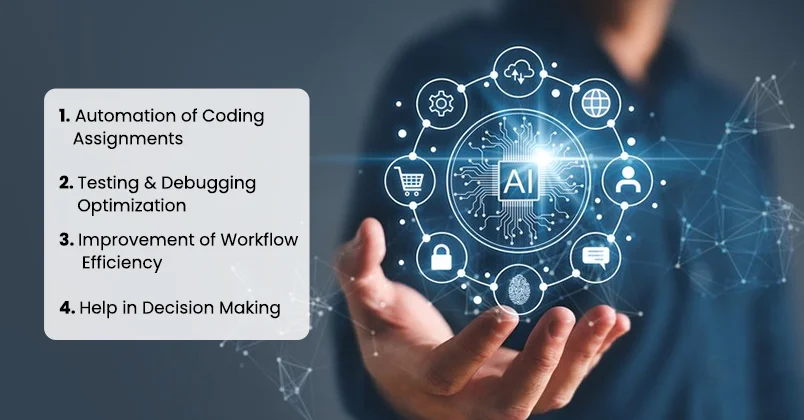
AI-driven software development is the use of artificial intelligence in software development lifecycles, from code generation to testing and deployment. This enables automation of tasks previously handled by humans. By AI integration in software development, the following can be achieved:
- Automation of Coding Assignments: Previously, developers had to repeatedly write the same code. This was resolved with the integration of artificial intelligence in software development, which helped with code generation, boilerplate creation, and refactoring.
- Testing and Debugging Optimization: With the assistance of AI-driven software development, the detection of errors and predicting bugs has become less time-consuming. This accelerates QA cycles over time.
- Improvement of Workflow Efficiency: Productivity has increased with machine learning, as it analyzes team patterns that save time and energy.
- Help in Decision Making: Humans have not always been good at decision-making. AI in these cases provides insights and opinions based on facts. This helps in the easier development of designs and architecture.
The Role and Impact of AI in Modern Software Teams
Incorporating agentic AI in software development has been the key to transforming development teams into a collaborative environment for both humans and smart agents. These benefits are:
- Easy Decision Making: Analyzing huge datasets has become easy. AI manages these time-consuming events and helps us cope with the rapidly changing market.
- Automating Tasks: It becomes a hassle when we have to perform a particular task repeatedly, especially when it has layers to it. Tasks like code reviews, analysis, and testing have been made easy with AI automation.
- Accuracy and Speed: This is one such niche that can be added to the impact of AI in software development. With automation in routine tasks, there is a reduction in human errors, which coherently accelerates development time.
These adoptive measures and practices seen in companies have made the experience less time-consuming, giving reliable outcomes and greater scalability.
Why Microservices Need Smart AI Agents?
Modern problems need modern solutions. This majorly emphasizes microservices that involve small and independent components for a complex application. Microservices come with challenges like coordination, monitoring, and optimization. This is where AI becomes handy. With the inclusion of agentic AI in software development , managing these simple yet time-consuming tasks becomes easy.
Challenges in Managing Complex Microservice Designing
There has been an increasing challenge in managing microservices. Hundreds of distributed services are to be managed, each with its own communication, dependencies, and failure points. These challenges are as follows:
- Complexity in Coordination: The maintenance of a constant flow of communication across independent services is necessary but difficult. This is solved with the help of artificial intelligence, where agents are trained to coordinate with each other based on code and integral connections.
- Monitoring Performance: Sometimes monitoring performance can become overwhelming, especially when it includes detecting latency and cascading failures. Integration of AI made this easier, and the tasks are completed in seconds.
- Conflicts in Controlling Version: It is known that various platforms demand a series of continuous updates. These cause inconsistencies in services. With artificial intelligence, updating software has become easy and hassle-free. Updated codes can now be generated automatically, making them a reliable and secure way of controlling novel software versions.
How Agentic AI Transforms Microservice Management
A revolution brought about in the world of microservices is agentic AI in software development. X-Byte Enterprise Solutions is an AI agent development company that provide autonomous, adaptive, and self-learning systems, which are known as AI agents. Let’s see the impacts of AI in the software development lifecycle.
- Monitoring resources and automated scaling in microservices are done by AI agents. This also balances the load effectively.
- By detecting potential failures or backlash, AI agents help manage the system and offer zero downtime.
- During service failure, AI agents are triggered automatically, causing systems to restart or troubleshoot in real-time.
- The adaptive behavior of AI agents reduces errors through the integration of data analysis. This also helps build resilience over time.
How Smart Agents Outperform Humans
Major transformation has been observed in monitoring, scaling, and optimization of microservices. This has been made possible with AI agents that surpass human efficiency.
AI integration in software development has greatly contributed to real-time decision-making, but human intervention is still valued for its creativity and strategic direction.
Speed, Scalability, and Self-Healing Capabilities
When it comes to accuracy and saving time, AI agent integration in software development is the best option. They can solve problems or complete tasks in a matter of seconds.
- Speed: Any delays that humans previously caused have now been taken care of by AI agents. Tasks like detection, analysis, and troubleshooting take longer periods of time when handled by humans, but are achievable in a fraction of a second when dealt with AI agents.
- Scalability: Growth in system software is inevitable. With the help of these agents, we can now predict patterns and adjust to them accordingly for maximum scalability. The agents can allocate resources across microservices more easily and efficiently than humans ever can.
- Self-Healing: Unlike humans, who get tired and need time to rest and restore, AI agents can work continuously without making any errors or delays in services. They are capable of non-stop monitoring and optimization, always providing accurate outcomes.
Real-World Use Cases of AI in Software Development Lifecycle
AI in the software development lifecycle: offers benefits like automation and intelligence with no room for error or failure if programmed successfully.
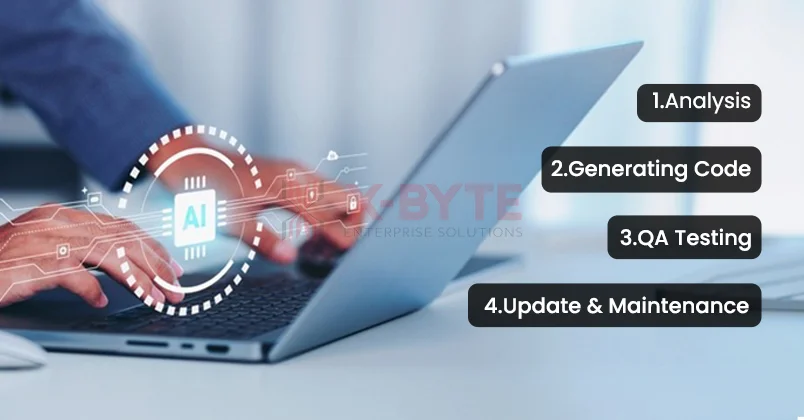
Analysis: In a project that involves analyzing a huge number of datasets, human error is possible. Whereas, when the same task is controlled and done by AI, it is not completed in a shorter time period, but also carried out with efficacy.
Generating Code: Various coding tools like GitHub and Copilot provide clean and well-optimized coding scripts in an automated way. This gives automated results in a very short time and delivers a reliable, swift outcome.
QA Testing: With AI agents, error detection and improving reliability have become simple and easier. It automatically corrects and fixes errors. This saves humans a lot of energy, which can otherwise be used to make creative decisions.
Update and Maintenance: previously, maintaining software and updating it to meet the software market trend was tedious and came with a lot of errors. AI agents can prove to be the solution to this. They can continuously integrate updates with no service breaks.
Integrating AI Agents into Your Development Workflow
The involvement of AI in software development helps with redesigning the workflow with human collaboration. This ensures accuracy, efficacy, and innovation.
Steps for AI Integration in Software Development
AI integration in software development can be seen as a complete procedure, but if we follow a structured plan, it can lead to smooth adoption.
- Repetitive Tasks: Try to identify which tasks rely heavily on repetitive actions on various datasets. This is where you can integrate AI tools for testing, monitoring, or automated code reviews.
- Choosing the Correct Tools: It is important to align the AI tools based on your software requirements. This can be done with the help of platforms like TensorFlow, PyTorch, etc. These platforms help in coding bug detection and optimization.
- Training and Deploying AI Agents: Each AI agent platform is integrated with a special use, like testing, detection, or microservice orchestration. It is best to deploy them at controlled phases for maximum accuracy.
Balancing Human Oversight and Automation
Supervision by humans is critical, even if AI plays an important role in software development. This maintains quality, ethics, and direction. Balancing human oversight and AI integration can be done as follows:
- Human Engagement in Making Decisions: Human intervention is deemed to be necessary when software developers check and validate AI integrations prior to any permanent changes.
- Maintaining Ethical Use: To ensure the AI software complies with company standards and regulations, it is essential for the developer responsible to ensure that it complies to avoid any backlash.
- Updating AI models: It is required for developers and analysts to periodically check the models in order to maintain accuracy as systems evolve.
The Future of Artificial Intelligence in Software Development
The role of AI in modern software development involves the ability to design, debug, and deploy systems. Let’s discuss the future of AI in software development.
Future Prospects of AI as Autonomous Agents
The world of software development is becoming a place where agentic AI in software development will observe systems, learn, and act accordingly to increase software reliability and precision:
- Collaboration in Learning: AI software will not only be able to learn and update itself but also share its knowledge across similar projects, applications, and performance improvements.
- Automatic Optimization: The agents will be continually tasked to keep up with updates and self-optimizing accordingly. This will increase efficiency and adaptability.
- Problem-Solving Skills: Many AI software development companies will use this feature extensively to complete tasks more quickly. This will reduce time consumption while maintaining accuracy.
What the Next Decade Holds for AI-Driven Development
Over the next decade, integrating AI in software development will be the basis of problem-solving and task completion. Here’s where you can expect:
- Fully Automated Pipelines: AI agents will manage and integrate end-to-end pipeline development, and coordination can be done in real time.
- Maintaining Ethics in Systems: Software automation will help ensure compliance with company standards and ethics, preventing unwanted situations or errors.
- Automatic Testing and Deployments: Simple repetitive tasks such as testing, security scanning, and debugging will be handled easily by automated AI agents.
Conclusion
With the integration of AI agents in software development, companies will be reaching new heights as their daily problems will be taken care of in seconds. This marks an evolutionary phase in coding, testing, and optimization.
Involvement of AI agents doesn’t replace human reactivity but assists in time-consuming tasks and carries them out with precision under a given time frame. With this collaboration, we now receive highly reliable coding scripts leading to smarter decision-making across software.
Companies adopting human and AI collaborations will be able to develop efficiency as well as gain future-proof workflows for the coming era. With automated intelligence, humans can now balance time and accuracy in various niches.
For the best experience in AI development service, consulting, and integration, explore our services.