
Key Highlights:
- IoT is transforming medical device management, allowing hospitals to monitor equipment in real time, predict failures early, and maintain higher uptime across critical devices.
- Smart IoT devices in the medical field use connected sensors and analytics to enhance equipment accuracy, ensure safer performance, and support faster, data-driven decisions.
- With IoT integration and the right IoT app development service partner, hospitals can build intelligent, secure, and scalable systems that save millions while improving patient care and operational reliability.
Introduction
In modern hospitals, medical devices are the silent heroes working around the clock, monitoring vitals, supporting surgeries, and powering life-saving treatments. But when one of these machines suddenly breaks down, the consequences go far beyond inconvenience.
It can delay care, strain hospital operations, and cost thousands in emergency repairs. For a system already stretched thin, every minute of downtime matters.
This is where IoT steps in as a quiet but powerful ally.
McKinsey & Company’s analysis on IoT-driven predictive maintenance, implementing predictive maintenance in hospital equipment (via IoT + analytics), could cut maintenance costs by ~40% and reduce downtime by up to 50%.
With IoT for predictive maintenance, it’s not just a tech upgrade; it’s a smarter way of keeping healthcare systems reliable and efficient. And as hospitals continue to adopt it, the results are clear: less downtime, better patient outcomes, and millions saved in maintenance costs each year.
Let’s keep on reading to know more about IoT in Medical Devices, predictive maintenance in healthcare, how to integrate IoT in medical devices , and beyond.
What is IoMT, and How Is It Revolutionizing Healthcare?
The Internet of Medical Things (IoMT) is a network of smart, connected medical devices that collect, share, and analyze data in real time. These devices include everything from wearables and patient monitors to MRI machines, infusion pumps, and smart hospital equipment.
IoMT is transforming healthcare by making hospitals more connected, efficient, and proactive. Doctors and care teams can access real-time patient data, equipment can alert technicians before problems occur, and hospitals can track everything, from device performance to inventory, without manual effort. This leads to faster decisions, safer care, fewer delays, and smoother operations.
In simple terms, IoMT brings together medical devices, data, and smart technology to improve the way healthcare works for both patients and hospitals.
Why IoT + Predictive Maintenance Matter Now?
Hospitals are entering a new era where every minute, every machine, and every decision counts. Traditional maintenance models can’t keep up with today’s speed, precision, and compliance demands. That’s where IoT and predictive maintenance come together. Let’s find out more:
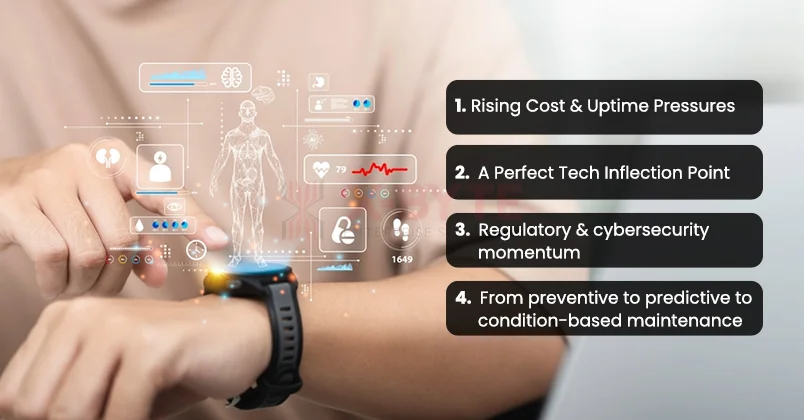
1. Rising Cost and Uptime Pressures
Hospitals today operate under immense financial and operational strain. Every minute a CT scanner or ventilator is down can mean canceled procedures, delayed ICU treatments, or the need to rent costly backup equipment.
Predictive maintenance powered by IoT helps hospitals stay ahead of these challenges by keeping critical machines running reliably. By preventing unplanned downtime, healthcare facilities can maintain smoother patient flow, improve OR and ICU throughput, and avoid the cascading costs of last-minute disruptions.
2. A Perfect Tech Inflection Point
The timing for IoT-driven maintenance couldn’t be better. The technology has matured, sensors are now affordable, edge computing makes real-time analysis faster, and connectivity across hospital networks is more reliable than ever.
Together, these advances make it practical for hospitals to monitor equipment continuously, predict failures accurately, and take action instantly. What once required complex infrastructure and high costs is now accessible, scalable, and ready to transform how medical equipment is managed.
3. Regulatory & cybersecurity momentum (audit-ready operations)
Healthcare regulations are becoming stricter, especially around equipment performance, data integrity, and patient safety. Hospitals must now prove that their devices are well-maintained, secure, and compliant with standards at all times.
IoT-powered predictive maintenance supports this shift by keeping a continuous digital record of equipment performance, service logs, and alerts, creating audit-ready documentation automatically. At the same time, modern IoT systems come with stronger cybersecurity layers, ensuring that sensitive operational and patient data stay protected while meeting compliance requirements.
4. From preventive to predictive to condition-based maintenance
For years, hospitals relied on fixed maintenance schedules, servicing equipment every few months, whether it needed it or not. Predictive maintenance takes this a step further by using real-time data to forecast when a failure might occur.
Now, the next evolution, condition-based maintenance, is emerging, where repairs are triggered only when specific performance conditions are met. This smarter, more dynamic approach minimizes unnecessary servicing, extends equipment life, and ensures resources are used exactly where and when they’re needed.
Smart Medical Devices, What Makes Them Actually Smart?
The real power of IoT in medical devices lies in how “smart” these systems have become. They don’t just run diagnostics or support patient care — they think, communicate, and adapt in real time. Let’s break down what makes them truly intelligent.
1. On-device sensors & health indicators (vibration, temp, current, pressure)
IoT-enabled medical devices are equipped with a range of sensors that constantly monitor their performance. These sensors track everything from vibration and temperature to current flow and pressure, helping detect even the slightest changes that could signal wear or malfunction.
For example, if a ventilator motor starts vibrating more than usual, the system can alert technicians before it fails. This constant flow of real-time data forms the foundation for predictive maintenance in healthcare, keeping devices running safely and smoothly.
2. Connectivity choices (BLE, Wi-Fi 6E, private 5G, MQTT/AMQP)
Smart connectivity is what keeps IoT devices in the medical field talking to each other. Depending on the use case, hospitals can choose from Bluetooth Low Energy (BLE) for close-range monitoring, Wi-Fi 6E for faster data transfer, or even private 5G networks for critical telemetry where reliability is non-negotiable.
Communication protocols like MQTT and AMQP ensure smooth and secure data flow between medical devices and central systems, enabling faster response times, real-time alerts, and better coordination across the hospital ecosystem.
3. Edge vs. cloud analytics (latency, privacy, cost)
When it comes to analyzing medical device data, hospitals now have options. Edge computing allows devices to process data locally, reducing latency and improving patient safety in time-sensitive scenarios like ICU monitoring.
Meanwhile, cloud analytics offers scalable storage and advanced AI insights that support long-term trend analysis and decision-making. Many healthcare providers use a hybrid model, blending both approaches to balance privacy, cost, and speed, a major step forward in IoMT predictive maintenance and smarter hospital equipment management.
4. Safety-by-design and fail-safe modes
In healthcare, safety can never be an afterthought. IoT app development services now focus heavily on building medical devices in IoT with safety-by-design principles, meaning systems are built to detect faults, switch to backup modes, and alert users automatically.
Fail-safe mechanisms ensure that even if a network drops or a sensor malfunctions, critical equipment like infusion pumps or ventilators continues to operate safely. This proactive approach not only strengthens reliability but also helps hospitals meet strict compliance and cybersecurity requirements.
How IoT + Predictive Maintenance Are Saving Hospitals Millions
The financial impact of medical equipment downtime goes far beyond repair bills—it affects patient care, scheduling, and overall hospital efficiency. By combining IoT connectivity with predictive maintenance, hospitals are finding smarter ways to cut costs and save millions.The financial impact of medical equipment downtime goes far beyond repair bills—it affects patient care, scheduling, and overall hospital efficiency. By combining IoT connectivity with predictive maintenance, hospitals are finding smarter ways to cut costs and save millions.
1. Cost drivers eliminated (unplanned downtime, emergency call-outs, rentals)
Unplanned downtime has always been one of the biggest cost drains in healthcare. When a critical machine goes down unexpectedly, hospitals face repair expenses and emergency technician call-outs, equipment rentals, and lost patient throughput. IoT changes this equation.
With sensors constantly monitoring equipment health, maintenance teams can predict and prevent failures before they happen, eliminating those costly, last-minute surprises.
2. Device quick wins (MRI chillers, CT tubes, sterilizers, ventilators, pumps, UPS)
Some equipment categories deliver fast returns once IoT and predictive maintenance kick in. For example, MRI chillers, CT scanner tubes, sterilizers, ventilators, infusion pumps, and UPS systems are all high-value assets prone to sudden faults.
Real-time monitoring helps spot early warning signs, like unusual temperature spikes or pressure drops, so hospitals can act early. The result: fewer breakdowns, longer equipment life, and smoother patient flow across departments.
3. ROI model & payback (downtime cost/hour, component life extension)
The math behind predictive maintenance is compelling. Every hour of downtime for critical devices like MRI or CT scanners can cost hospitals thousands in lost revenue and rescheduling costs.
IoT solutions help reduce that downtime dramatically while extending component life by 20–40%. When you factor in fewer emergency repairs, better asset utilization, and improved scheduling efficiency, most hospitals see payback on their predictive maintenance investments within months.
4. Scheduling resilience (reslotting cases before failure windows)
Predictive insights give hospitals something they’ve rarely had before: time to adjust. When the system detects a failure window approaching, operations teams can reschedule scans, reallocate machines, or shift elective cases before downtime hits. This level of foresight prevents cancellations, protects patient trust, and keeps throughput steady, even when equipment needs attention.
Key Benefits of Predictive Maintenance for Medical Devices
Hospitals don’t just need machines that work; they need machines that keep working, especially when every scan, surgery, or infusion depends on it. Predictive maintenance brings that reliability by turning equipment data into early action for smooth and uninterrupted operations.
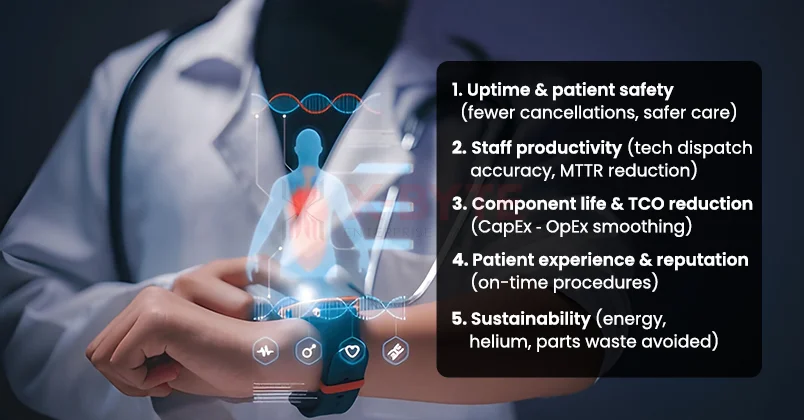
1. Uptime & patient safety (fewer cancellations, safer care)
Every canceled procedure impacts more than just the schedule; it affects diagnosis timelines and patient trust. Predictive maintenance keeps uptime near 100% by detecting anomalies before they escalate into failures. This means fewer last-minute cancellations, faster care delivery, and safer patient outcomes, especially in critical care and imaging environments where every minute counts.
2. Staff productivity (tech dispatch accuracy, MTTR reduction)
When maintenance becomes predictive, hospital staff work smarter. Instead of dealing with surprise breakdowns, technicians receive precise alerts about which device needs service and why. This eliminates unnecessary checks and reduces the time spent diagnosing issues. It helps professionals plan their workload efficiently, improving response times and minimizing disruptions.
3. Component life & TCO reduction (CapEx → OpEx smoothing)
Predictive insights allow hospitals to maintain equipment only when necessary, not too early (wasting resources) or too late (causing costly damage). This balance extends the lifespan of critical components. Over time, this precision maintenance lowers the total cost of ownership (TCO) by reducing repair frequency and turning unpredictable expenses into planned, data-driven maintenance cycles.
4. Patient experience & reputation (on-time procedures)
Behind every reliable machine is a better patient experience. Predictive maintenance ensures equipment is always ready when patients arrive — reducing waiting times, rescheduling hassles, and diagnostic delays. Consistent reliability improves patient trust and strengthens the hospital’s reputation as a dependable care provider.
5. Sustainability (energy, helium, parts waste avoided)
Predictive maintenance also supports a hospital’s sustainability goals. By cutting down on unnecessary part replacements, reducing helium leaks in MRI systems, and optimizing equipment energy consumption, hospitals minimize waste and operational emissions. Fewer emergency shipments and fewer discarded components mean smaller environmental footprints, smarter resource use while contributing to sustainability initiatives.
Automated Inventory & Smart Supply Chains
Hospitals depend on thousands of supplies and spare parts every day, and running out of even one critical item can slow down care. So, having a fully managed inventory and supply chain goes a long way. And, the use of IoT in medical devices makes it all easier. Let’s find out how.
1. Predictive spare-parts planning (tubes, seals, filters, batteries)
Hospitals rely on hundreds of small but crucial components to keep medical devices running smoothly. IoT makes managing these parts easier with real-time visibility into how each device and its components are performing.
Sensors collect data on usage patterns, operating hours, and wear levels, helping maintenance teams spot when a part is nearing the end of its life and predict exactly when to replace parts, cutting emergency costs and ensuring equipment is always ready for patient care.
2. Auto-replenishment & vendor-managed inventory (contract alignment)
Instead of manually checking stock and placing orders, auto-replenishment systems take care of it automatically. IoT-powered inventory systems automatically track stock levels of spare parts and consumables.
When supplies run low, they can trigger reorders or notify vendors through connected platforms. This ensures hospitals always have the right parts on hand while staying aligned with vendor contracts and delivery timelines.
3. Cold chain & pharmacy/lab monitoring (alerts, compliance trails)
For pharmacies and labs, temperature-sensitive items like vaccines and blood samples need the right storage conditions.
IoT sensors continuously monitor storage conditions. If the temperature or humidity drifts outside safe limits, the system immediately alerts staff. These connected records help maintain compliance, reduce waste, and protect patient safety.
4. Recall & UDI traceability integrated with maintenance records
When a product recall happens, hospitals need to act fast. IoT connectivity makes tracking and managing recalled medical devices efficient and more accurate.
By linking maintenance data with unique device identifiers (UDI), hospitals can instantly locate affected devices and remove them from use. This helps ensure compliance, minimize disruptions, and keep patients safe.
Adoption Challenges (and How to De-Risk Them)
1. Data quality & model drift (calibration, ground truth, feedback loops)
Predictive systems only work well when the data behind them is clean and consistent. If sensors collect inaccurate readings or the system doesn’t get regular updates, predictions start drifting away from reality and yield inaccurate results.
That’s why hospitals need to keep sensors calibrated, verify alerts with real-world checks, and set up feedback loops so technicians can confirm what’s actually happening. When the system learns from these updates, its predictions stay sharp and trustworthy.
2. Cybersecurity & PHI minimization (segmentation, SBOM, patch windows)
Every new connected device adds a door to the hospital network, and hackers are always looking for open ones. Hospitals have access to the most confidential data, and if that’s accessible to hackers, you’ll be putting your patients’ trust and hospital credibility at risk.
Hospitals can close those gaps by segmenting their IoT devices on separate networks, keeping a software inventory (SBOM) for every connected system, and applying patches on time. It also helps to collect only the data that’s truly needed; not every device has to store patient details. The smaller the data footprint, the smaller the risk.
3. Interoperability with legacy fleets (gateways, protocol bridging)
Many hospitals still depend on older machines that don’t speak the same language as modern IoT systems. This can lead to data silos, manual work, and missed insights. But, instead of replacing everything, hospitals can use IoT gateways and protocol bridges to connect old and new equipment.
Gateways and protocol bridges let older devices share data with newer systems without changing how they work. It’s like giving your old equipment a digital translator, so everything from legacy ventilators to modern imaging systems can connect, communicate, and contribute to the same data ecosystem.
4. Change management for HTM/biomed teams (playbooks & SLAs)
New technology often creates pushback, especially from staff who’ve managed devices the same way for years. Without proper training or clarity, IoT systems can feel more confusing than helpful. The key is communication and structure.
Hospitals should build clear playbooks that explain how workflows change, set expectations through service-level agreements, and offer hands-on training. When teams understand how IoT makes their jobs easier, not harder, adoption becomes much smoother.
5. Validation & compliance for analytics (risk files, V&V, documentation)
In healthcare, even the smartest system can’t be used unless it’s validated. Predictive models must prove they’re safe, reliable, and compliant with regulations. Skipping this step can create audit problems or even patient safety risks.
Hospitals can manage this by maintaining complete risk files, documenting how systems are tested (V&V), and building compliance into every stage of deployment. This approach ensures that innovation never comes at the cost of safety or trust.
The Future of IoT in Healthcare
The future of IoT in medical devices looks smarter, faster, and more connected with changing and ever-evolving tech. Let’s keep on reading to know about what the future holds:
1. Digital twins of devices & departments (what-if simulations)
Digital twins are virtual copies of real hospital devices or departments. They help hospitals test what-if situations, like what happens if an MRI machine runs continuously for 12 hours or if a cooling system slows down. By simulating these conditions, hospitals can plan better maintenance schedules, prevent downtime, and improve predictive maintenance for medical devices without disrupting patient care..
2. Federated/edge learning (privacy-preserving model updates)
As hospitals collect massive amounts of data from connected medical devices, protecting patient privacy becomes a top priority. The future is federated and edge learning, and it solves this challenge by training AI models directly on the devices or local servers without sending sensitive data to the cloud.
This means hospitals can still improve IoT-powered predictive analytics and maintenance while keeping patient data safe. It’s a big step toward smarter, privacy-first IoT in medical devices, where insights are shared, but data never leaves the hospital.
3. Network evolution (Wi-Fi 6E/7, private 5G for critical telemetry)
The next generation of networks, Wi-Fi 6E, Wi-Fi 7, and private 5G, will completely change how hospitals connect and manage their IoT devices. These faster and more reliable networks will support thousands of medical devices working in real time, sending telemetry data without delays or drops.
For healthcare teams, that means smoother data flow, quicker alerts, and better predictive maintenance for medical devices. Stronger networks will make it easier to integrate IoT app development services and enable hospitals to scale their smart systems safely and efficiently.
4. Self-healing assets & autonomous maintenance windows
Imagine hospital equipment that can detect a problem, fix it automatically, or schedule its own maintenance; that’s the future of IoT in healthcare. With IoMT predictive maintenance, devices can monitor their health continuously, run self-diagnostics, and even correct minor issues before they affect patient care.
This self-healing approach reduces downtime and ensures critical equipment, like ventilators or monitors, stays available when needed. It’s a big leap toward autonomous hospital operations, powered by IoT devices in the medical field.
5. Ops copilots (natural-language insights for HTM leaders)
Ops copilots are the new AI assistants built to make hospital operations smarter and easier. Using IoT data from medical devices, these copilots help HTM leaders get real-time insights in plain language, no complex dashboards needed.
By combining IoT in medical devices with AI, hospitals can simplify predictive maintenance in healthcare, improve planning, and reduce downtime. It’s like having a digital co-pilot who keeps every device running smoothly and every team one step ahead.
Wrap it Up!
The future of healthcare is connected, intelligent, and proactive, and IoT is right at the heart of it. From smarter maintenance planning to real-time device monitoring and AI-driven insights, IoT is helping hospitals move from reactive fixes to predictive and automated operations.
But to truly unlock this potential, healthcare organizations need the right technology partner, one that understands both innovation and integration.
At X-Byte Enterprise Solutions – the leading IoT app development company, we help you turn IoT possibilities into practical solutions. Our IoT app development and integration services are designed to connect your medical devices, streamline data flow, and build intelligent systems that make healthcare safer, faster, and more efficient.
With the right IoT strategy, hospitals can focus more on patient care while their systems take care of the rest.