
Key Highlights:
- Learn the step-by-step process of Laundry App Development, from market research and UI/UX design to deployment and scaling.
- Explore must-have features for customers, service providers, and admins to ensure operational efficiency and superior user experience.
- Understand monetization models, cost breakdowns, and future trends to build a profitable and scalable on-demand laundry app.
The on-demand economy has transformed how consumers access everyday services and laundry is no exception. From busy professionals to large residential communities, users now expect fast, reliable, and app-based laundry. This growing demand has opened massive opportunities for enterprises to invest in Laundry App Development and build scalable, profitable digital platforms.
In this guide, we’ll walk you through how to build an on-demand laundry app, key features, development steps, cost breakdown, and future trends, helping enterprises make informed decisions and launch a competitive solution.
Why Invest in Laundry App Development?
Laundry services are shifting from fragmented, offline operations to centralized, tech-driven platforms. For enterprises, Laundry App Development is not just about digitization, it is about building predictable, scalable service infrastructure.
Modern laundry apps allow enterprises to standardize service quality across locations, automate vendor coordination, and generate recurring revenue through subscriptions and long-term contracts. With urban density increasing and consumer expectations rising, digital laundry platforms are becoming foundational infrastructure for residential communities, hospitality chains, and commercial facilities.
Enterprises that invest early benefit from operational leverage, data visibility, and long-term market control rather than competing on price alone.
What is an On-Demand Laundry App?
An On-Demand Laundry App is a digital platform that enables customers to book laundry services through a mobile or web application. Often described as the Uber for Laundry App, it connects users, laundry service providers, and delivery agents within a single ecosystem.
Unlike traditional laundry services, these apps offer:
- Real-time pickup scheduling
- Transparent pricing
- Live order tracking
- Digital payments
- Automated service workflows
From single-brand enterprises to multi-vendor marketplaces, laundry apps can be customized to support diverse business models while ensuring scalability and operational efficiency.
Key Benefits of a Laundry App
An enterprise laundry app delivers operational automation, scalability, and enhanced customer experience, helping businesses streamline workflows, reduce manual errors, and achieve significant cost savings. The integration of advanced analytics and data-driven decision-making enables businesses to track demand trends, optimize service offerings, and grow revenue.
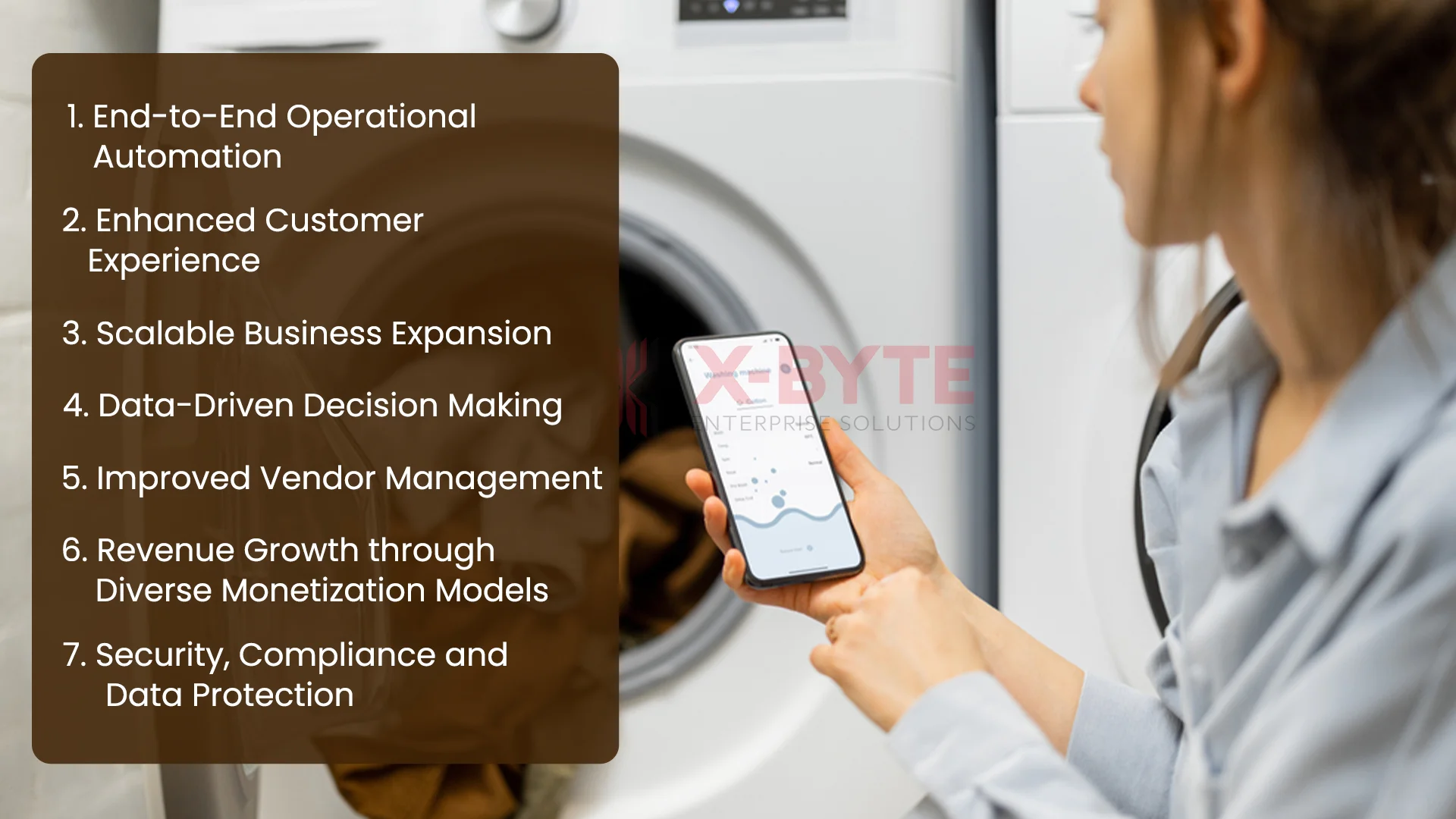
1. End-to-End Operational Automation
Enterprise laundry apps automate order processing, vendor assignment, delivery routing, billing, and notifications, significantly reducing manual errors and operational costs.
2. Enhanced Customer Experience
Customers benefit from convenience, transparency, and reliability. Features such as order tracking, real-time alerts, and digital payments build trust and increase customer lifetime value.
3. Scalable Business Expansion
With a centralized admin panel, enterprises can easily expand operations into new cities, onboard multiple service providers, and manage high order volumes without infrastructure bottlenecks.
4. Data-Driven Decision Making
Advanced analytics provide insights into user behavior, peak demand times, service quality, and revenue trends, helping enterprises optimize performance and profitability.
5. Improved Vendor Management
An enterprise-grade app enables businesses to effectively onboard and manage multiple vendors, ensuring consistent service quality, timely delivery, and streamlined communication between service providers and customers.
6. Revenue Growth through Diverse Monetization Models
Laundry apps support multiple revenue streams such as commission per order, subscription plans, and surge pricing. This flexibility enables businesses to optimize pricing strategies based on market demand, boosting profitability.
7. Security, Compliance and Data Protection
Security and data protection are crucial for any laundry app. Our platform ensures secure handling of customer data, with encrypted storage and payment processing. We follow industry best practices to ensure your customers’ data is safe, building trust and compliance as you scale.
Must-Have Features of an On-Demand Laundry App
An enterprise-grade on-demand laundry app must support three operational layers; customers, service providers, and administrators while maintaining system-wide visibility and control.
User App Features
- Easy Registration & Profile Management: Users can quickly sign up, create profiles, and manage personal details for a seamless experience.
- Service Selection (Wash, Fold, Dry Cleaning, etc.): Customers can choose from various laundry services such as washing, folding, and dry cleaning based on their needs.
- Pick-up Scheduling & Order Tracking: Customers can schedule pick-up times at their convenience and track their laundry orders in real time.
- Secure Digital Payments & Ratings: The app supports secure payment options, ensuring safe transactions, while ratings and reviews help maintain service quality.
- Real-Time Notifications: Customers receive timely updates on order status, pick-up, delivery, and any delays, keeping them informed throughout the process.
Service Provider & Delivery Partner App Features
- Job Assignment & Order Status Updates: Service providers receive job assignments and can update order statuses, ensuring accurate tracking for both customers and admins.
- Optimized Delivery Routing: Delivery partners are provided with optimized routes for faster pick-up and drop-off, improving efficiency and reducing delivery times.
- Availability Management: Service providers can manage their working hours, making them available for jobs based on their schedule.
- Earnings Dashboard & Order History: Providers can track their earnings, view completed orders, and manage their financial performance through a user-friendly dashboard.
Admin Panel Features
- Centralized User & Vendor Management: Administrators can efficiently manage customer and service provider data, ensuring smooth operations and customer satisfaction.
- Pricing & Commission Structures: Admins can set and adjust pricing for services, as well as commission rates for vendors, ensuring flexibility and profitability.
- Service Workflow Automation: The admin panel automates various service workflows such as order processing, vendor allocation, and notifications, reducing manual effort and improving efficiency.
- Analytics & Reporting for Demand & Revenue Insights: Admins can access detailed analytics and reports, providing insights into demand patterns, service performance, and revenue, allowing for data-driven decision-making.
Step-by-Step Laundry Service App Development Process
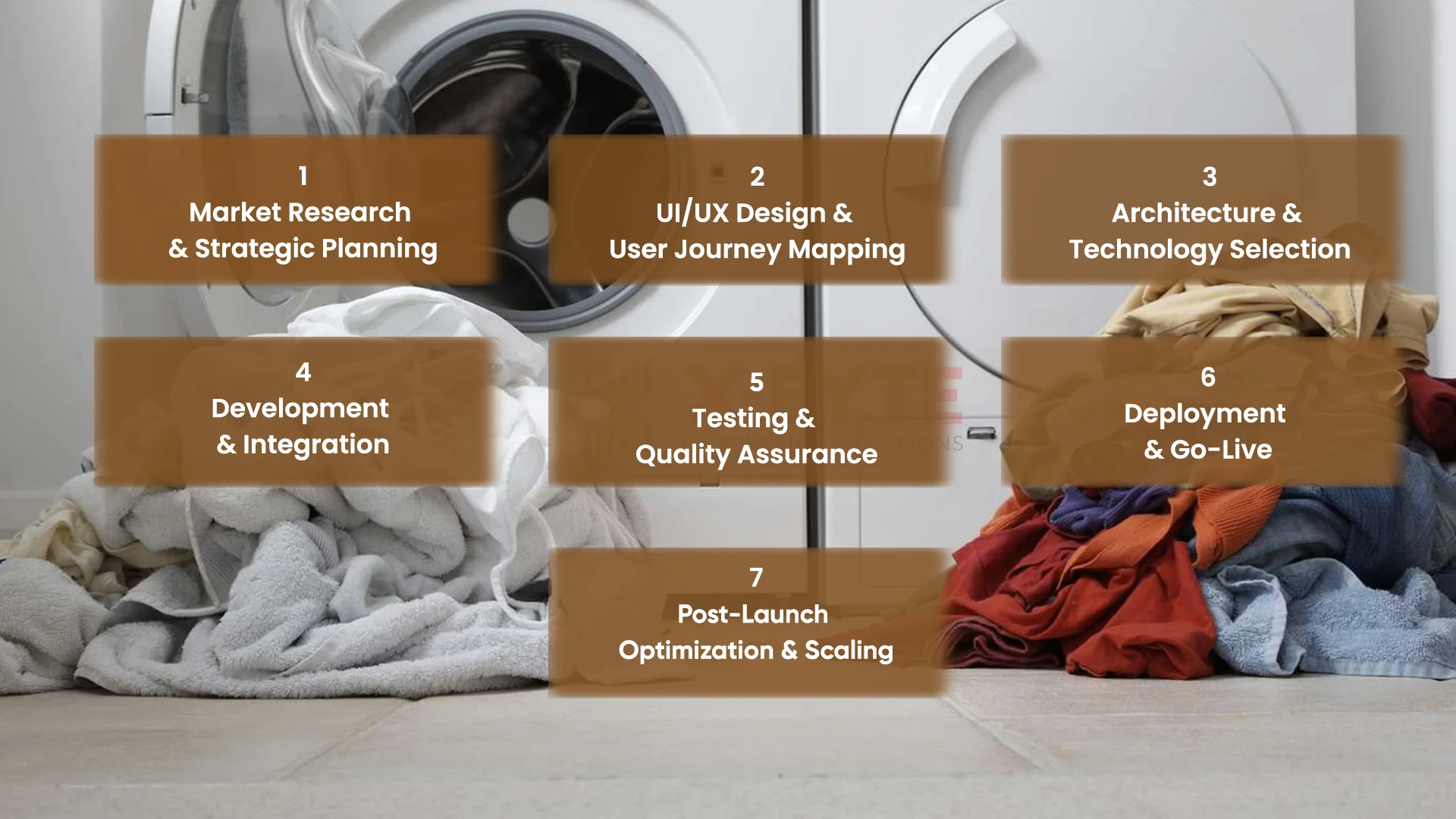
Step 1: Market Research & Strategic Planning
The development process begins with in-depth market research and strategic planning. Enterprises analyze customer demand, competitor offerings, pricing models, and regional service expectations to define a clear roadmap. This phase also includes identifying the right business model, revenue strategy, and compliance requirements to ensure the laundry service app aligns with enterprise goals and market needs.
Step 2: UI/UX Design & User Journey Mapping
A well-designed user interface is essential for customer retention and engagement. During this stage, designers focus on creating simple, intuitive, and responsive interfaces for customers, service providers, and administrators. User journey mapping helps ensure smooth navigation from service selection to payment, while usability testing validates the design for better conversions and user satisfaction.
Step 3: Architecture & Technology Selection
Selecting the right technology stack is critical for building a scalable and secure laundry service app. Enterprises typically choose cloud-based architecture, secure APIs, and modular systems that support real-time operations and future feature upgrades. This ensures the platform remains flexible, high-performing, and easy to scale as the business grows.
Step 4: Development & Integration
The development phase involves building front-end and back-end components of the application. Core functionalities such as service booking, order management, payment processing, GPS tracking, and notifications are implemented. Third-party integrations are added to enhance functionality while maintaining data security and system stability.
Step 5: Testing & Quality Assurance
Before launch, the app undergoes thorough testing to ensure smooth performance across devices and platforms. Functional testing, performance testing, and security checks help identify issues and ensure the app can handle real-world usage scenarios without disruptions.
Step 6: Deployment & Go-Live
Once testing is complete, the app is deployed on app stores and hosted on secure cloud infrastructure. Performance monitoring tools are set up to track system health and user activity, ensuring a smooth and stable launch.
Step 7: Post-Launch Optimization & Scaling
After launch, continuous monitoring and updates help improve performance and user experience. Enterprises use analytics and user feedback to optimize features, add enhancements, and scale the platform to new locations or service areas.
Enterprise-Grade Technology Stack
Our technology stack combines cutting-edge frameworks and cloud infrastructure to build scalable, secure, and high-performing laundry service apps. From real-time order tracking and payment processing to efficient service management, we ensure seamless operations across all platforms.
Frontend: (React Native / Flutter): These frameworks ensure fast and responsive user interfaces across both iOS and Android platforms, providing a seamless experience for customers, service providers, and admins.
Backend (Node.js / Python / Java): These powerful back-end technologies enable real-time processing, smooth integration with external services, and robust handling of high transaction volumes, ensuring scalability and performance.
Database: (PostgreSQL / MongoDB): PostgreSQL supports structured data, perfect for handling user and service provider information, while MongoDB handles large-scale, unstructured data such as order logs and real-time service status.
Cloud: (AWS / Azure / Google Cloud): Cloud platforms ensure high availability, scalability, and security, offering robust infrastructure for data storage, application hosting, and service reliability at enterprise scale.
Payments: (Stripe, PayPal, Razorpay): Secure and reliable payment gateways for processing transactions, enabling customers to make easy, hassle-free payments, while supporting various payment methods (credit card, digital wallets, etc.).
Maps & Tracking: (Google Maps API): Real-time tracking of laundry orders and optimized delivery routes for service providers, ensuring quick and efficient pick-up and delivery processes.
Notifications: (Firebase / Twilio): Push notifications and SMS integration for real-time updates on order status, delivery times, and service reminders, enhancing user engagement and experience.
At X-Byte Enterprise Solutions, we architect enterprise-ready Laundry Service Apps with scalability, security, and performance at the core, ensuring a seamless and reliable experience for both end-users and service providers.
Laundry App Development Cost Breakdown
The cost of developing a laundry app varies based on the platform’s complexity, scalability needs, and enterprise integrations. It’s not just about the number of features but also the level of functionality and service required. A basic app caters to small operators with limited features, while an enterprise-grade app is designed for large-scale operations with multi-vendor support and high concurrency.
Here’s a breakdown:
Basic Laundry App:
- Supports limited features
- Single-location operations
- Suitable for small operators
- Lower initial cost
Standard Laundry App:
- Includes real-time tracking, payment gateways, and analytics dashboards
- Suitable for moderate order volumes
- More features, moderate cost
Enterprise-Grade Laundry App:
- Supports multi-vendor onboarding
- Includes AI-powered analytics
- High scalability for concurrent usage
- Compliance features
- Higher initial investment but offers long-term operational cost savings
Build vs Buy vs White-Label Laundry App
Enterprises planning to launch a laundry service platform typically evaluate three approaches; building from scratch, buying a ready-made solution, or using a white-label laundry app.
1. Building from Scratch
Custom development offers maximum flexibility, scalability, and ownership. Enterprises can design workflows, integrations, and monetization models aligned with long-term business goals. This approach is ideal for enterprises planning multi-city expansion, complex vendor management, and data-driven optimization.
2. White-Label Laundry App
White-label solutions offer faster time-to-market with predefined features. However, they often limit customization, scalability, and integration capabilities, making them less suitable for enterprise-scale operations.
3. Buying Off-the-Shelf Software
Ready-made platforms may reduce initial cost but usually lack flexibility, security customization, and performance optimization required for enterprise use cases.
For enterprises focused on growth, control, and long-term ROI, custom Laundry Service App Development provides the strongest competitive advantage.
Monetization Models for Laundry Apps
Laundry apps can generate revenue through various monetization strategies, each tailored to suit different business models and customer needs. By combining multiple revenue streams, laundry service platforms can ensure consistent cash flow and optimize profitability.
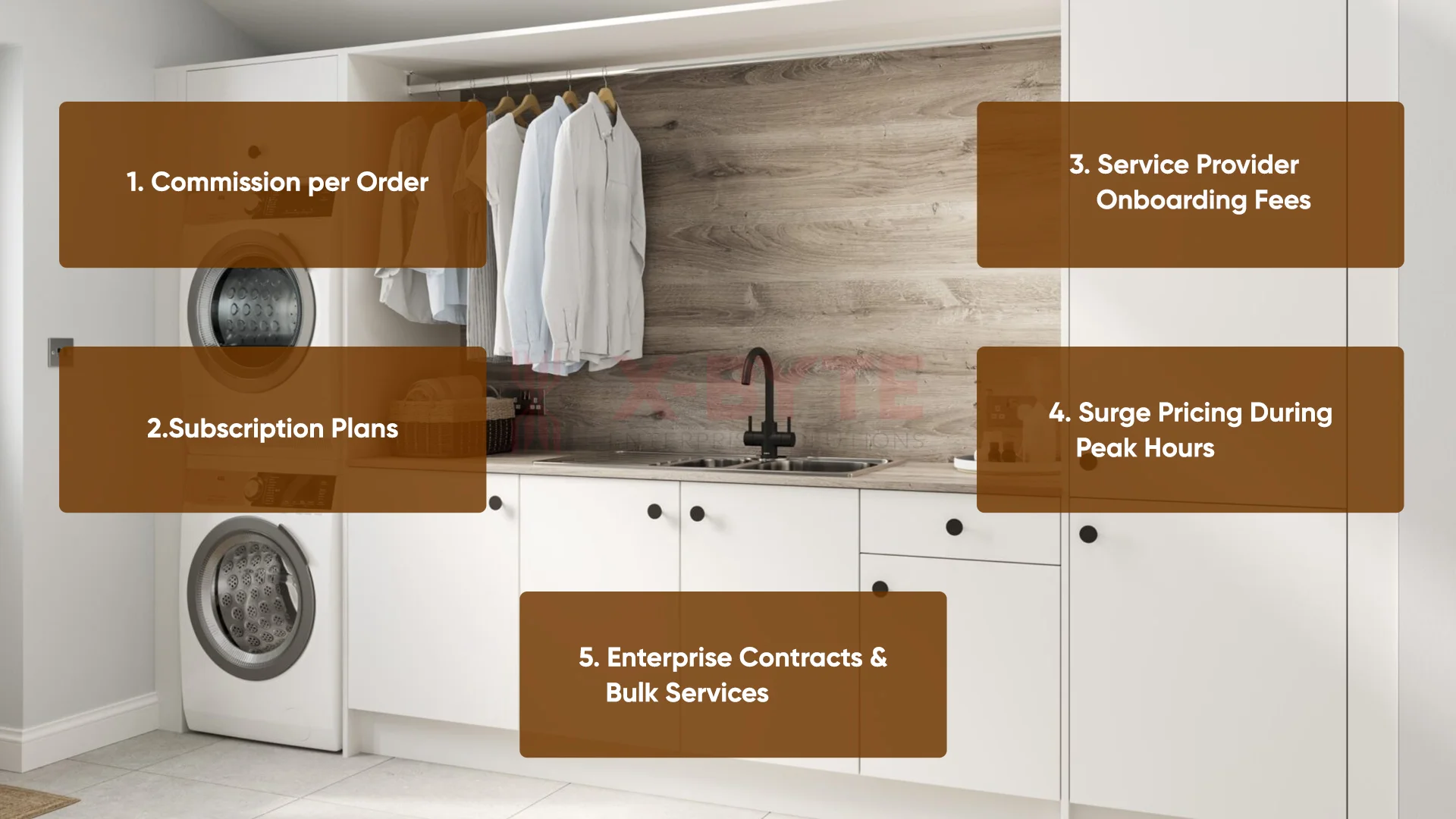
1. Commission per Order
This model involves charging a percentage or fixed fee on each completed transaction. It’s a straightforward approach where the app earns a commission from service providers for every order placed through the platform, ensuring steady revenue as long as demand is high.
2. Subscription Plans
Subscription-based models allow customers to pay a recurring fee for regular services, such as weekly or monthly laundry pick-ups. This provides the business with predictable, recurring income and builds customer loyalty by locking in long-term service agreements.
3. Service Provider Onboarding Fees
Charging service providers a one-time fee to join the platform is a common practice. This can cover registration, platform access, and onboarding costs, ensuring the app generates initial revenue when adding new vendors, especially useful for marketplaces with many service providers.
4. Surge Pricing During Peak Hours
Surge pricing is used to adjust service fees during high-demand periods, such as weekends or holidays. This model allows the app to capitalize on peak demand by charging higher fees, while also managing service capacity and ensuring service quality during busy times.
5. Enterprise Contracts & Bulk Services
For larger businesses or commercial clients, enterprise contracts and bulk services offer customized pricing for high-volume laundry needs. These agreements are typically long-term, offering predictable revenue streams and fostering relationships with corporate clients, hotels, and large residential complexes.
Future Trends in Laundry Service App Development
The future of laundry service platforms lies in intelligence, automation, and sustainability. Artificial intelligence is enabling enterprises to forecast demand, optimize pricing, and allocate resources dynamically based on usage patterns. IoT integrations provide real-time visibility into machine health, energy consumption, and maintenance requirements, reducing downtime and operational risk.
Automation is further transforming laundry operations by minimizing manual intervention in sorting, washing cycles, and delivery scheduling. Additionally, sustainability-focused innovations, such as water-efficient processes and energy analytics, are becoming competitive differentiators as enterprises respond to environmental regulations and customer expectations.
Why Laundry Apps Fail?
Despite high demand, many laundry apps fail due to poor execution rather than market limitations. Common failure points include:
Lack of Operational Automation: Without automating processes like order management, vendor assignment, and delivery, the platform becomes inefficient and error-prone, limiting growth potential.
Weak Vendor Management: Poor coordination with service providers leads to inconsistent quality, missed orders, and delays, which tarnish the customer experience.
Non-Scalable Architecture: As usage grows, platforms with non-scalable infrastructure struggle to handle increased orders and service requests, causing performance issues and customer dissatisfaction.
Enterprises often underestimate the complexity of real-time logistics, multi-vendor coordination, and peak-hour demand handling. Without proper analytics, pricing optimization, and system scalability, platforms struggle to maintain service quality as usage grows.
To ensure long-term success, Laundry Service App Development requires enterprise-grade planning, robust architecture, and continuous optimization, not just feature implementation.
Why Choose X-Byte Solutions for Laundry App Development?
X-Byte Enterprise Solutions is a trusted provider of enterprise-grade laundry app development services, focusing on building robust, secure, and high-performing platforms tailored to meet the needs of businesses at scale. Our team helps enterprises develop on-demand laundry apps that not only meet current customer demands but also adapt to evolving trends in the industry.
Here’s why enterprises choose us for their laundry app development needs:
- Build robust on-demand platforms
- Integrate advanced technologies like AI & IoT
- Scale operations across global markets
- Custom Solutions for Enterprise Needs
- Post-Launch Support & Optimization
- Ensure long-term maintainability and ROI
Explore our Mobile App Development Services and On-Demand App Development Solutions to see how we transform ideas into scalable digital platforms.