Key Highlights:
- AI agent development cost varies widely based on use case, intelligence level, integrations, and scale, not just the AI model used.
- The AI agent tech stack plays a major role in pricing, including model choice, orchestration frameworks, infrastructure, and security layers.
- Building in-house vs hiring an AI agent development company has a direct impact on cost, speed, and long-term scalability.
- AI agent costs can be reduced without compromising quality by starting with the right use case, avoiding overengineering, and planning for scale early.
Introduction
Remember when having a chatbot on your website was considered cutting-edge? Those days feel like ancient history now. Today’s businesses aren’t just asking about chatbots; they’re asking about AI agents that can actually think, reason, and take action on their behalf.
Yes, we are living in an AI era, and it is no longer a novelty.
Instead, 79% of organizations report at least some level of AI agent adoption, with 19% deploying agents at scale and another 35% in pilot/testing phases, showcasing how common agentic AI pilots are before committing to full development spend.
So, if you are a business planning to build an AI agent for your business, the first question that usually pops up is simple: how much does it actually cost?
The answer isn’t a flat number, because AI agent development cost depends on what you’re building, how smart you want it to be, and how deeply it needs to integrate into your business workflows.
Here’s the uncomfortable truth that asking how much AI agent development costs is similar to asking how much a house costs. The answer can range from a modest investment to a very large one, depending on what you’re building.
Unlike vague real estate analogies, this guide provides real numbers, practical examples, and a clear framework to help you estimate your specific project.
What Is an AI Agent?
In simple, expert terms, an AI agent is a software program that can act on its own to achieve goals you set, rather than just waiting for instructions at every step. Think of it like a digital teammate, it observes data, understands context, makes decisions, and takes actions to solve problems or complete tasks.
This differentiates it from traditional scripted automation or basic chatbots that only respond to direct commands.
- Autonomous task execution: It doesn’t need constant human direction. Once given a goal, it figures out how to meet it.
- Goal-oriented behaviour: You define what you want done; it works out how to do it.
- Decision-making ability: It uses AI logic to choose actions instead of just following hard-coded rules.
- Environment awareness: It can gather information about its surroundings (data, systems, user inputs) before acting.
- Adaptability: Some agents learn over time, improving performance as they interact with more data and feedback.
This combination makes AI agents powerful for real business workflows, from automating customer service tasks to coordinating complex operations across systems.
Types of AI Agents & Their Cost Impact
When planning AI agent development, one of the biggest drivers of cost is what kind of agent you’re building. Different types of AI agents require different levels of intelligence, integration, and engineering effort, and that directly affects your budget.
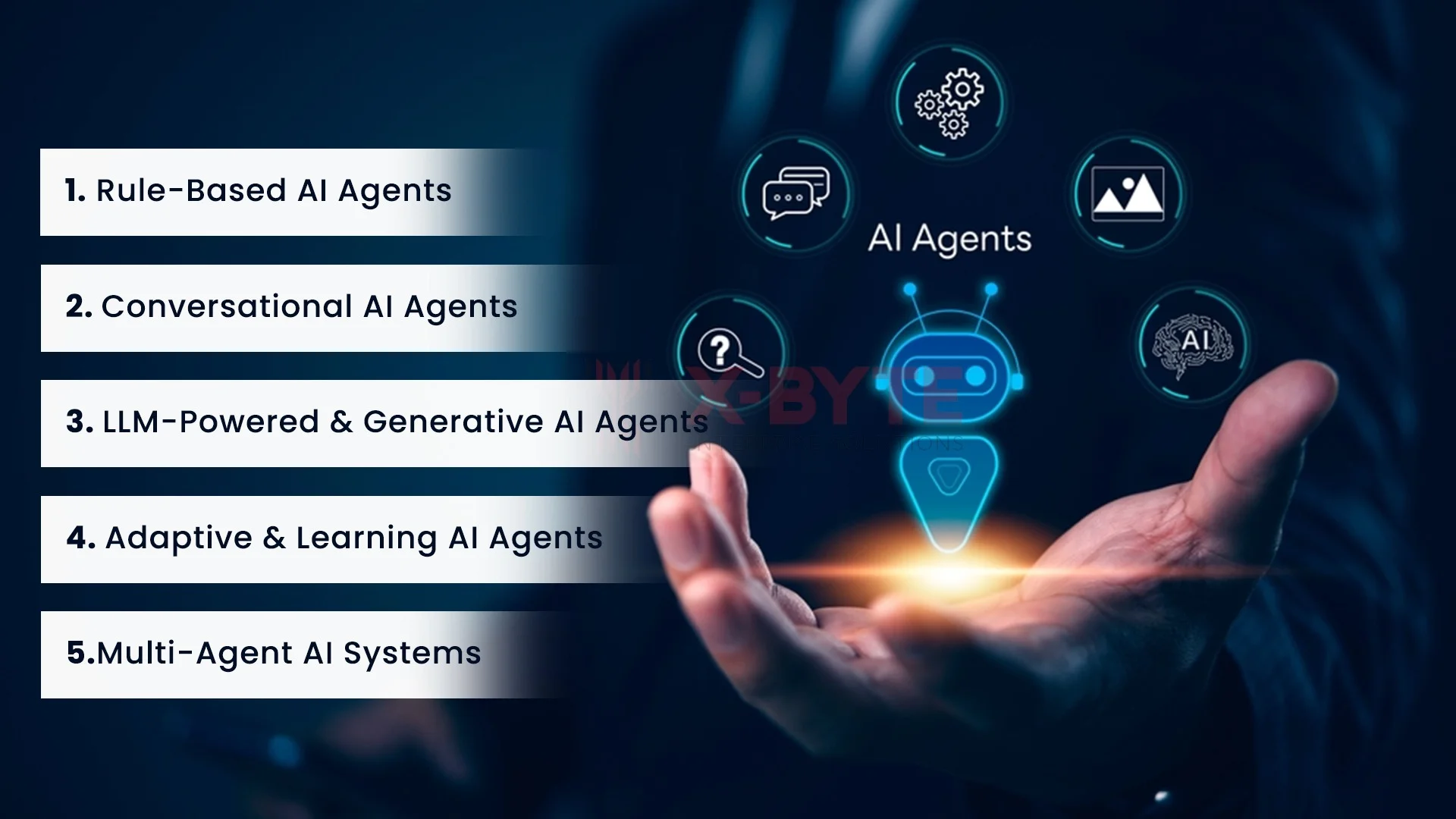
1. Rule-Based AI Agents
What they are: These agents follow predefined flows and logic. They don’t really reason or learn; they just execute if-then rules.
Where they’re used: Basic customer service bots, internal process automation, guided workflows.
Cost Range: ~$5,000 – $15,000
Cost impact:
- Lowest-cost tier. Simpler logic means fewer development hours.
- Little need for extensive data, APIs, or learning systems.
Why cost stays low: Minimal integration overhead and straightforward development, perfect when you don’t need advanced reasoning.
2. Conversational AI Agents
What they are: Agents that understand natural language and interact in human-like conversations.
Where they’re used: Customer support, FAQs, lead generation, internal help desks.
Cost Range: ~$20,000 – $150,000
Cost impact:
- Moderate cost tier – requires natural language processing (NLP), dialogue management, and UX design.
- The complexity of language flow and context handling raises costs compared to rule-based systems.
Why cost go up: They need smarter language models and more testing to make conversations feel natural.
3. LLM-Powered & Generative AI Agents
What they are: Agents driven by large language models (LLMs) like GPT, designed to generate original responses and content.
Where they’re used: Complex support, content creation assistance, adaptive automation.
Cost Range: ~$40,000 – $70,000
Cost impact:
- Mid-to-high cost tier – depends on model size, API usage, and specialized integration.
- Prompt engineering, safety layers, and monitoring add to the project scope.
Why cost goes up: You’re paying for compute, licensing, and specialist development to control and fine-tune generative behavior.
4. Adaptive & Learning AI Agents
What they are: Agents that improve over time by learning from data and feedback, often using reinforcement learning or custom models.
Where they’re used: Personalized recommendations, predictive workflows, adaptive user experiences.
Cost Range: ~$40,000 – $150,000+
Cost impact:
- High cost tier as it involves data pipelines, model training, evaluation cycles, and performance monitoring.
Why cost jumps: You need robust data infrastructure, ongoing model update pipelines, and subject-matter expertise.
5. Multi-Agent AI Systems
What they are: Groups of agents that collaborate, negotiate, and coordinate with each other to solve complex tasks.
Where they’re used: Enterprise automation orchestration, dynamic workflows, cross-system decision engines.
Cost Range: ~$100,000 – $250,000+
Cost impact:
- The highest cost tier is because its complexity grows exponentially as agents communicate, share information, and balance objectives.
- Requires advanced architecture, orchestration layer, and often custom tooling.
Why they’re most expensive: Each agent adds interactions, dependencies, and integration needs, plus you need infrastructure to manage them reliably.
AI Agent Development Cost in 2026
After surveying vendor guides, agency write-ups, and industry research, a practical planning range for AI agent projects in 2026 is:
- Prototype / Pilot (MVP): $5,000 – $20,000
- Basic production agent (support / simple automation): $15,000 – $50,000
- Mid-level/custom agent (personalization, CRM integration): $40,000 – $120,000
- Advanced / learning agent (training, data pipelines): $80,000 – $250,000
- Enterprise multi-agent / orchestration systems: $150,000 – $400,000+
In 2026, a practical planning range for AI agent development cost is generally $20,000 – $300,000+, with the variation driven by use case complexity, autonomy level, integrations, and compliance needs.
Key Factors That Affect AI Agent Development Cost
We have added the AI agent cost, but that’s the ballpark figures, and the number actually varies based on several factors.
When businesses ask about AI agent development cost, what they really want to know is why one AI agent costs $15,000 and another costs $150,000+. The difference comes down to a few very specific factors. Each one directly adds time, tooling, or ongoing expense, and that’s what shapes the final cost.
Let’s break it down in a way that actually makes sense.
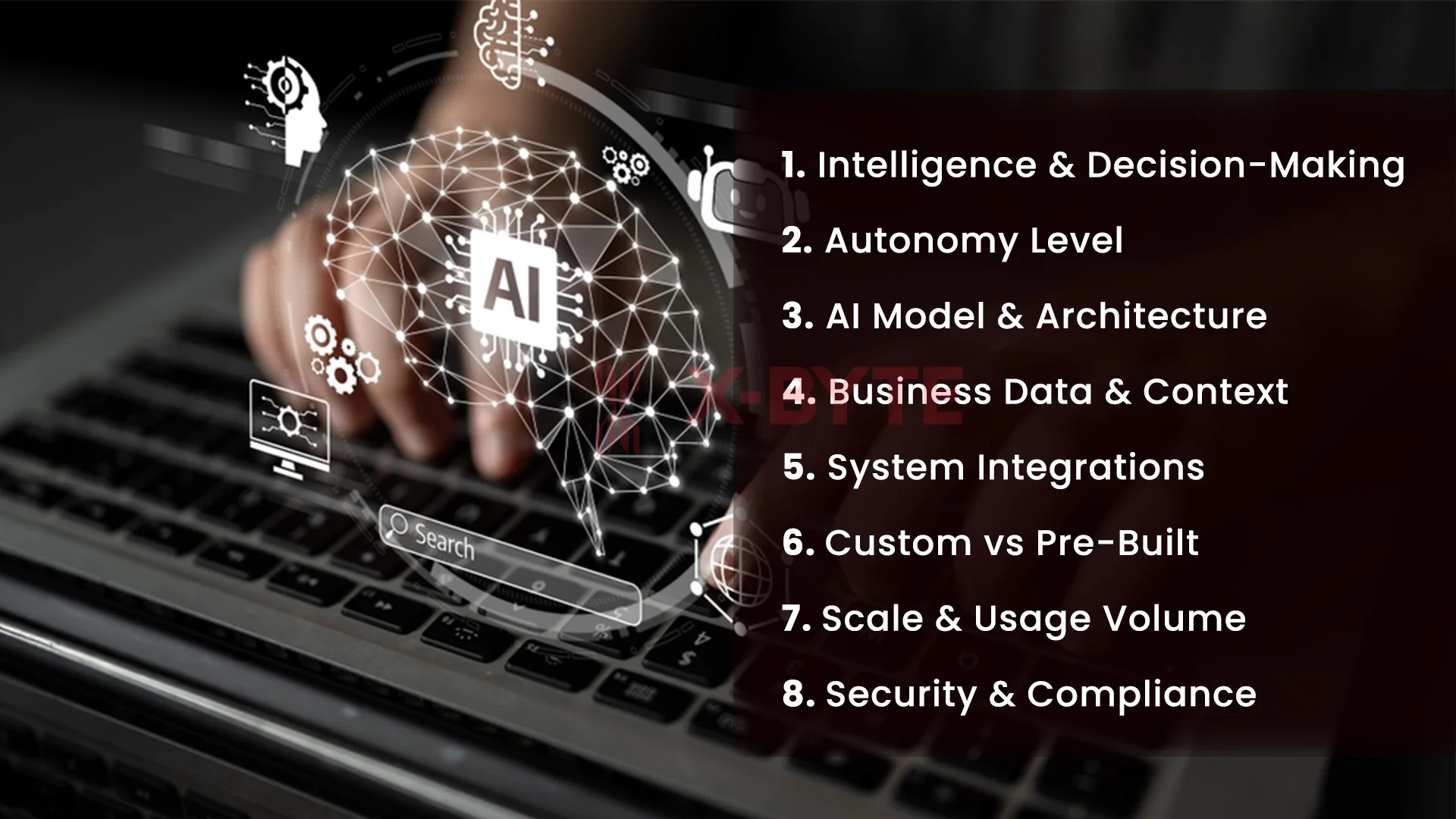
1. Agent Intelligence & Decision-Making Ability
This is the single biggest cost driver.
A basic agent that follows predefined flows is quick to build and relatively inexpensive. But as soon as you expect the agent to reason, handle ambiguity, or make decisions without human input, the cost increases. LLM-powered agents and generative AI agents require more engineering, extensive testing, and safety controls to avoid incorrect or risky actions.
How does this affect cost:
Higher intelligence = more development time, more testing, and higher usage costs for AI models. This alone can multiply the cost to build an AI agent for business several times.
2. Level of Autonomy (How Much Control the Agent Has)
Not all AI agents act independently. Some only assist; others execute tasks end-to-end.
An agent that suggests actions is cheaper than one that takes actions, such as updating systems, triggering workflows, or interacting with customers without approval. Fully autonomous agents need guardrails, fallback logic, and monitoring.
How this affects cost:
More autonomy means more failure scenarios to handle. That increases design complexity, QA effort, and long-term maintenance, raising the overall AI agent development cost breakdown.
3. Model Choice and AI Architecture
Using more powerful language models improves results, but it also raises costs.
High-end LLMs increase accuracy, but they also increase:
- API usage fees
- Infrastructure costs
- Optimization and monitoring effort
In ai in software development, choosing the right model is about balancing performance with long-term cost efficiency.
How this affects cost:
Better models = better outcomes, but higher ongoing operational expenses, especially at scale.
4. Business Data and Context
AI agents are only as good as the data they can access.
If your data is clean, structured, and accessible, development stays efficient. If data is scattered, outdated, or unstructured, engineers need to build pipelines, clean datasets, and create retrieval systems. Developing an agentic AI system without proper data planning is where costs spiral.
How this affects cost:
More data work = more engineering hours + higher long-term maintenance costs.
5. System Integrations
Most agents need to connect with CRMs, ERPs, dashboards, or internal tools.
Each integration requires API work, authentication, error handling, and testing. In agentic AI web development, integration complexity often costs more than the AI itself.
How this affects cost:
More integrations = more build time, more testing, and more points of failure to manage.
6. Custom Build vs Pre-Built Frameworks
Pre-built frameworks can reduce upfront cost but limit flexibility.
When businesses choose custom AI agent development, they pay more initially, but gain control over logic, behavior, and scalability. This is often necessary for businesses with unique workflows.
How this affects cost:
Customization increases development time but reduces long-term compromises and rework.
7. Scale and Usage Volume
An internal agent used by 10 people is very different from a public-facing agent used by thousands.
Higher usage drives:
- Increased model inference costs
- Stronger infrastructure needs
- Continuous performance monitoring
How this affects cost:
Scale directly increases both development and ongoing operational expenses.
8. Security, Compliance & Guardrails
Security is not an add-on in AI agent development; it’s a core requirement.
- If an agent only provides information, security needs are lighter.
- But when it can read customer data, update systems, or trigger workflows, you need strict guardrails: access controls, permission checks, audit logs, and limits on what the agent can do.
How this affects cost:
Implementing security and compliance adds design time, engineering effort, and extensive testing. The more powerful the agent, the more expensive these safeguards become, but skipping them leads to far higher costs later.
Bonus Point: Your AI Agent Development Partner.
Another leading factor that could impact the total AI agent development cost is the expertise and location of your development partner. Their technical depth, delivery process, tooling, ability to design scalable architectures, and approach to testing and deployment all affect timelines and cost predictability.
Choosing the right AI agent development company helps avoid delays, rework, and scaling issues, making the investment more predictable and cost-effective over time.
AI Agent Cost by Business Use Case
1. Customer Support AI Agent
This type of AI agent handles FAQs, order-related queries, basic troubleshooting, and routes complex issues to human agents when needed. It’s usually the first AI agent businesses build because it delivers quick value without heavy risk.
Typical cost: $15,000 – $50,000, depending on integrations with helpdesk tools and daily query volume.
2. Sales & Lead Qualification AI Agent
Sales agents engage website visitors, answer product-related questions, qualify leads based on predefined criteria, and book demos or sales calls. Since they directly influence revenue, accuracy and personalization matter more here.
Typical cost: $25,000 – $70,000. Pricing increases with CRM integrations, multi-channel support, and real-time personalization.
3. Internal Operations & Data Intelligence AI Agent
This category combines internal automation and data-driven decision support. These agents automate reports, approvals, and internal requests, and also analyze business data to generate insights, summaries, and recommendations for teams.
Typical cost: $40,000 – $120,000, driven by the number of internal tools, data sources, security requirements, and accuracy expectations.
4. Marketing & Content AI Agent
Marketing agents help create content, personalize campaigns, assist with SEO tasks, and support messaging across channels. They’re easier to deploy but still need strong brand controls.
Typical cost: $20,000 – $60,000, depending on content volume, formats, and approval workflows.
5. Autonomous or Multi-Agent AI System
These are advanced AI systems where multiple agents work together to plan, coordinate, and execute complex workflows with minimal human input. They’re used for cross-team automation, dynamic decision-making, and large-scale operational efficiency.
Typical cost: $80,000 – $250,000+, reflecting the added complexity of agent orchestration, continuous monitoring, fail-safes, and production-grade reliability.
Build In-House vs Hire an AI Agent Development Company
Building in-house gives you control, but it also requires deep expertise in LLM-powered agents, agentic AI web development, data pipelines, security, and ongoing maintenance. On the other hand, hiring an experienced provider offering AI agent development services or agentic AI development services can speed up delivery and reduce risk.
Below is a clear comparison to decide which approach fits your goals, budget, and internal capabilities.
| Criteria | Build an In-House AI Agent | Hire an AI Agent Development Company |
| Upfront AI Agent Development Cost | High initial cost due to hiring, training, and tooling | Lower upfront investment with predictable pricing |
| Time to Market | Slower as teams need time to learn and experiment | Faster due to ready frameworks and proven delivery models |
| Expertise Required | Requires in-house experts in LLMs, agent frameworks, data, and security | Access to specialists experienced in agentic AI development |
| Scalability | Difficult early on; requires architectural experience | Designed for scale from day one |
| Technology Stack | Team must evaluate and manage AI agent development tools internally | Pre-tested tech stack optimized for performance and cost |
| Risk of Rework | Higher, as a trial-and-error approach is common | Lower due to prior production experience |
| Security & Compliance | Needs dedicated effort and internal policies | Built-in best practices for enterprise-grade security |
| Maintenance & Optimization | Ongoing internal burden | Often included as part of AI agent development services |
| Long-Term Cost Efficiency | Can be expensive if mistakes or rebuilds occur | More cost-effective over time due to fewer failures |
| Best For | Large enterprises with mature AI teams | Startups, SMBs, and enterprises seeking faster ROI |
The Final Takeaway!
- Build in-house, if you already have strong AI talent, long timelines, and a long-term research focus.
- Hire an AI agent development company, if you want faster delivery, a controlled AI agent development cost breakdown, and production-ready AI agent development solutions without unnecessary risk.
How to Reduce AI Agent Development Cost Without Compromising Quality?
- Start with a focused use case: Build the agent for one high-impact task instead of trying to automate everything at once. This keeps the initial AI agent development cost under control.
- Avoid overbuilding early: Skip complex autonomy or multi-agent setups unless they’re truly required. Simple, well-designed agents often deliver better ROI than over-engineered ones.
- Choose the right AI model, not the most expensive one: High-end LLMs aren’t always necessary. Using the right model for the task can significantly reduce ongoing usage costs without hurting performance.
- Reuse proven agent frameworks and tools: Leveraging existing AI agent development tools and frameworks reduces custom engineering time while maintaining reliability.
- Limit integrations in phase one: Each system integration adds cost. Start with essential tools only, then expand once the agent proves value.
- Design with scalability in mind from day one: A clean architecture prevents expensive rewrites when usage grows.
- Add security and guardrails early: Fixing security issues later is far more expensive than building them in from the start.
- Use human-in-the-loop where needed: Let humans approve high-risk actions instead of building full autonomy immediately.
- Monitor and optimize continuously: Tracking usage and performance helps reduce unnecessary model calls and infrastructure spend.
- Work with an experienced AI agent development partner: The right partner offering AI development services helps avoid rework, failed pilots, and long-term cost overruns, while still delivering high-quality, scalable solutions.
Conclusion
At the end, AI agent development cost isn’t about chasing the most advanced setup; it’s about choosing the right use case, the right level of intelligence, and a tech stack that actually fits your business.
At X-Byte Solutions, we see AI agents as long-term enablers, not quick experiments. Our approach at our AI agent development company is to keep things practical, starting with what delivers value today, and building in a way that’s easy to scale tomorrow.
When AI agents are planned thoughtfully, they become part of everyday workflows and quietly drive better outcomes over time.
If you’re exploring AI agents and want clarity on what makes sense for your business, how much it actually costs, and other things around, then book a free consultation with our X-Byte team.