Introduction: Why AI Development in 2025 Matters
Artificial Intelligence has moved far beyond the experimental stage. In 2025, it has become the backbone of modern business strategies, from streamlining operations to building intelligent digital products. Whether it’s AI software development, AI-powered mobile and web apps, or enterprise-grade systems built on Advanced RAG (Retrieval-Augmented Generation), organizations across the US, UK, and Middle East are embracing AI at scale.
This guide is designed to be your pillar resource on the AI development process—a step-by-step roadmap covering costs, technology stacks, security, compliance, architecture patterns, and real-world case studies.
If you’re exploring AI to accelerate growth, reduce costs, or create new revenue streams, this guide will show you how to plan, implement, and scale AI effectively with the support of the right Enterprise AI Development company.

Kickstart Your AI Journey Today
Discover proven strategies and real-world use cases in our ultimate AI development guide — start building smarter solutions for 2025 and beyond.
1. Evolution of AI Development in 2025
AI development has grown steadily more sophisticated over the past ten years. What started as isolated machine learning models has evolved into end-to-end AI development services where advanced components work together seamlessly.
Key Trends Shaping AI in 2025
- LLMs (Large Language Models): Driving conversational AI, document analysis, and content creation.
- Advanced RAG Architectures: Allowing AI to access dynamic, real-time data instead of relying only on pre-training.
- AI Agent Development: Agents that can reason, plan, and take autonomous actions in enterprise workflows.
- AI in Computer Vision: From smart surveillance to medical imaging, CV is becoming mainstream.
Classic Machine Learning: Predictive models for fraud detection, inventory forecasting, and process optimization.
2. Understanding the AI Development Process
The AI development process is structured yet flexible. A successful project requires not only coding expertise but also business alignment, robust data pipelines, and ongoing evaluation.
Core Phases of AI Development
- Problem Definition & Feasibility Study
- Start by outlining the problem and assessing if AI offers the right approach.
- Example: Predicting customer churn vs. optimizing pricing models.
- Start by outlining the problem and assessing if AI offers the right approach.
- Data Collection & Preparation
- Secure, clean, and label high-quality data.
- Middle East projects often face challenges due to fragmented data systems; solutions require stronger governance.
- Secure, clean, and label high-quality data.
- Model Selection & Development
- Choose between RAG, fine-tuning, or custom AI agent development based on business needs.
- Example: RAG is ideal for knowledge retrieval; fine-tuning works well for domain-specific applications.
- Choose between RAG, fine-tuning, or custom AI agent development based on business needs.
- MVP (Minimum Viable Product) Development
- Build a proof of concept, test with stakeholders, and iterate.
- Use lightweight AI-powered mobile/web apps for validation before scaling.
- Build a proof of concept, test with stakeholders, and iterate.
- Deployment & MLOps
- Move to production with strong CI/CD pipelines.
- Implement monitoring, guardrails, and evaluation frameworks for bias, drift, and accuracy.
- Move to production with strong CI/CD pipelines.
- Scaling & Continuous Improvement
- Integrate feedback loops, expand datasets, and align the AI roadmap with long-term enterprise goals.
Unlock the Future of AI Development
Get expert insights into processes, best practices, and use cases to accelerate your business transformation with AI in 2025.
3. RAG vs Fine-Tuning: Which to Choose?
Choosing between RAG (Retrieval Augmented Generation) and fine-tuning is a major decision in AI projects. Many competitor blogs gloss over this—but it’s critical for ROI.
When to Use RAG Technique
- Need real-time access to updated knowledge.
- Cost-efficient since the base LLM doesn’t require retraining.
- Ideal for customer support systems, enterprise knowledge bases, and compliance checks.
When to Use Fine-Tuning
- When domain-specific language or tasks are repetitive.
- Better suited for medical, legal, or highly specialized industries.
- More resource-intensive but improves precision.
Hybrid Approach
Many Enterprise AI Development companies in 2025 combine RAG + fine-tuning for maximum accuracy and efficiency.
4. Cost Modeling & ROI in AI Development
One of the most common questions enterprises ask is: “How much does AI development cost?” Factors such as scale, technical difficulty, region, and implementation approach determine the outcome.
Typical Cost Ranges in 2025
- US:
- Proof of Concept (PoC): $30,000–$80,000
- MVP: $100,000–$250,000
- Enterprise Deployment: $500,000+
- Proof of Concept (PoC): $30,000–$80,000
- UK:
- PoC: £20,000–£60,000
- MVP: £80,000–£180,000
- Full Production: £400,000+
- PoC: £20,000–£60,000
- Middle East (UAE, KSA):
- PoC: AED 100,000–250,000
- MVP: AED 300,000–700,000
- Large-Scale Enterprise: AED 1M+
- PoC: AED 100,000–250,000
Costs cover data engineering, AI software development, MLOps setup, and deployment. Cloud expenses and compliance audits may increase budgets further.
Factors Influencing AI Development Costs
- Complexity of AI use cases (basic chatbot vs. AI agent development).
- Data availability & quality— cleaning fragmented datasets takes time.
- Infrastructure choices (cloud GPUs, vector DBs, security guardrails).
- Team composition— engineers, data scientists, QA, compliance experts.
- Regulatory overhead (especially in healthcare, finance, or government).
ROI Considerations
- Operational Efficiency Gains: Automating repetitive tasks can reduce costs by 30–50%.
- Revenue Growth: AI-powered mobile & web apps unlock new markets and services.
- Risk Reduction: AI in fraud detection or diagnostics reduces compliance penalties.
💡 Pro Tip: Always run a cost vs. benefit analysis before scaling. Embedding a simple ROI calculator (input: scope, timeline, team size → output: expected savings) helps decision-makers justify investment.
5. Architecture Patterns in AI Development
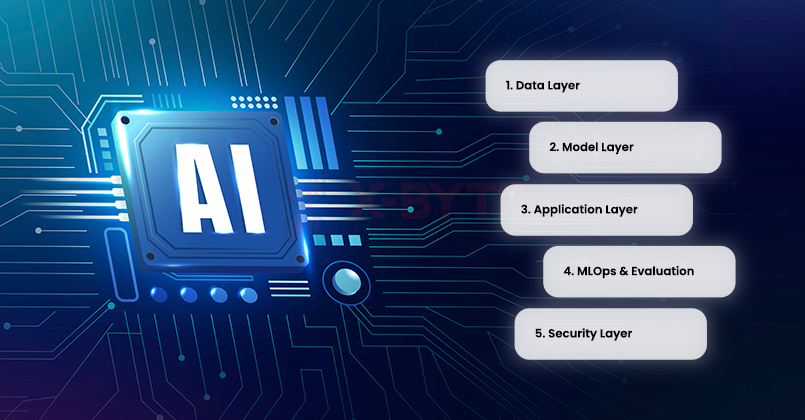
AI success in 2025 is not only about models—it’s about system architecture. Enterprises demand scalable, secure, and auditable frameworks.
Key AI Architecture Components
- Data Layer
- Data lakes & warehouses.
- Governance pipelines for PII handling.
- Data lakes & warehouses.
- Model Layer
- Pre-trained LLMs (GPT, LLaMA, Falcon, Mistral).
- Fine-tuned domain models.
- Advanced RAG pipelines with vector databases (Pinecone, Weaviate, Milvus).
- Pre-trained LLMs (GPT, LLaMA, Falcon, Mistral).
- Application Layer
- APIs for integration into enterprise systems.
- AI-powered mobile & web apps for customer-facing interactions.
- Agent orchestration (LangChain, Semantic Kernel).
- APIs for integration into enterprise systems.
- MLOps & Evaluation Layer
- Continuous monitoring for drift and bias.
- Guardrails for hallucination control.
- Evaluation frameworks to measure accuracy, fairness, and latency.
- Continuous monitoring for drift and bias.
- Security Layer
- Encryption, role-based access, audit logs.
- Compliance with the ISO/IEC 42001 standard for AI management, established in 2024.
- Encryption, role-based access, audit logs.
Example Blueprint: AI Agent Development
- Input: Structured + unstructured enterprise data.
- Process: Retrieval → Context → Action planning via agent framework.
- Output: Autonomous decision-making with human-in-the-loop oversight.
6. Security, Compliance & Trust
As enterprises scale AI, security and compliance have become board-level concerns in 2025.
Top Security Challenges
- Data Privacy & PII Protection
- Health, finance, and government data require anonymization and strong governance.
- Compliance frameworks: GDPR (UK/EU), DIFC DP Law (UAE), CCPA (US).
- Health, finance, and government data require anonymization and strong governance.
- Model Risk & Bias
- AI decisions must be explainable and auditable.
- Introduce model risk management frameworks to prevent unfair or harmful outputs.
- AI decisions must be explainable and auditable.
- Adversarial Threats
- Prompt injection attacks targeting LLMs.
- Poisoned training data used for malicious influence.
- Prompt injection attacks targeting LLMs.
Compliance in 2025
- Globally, the EU AI Act is recognized as a standard for ensuring AI systems are safe and transparent.
- ISO/IEC 42001 AI management system standard adopted by enterprises worldwide.
- Industry-specific standards: HIPAA (health), PCI DSS (finance).
Best Practices for Secure AI Development
- Adopt “privacy by design” in every AI development process.
- Implement human-in-the-loop review for high-stakes outputs.
Conduct regular audits and model evaluations.
7. Data Strategy & Governance
No AI system is better than the data it’s trained on. Enterprises that neglect data readiness often see AI initiatives fail.
Challenges in Data Management
- Fragmented sources (legacy ERPs, CRMs, IoT devices).
- Low data quality—inconsistencies, missing values, bias.
- Unstructured data growth—emails, chats, PDFs, sensor feeds.
Key Steps for Strong Data Governance
- Data Discovery & Inventory
- Audit all enterprise data assets.
- Prioritize datasets that align with AI use cases.
- Audit all enterprise data assets.
- Data Cleansing & Labeling
- Invest in Data QA analysts for annotation and error detection.
- Use AI-powered data preparation tools for scalability.
- Invest in Data QA analysts for annotation and error detection.
- Bias Detection & Fairness
- Test datasets for demographic imbalances.
- Introduce synthetic data augmentation to balance samples.
- Test datasets for demographic imbalances.
- Secure Data Pipelines
- End-to-end encryption in data movement.
- Mask or anonymize sensitive records.
- End-to-end encryption in data movement.
8. Real-World Case Snapshots (US, UK, UAE)
Case studies help enterprises see how AI development services translate into real results.
United States – AI in Healthcare Diagnostics
- Problem: Early disease detection was manual and error-prone.
- Solution: An AI software development team built a diagnostic system using computer vision + fine-tuned LLMs.
- Result: Diagnostic errors dropped by 25%, lowering the number of disputed insurance claims.
United Kingdom – AI-Powered Customer Service Agents
- Problem: A retail bank struggled with call center backlogs.
- Solution: Deployed AI agent development with RAG integration to retrieve answers from internal policies.
- Outcome: Cut wait times by 40%, saving £2M annually.
United Arab Emirates – Smart Infrastructure Management
- Problem: City planners needed real-time monitoring of traffic and utilities.
- Solution: Partnered with an Enterprise AI Development company to deploy IoT + AI-powered mobile and web apps.
Outcome: Improved resource allocation, saving AED 50M in operational costs.
9. Best Practices & Operational Readiness
Building AI is only half the battle. Scaling it across the enterprise requires operational excellence.
Best Practices for 2025
- Start with Clear Use Cases
- Don’t “do AI for AI’s sake.” Tie each initiative to KPIs.
- Don’t “do AI for AI’s sake.” Tie each initiative to KPIs.
- Choose the Right Delivery Model
- PoC → MVP → Production ensures agility without wasted spend.
- PoC → MVP → Production ensures agility without wasted spend.
- Adopt Human-in-the-Loop
- Keep humans involved in decisions—especially in healthcare, finance, and government.
- Keep humans involved in decisions—especially in healthcare, finance, and government.
- Measure Continuously
- Use evaluation frameworks to monitor model accuracy, fairness, and ROI.
- Use evaluation frameworks to monitor model accuracy, fairness, and ROI.
- Plan for Change Management
- Train teams to work with AI systems.
- Assign AI “champions” in each department.
- Train teams to work with AI systems.
- Design for Scale
- Build modular architectures with MLOps pipelines for continuous iteration.
10. Tools, Frameworks & Open-Source Levers
AI development in 2025 thrives on open-source innovation. Here are the most widely used frameworks and tools.
Development Frameworks
- TensorFlow & PyTorch: Core ML libraries for model training.
- LangChain & Semantic Kernel: Orchestration of AI agents.
- Hugging Face Transformers: Pre-trained LLMs with community support.
Vector Databases for RAG
- Pinecone, Weaviate, Milvus: Power semantic search and context retrieval.
MLOps & Deployment
- Kubeflow, MLflow, Airflow: Automate pipelines and monitoring.
- Weights & Biases: Model evaluation and experiment tracking.
Compliance & Security
- Great Expectations: Data quality validation.
AI Fairness 360 (IBM): Bias detection and mitigation toolkit
Conclusion: Your Roadmap to Smarter AI Development
AI in 2025 is no longer a futuristic experiment—it’s an enterprise necessity. From AI-powered mobile and web apps to advanced RAG systems and AI agent development, organizations that adopt structured AI strategies gain a competitive advantage.
By following a proven AI development process, addressing compliance, and focusing on ROI, you can ensure your investment delivers measurable results.
Partnering with an experienced Enterprise AI Development company is the fastest way to navigate complexity, avoid risks, and scale AI solutions that truly transform business operations.