
Quick Summary:
Innovations like AI-first mobile apps redefine how people are interacting with technology nowadays. This blog shall explore the foundations of AI App Development. It will highlight real-world AI use cases in mobile apps. It will also reveal why smart automation, predictive analytics, and personalization are becoming the standard practice. We will also gather key takeaways on planning, ethical adoption, and strategies for long-term competitiveness. The companies can now future-proof their mobile solutions and enrich the experiences using AI in mobile app initiatives. This truly resonates with users in an evolving digital world.
Why is the AI-First Approach Crucial?
Making AI the core of mobile development implies that apps will become learning, adjusting, and self-improving applications. Rather than the fixed workflows, these applications are contextual and predictive.
Why It Matters:
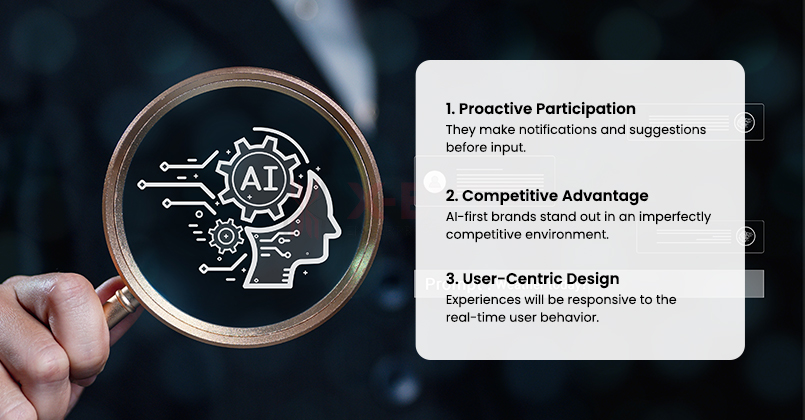
- Proactive Participation: They make notifications and suggestions before input.
- Competitive Advantage: AI-first brands stand out in an imperfectly competitive environment.
- User-Centric Design: Experiences will be responsive to the real-time user behavior.
Key Takeaways
- Modern-day apps deliver personalized experiences, instead of standardised features.
- AI-first thinking leads to deeper engagement and loyalty.
- Developers benefit from scalable frameworks that keep evolving with data.
Businesses aren’t just following a trend by moving to an AI-first model. They are also redefining the foundation of interaction. This transition transforms the functionality of apps into interactive digital assistants. Companies that fail to adopt AI-first on-demand mobile development risk being left behind as user behavioral patterns continue to grow at an ever-faster pace.
Core AI Use Cases in Mobile
The potential of AI in mobile app development lies in its ability to bring intelligence to daily usage. AI is transforming app customer interactions to a greater degree in terms of personalization and security.
Prominent AI Use Cases
- Personalization Engines: Tailored content, layouts, and offers based on how the user behaves. This establishes a continuous feeling of relevance.
- Voice and NLP Interfaces: Voice commands and conversational assistants make the driving process intuitive and accessible because it is hands-free.
- Visual Intelligence: AI can be used to add recognition capabilities to photos and AR experiences, as well as biometric security.
- Predictive Analytics: Applications predict the user’s required activities and execute them in advance of the user’s request.
- Fraud Detection: The constant watch prevents fraud and gives confidence in such sensitive programs as banking and healthcare.
Why Businesses Care
- Delivers more innovative automation that reduces user effort
- Improves security, de-emphasizes complexity
- Offers a distinction in markets with copycat apps
Mobile AI app development evolves from tools into intelligent assistants. They enable users to accomplish objectives more smoothly and securely than before.
AI Features in Mobile Applications
Being able to see AI directly translating to the improved user experience can be used to prioritise development efforts. The table below summarises essential characteristics for AI in mobile apps and the value they offer:
AI Feature | User Benefit |
Personalized Content | Higher engagement, tailored recommendations |
Voice/NLP Interfaces | Conversational experience, better accessibility |
Visual Intelligence (AR/ID) | Immersive experiences, secure login |
Predictive Analytics | Proactive support, intelligent alerts |
Fraud Detection | Safer transactions, improved trust |
Sentiment Analysis | Apps detect mood for context-aware responses |
Intelligent Search | More accurate, faster, and context-driven results |
Recommendation Systems | Smarter product, video, or service suggestions |
Context-Aware Assistance | Real-time adaptation to location and activity |
Automation & Task Scheduling | Streamlined workflows, reduced manual effort |
Insights
- Personalization drives ongoing engagement by keeping experiences relevant.
- Voice/NLP improves accessibility, ensuring inclusivity.
- Security-first AI helps businesses meet compliance and user trust goals.
This table demonstrates that every AI capability ties directly to a practical user advantage. Businesses that align features with user benefits create stronger adoption and lasting retention. It’s not about putting AI as a cool factor; it’s about real functionality.
Pro Tip: Businesses investing in mobile app development services can leverage this feature-benefit lens to prioritize their AI roadmap.
Challenges of Implementing AI-First Mobile Apps
Although AI brings obvious benefits, implementation is not without planning. Business culture involves both technical and organizational obstacles in becoming successful.
- Data Quality: AI is worthless unless actionable intelligence can be gleaned using clean, structured, and non-biased data.
- Resource Management: The expertise of teams and their infrastructure are the key components to scalability over the long run.
- Integration Barriers: There could be a problem with the seamless integration of AI by legacy systems.
- User Acceptance: Believability and openness need to be taken into consideration to avoid resistance.
A proactive approach to these hurdles ensures smoother AI-first adoption.
Strategic Framework for Building AI-First Mobile Apps!
Designing AI-first mobile apps requires both strategy and discipline. Developers must align goals, technology, and ethics for sustainable success. Let’s understand the five essential framework steps:
1. Define AI Use Cases
Begin by determining where AI can have tangible, measurable benefits to your mobile app.
- Concentrate on the personalization, predictive analytics, and automation.
- Align with the user needs and business objectives.
- Focus on areas that yield significant returns and short-term ROI.
- Avoid over-engineering your AI with unnecessary capabilities.
2. Select the Right Architecture
Select AI-based app personalization models that can help to separate performance, scalability, and privacy.
- On-device AI guarantees speed and offline use.
- Cloud AI is offering enhanced processing and growth.
- Hybrid models provide a middle ground between speed and the security of data.
- Consider efficiencies in the cost of mobile app development for long-term sustainability.
3. Seamless System Integration
AI must connect smoothly with backend services and existing workflows.
- Sync AI with databases, APIs, and analytics tools.
- Enable compatibility with AI-based mobile applications pipelines.
- Ensure minimal latency in real-time processing.
- Offer continuous facilities of maintenance and updates.
4. Ethical and Transparent AI Design
Responsible AI ensures user trust and compliance at the starting point.
- Prevent bias by using a variety of training data
- Make the decision-making of Communicate AI clear to users.
- Focus on user privacy and streamline around regulation.
- Implement transparent and accountable systems that are easily explained.
5. Continuous Learning & Optimization
AI-first apps require constant implementation using feedback, data, and usage trends.
- Provide adaptive improvement through feedback loops.
- Monitor the use of apps with AI-enabled analytics.
- Keep the models updated and upgraded.
- Experiment with new AI in controlled rollouts.
Key Outcomes
- User Trust: Transparent design improves adoption rates.
- Performance Gains: On-device models improve speed while protecting privacy.
- Scalability: AI-driven frameworks adapt as usage expands.
Companies extend beyond the experimental realm of AI with such strategies. When creating applications, they do so in a way that makes them reliable in performance, scalable in terms of growth, and ethical. It is a holistic approach that makes the AI-first apps not only innovative but also sustainable.

Smart, scalable, and trained to drive honest customer conversations from day one.
Future Trends & Long-Tail Perspectives
AI-first apps are evolving quickly. Understanding trends helps developers stay ahead.
The Future of Mobile App Development with AI
Edge AI shall make devices more innovative, delivering faster responses. Apps will adjust in real time to the environment, activity, or biometrics.
How AI Enhances Mobile Apps?
- AI anticipates needs by learning user patterns.
- Proactive prompts save time and create seamless routines.
AI Transforming the Software Industry
- Software design is increasingly AI-driven from the ground up.
- Custom on-demand app development will embed AI-first logic at every stage of innovation.
What does this mean for Businesses?
- Be in a position to keep pace because you adapted early
- Instead of adding a new feature, leverage AI as the foundation of your digital strategy.
- Organize development teams around thinking AI-first mobile apps.
Ultimately, all these trends lead in one direction, in that apps will cease to be inert and become active companions. Companies that take advantage of this transition will lock in the mobile future of their communities and will see their users highly engaged.
Leverage custom NLP and ML to automate your customer experience at scale.
Conclusion!
Embracing AI-first mobile apps is no longer optional as AI reshapes mobile interaction. Incorporating it in businesses is crucial. By incorporating AI app development in mobile strategies, businesses can create truly resonating experiences. It involves personalizability, forecasting, and chatbots. AI-first companies achieve loyalty, efficiency, and growth.
Smart apps are the future of businesses; hence, this principle becomes imperative when exploring mobile app development services. It is also essential when planning for a custom on-demand app development or evaluating the cost of mobile app development. Contact X-Byte Enterprise Solutions to start building with AI today to stay ahead of tomorrow.