
Key Highlights:
- Scheduling inefficiencies and no-shows cost the U.S. healthcare system over $150 billion every year, and nearly 8 in 10 dissatisfied patients point to wait times as their top frustration.
- AI doesn’t just fill slots; it connects appointment histories, cancellation patterns, provider availability, and patient behavior to make scheduling smarter, faster, and more predictable.
- From online self-booking and smart slot matching to automated reminders, real-time adjustments, and post-visit follow-ups, AI removes the friction at every touchpoint without adding work to your team’s plate.
- AI scheduling works alongside your existing EHR systems, not against them. With the right partner, the transition is far less disruptive than most healthcare leaders anticipate, and the ROI shows up faster than expected.
Introduction
Somewhere between the phone ringing at the front desk and a patient finally sitting in the exam room, a lot can go wrong.
Phone tag. Long hold times. Double bookings. A no-show at 10 am leaves a provider idle for an hour with no way to fill the slot in time. These aren’t rare occurrences; they’re daily realities for most healthcare facilities. And they’re quietly draining revenue, burning out staff, and pushing patients toward competitors who make it easier.
Nearly 8 in 10 patients who reported being unhappy with their provider experience pointed to appointment wait times as the top reason, and 61% said they’d consider switching to a provider that offers digital scheduling. According to MGMA, no-shows and scheduling inefficiencies cost the U.S. healthcare system over$150 billion each year, with providers losing around $200 for every empty slot.
The good news? These aren’t problems you just have to live with anymore.
AI is already helping healthcare facilities cut wait times, reduce no-shows, and automate the scheduling workflows that eat up hours of staff time every single day, and the results are measurable. We’re talking 20-30% reductions in no-show rates, faster appointment turnaround, and front-desk teams finally free to focus on patients instead of phone queues.
This post breaks down exactly how it works, what real implementation looks like, and how to evaluate whether it’s the right move for your facility.
What Are the Challenges in Healthcare Scheduling and Patient Wait Times?
If you’ve ever watched a front-desk staff member juggle three phone calls, a walk-in, and a rescheduling request all at once, you already know the answer.
But let’s name the specific problems, because they’re worth calling out clearly.
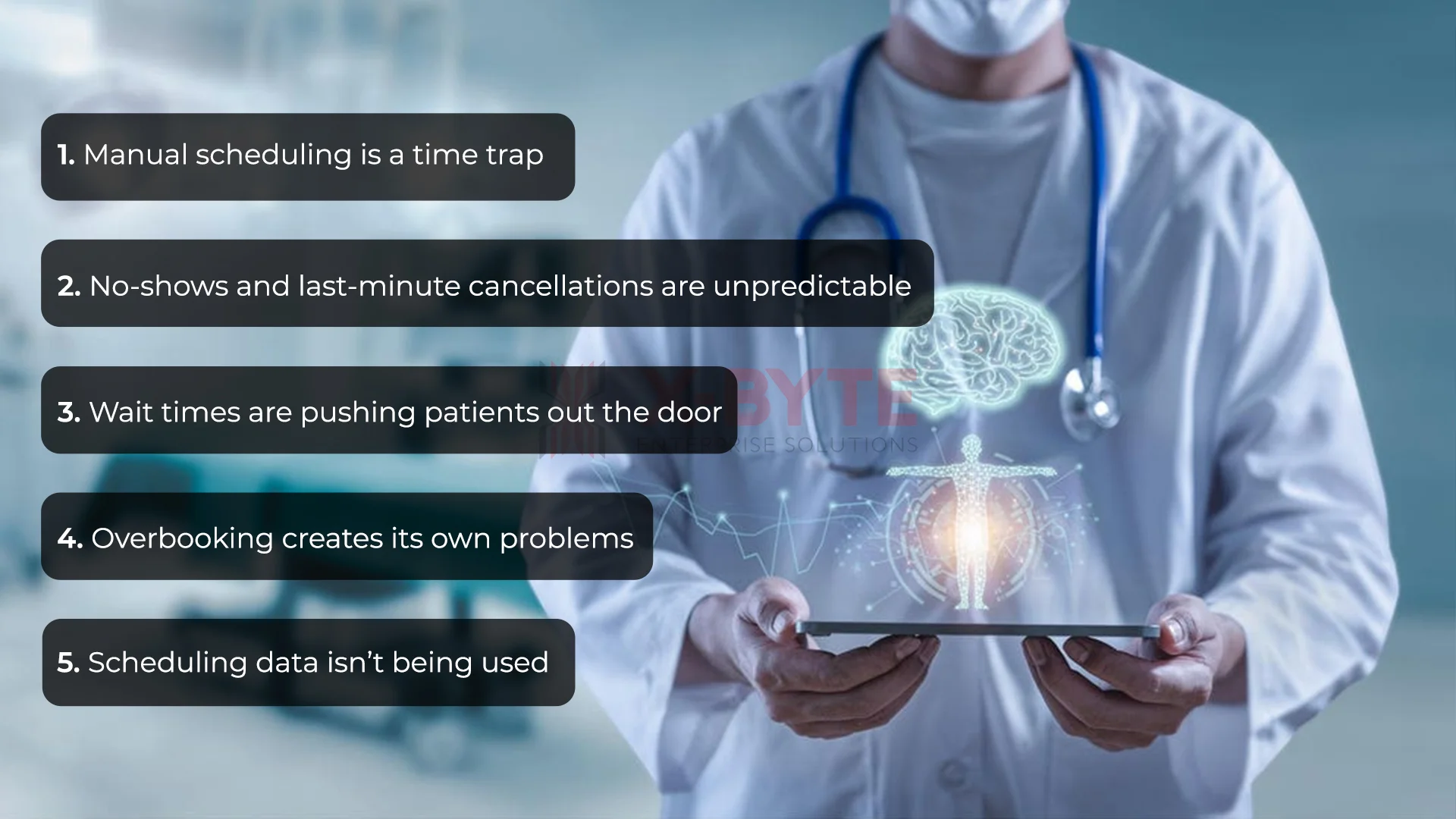
- Manual scheduling is a time trap: Most facilities still rely on phone calls, spreadsheets, or outdated EHR scheduling modules that require staff to do the heavy lifting. Every booking, cancellation, and reschedule is a manual touchpoint, and it adds up fast. The time your team spends on scheduling is time they’re not spending on patients.
- No-shows and last-minute cancellations are unpredictable: One no-show at the wrong time can throw off an entire day’s schedule. Without a way to predict who’s likely to cancel or automatically fill vacant slots, that time is simply lost, and lost time in healthcare is lost revenue.
- Wait times are pushing patients out the door: Patients today have options. If they wait too long for an appointment or sit in your waiting room longer than expected, they’ll find somewhere easier.
- Overbooking creates its own problems: Trying to compensate for no-shows by overbooking puts pressure on providers, frustrates patients who show up on time, and burns out staff trying to manage the fallout.
- Scheduling data isn’t being used: Most facilities are sitting on months, even years, of appointment data and doing nothing with it. Peak hours, high no-show patient profiles, seasonal demand spikes, all of it could inform smarter scheduling decisions, but only if someone’s actually analyzing it.
The good news is that every single one of these challenges has a direct AI solution, and that’s exactly what we’ll get into next.
The Role of AI in Healthcare Operations: An Overview
AI in healthcare gets a lot of hype. But when you strip away the buzzwords, what it actually does in an operational context is pretty simple: it takes the repetitive, data-heavy tasks that slow your team down and handles them faster and more accurately than any manual process can, be it patient scheduling, reducing no shows, managing other things around it, etc.
Let’s understand the how?
Your facility already generates enormous amounts of data every single day. Appointment histories, cancellation patterns, patient demographics, provider availability, peak hours. The problem is that most of it just sits there, unanalyzed and unused.
AI changes that. It connects all of this data, finds patterns within it, and uses those patterns to make your scheduling and patient flow smarter automatically, and in real time.
And it doesn’t require replacing your existing systems. It works alongside your current EHR and practice management setup, making what you already have significantly more powerful.

How AI Can Automate Patient Scheduling?
To understand what AI actually changes, here’s what a typical scheduling journey looks like when AI in healthcare operations is running in the background.
Step 1: Patient Requests an Appointment. Instead of calling the front desk and waiting on hold, the patient books online, anytime, from any device. The AI healthcare scheduling software instantly checks provider availability, appointment type requirements, and patient history to surface the most suitable slots. No back and forth. No hold music.
Step 2: Smart Slot Matching: AI doesn’t just find an open slot; it finds the right slot. It factors in appointment duration, provider specialization, patient preferences, and existing schedule density to ensure the automated patient scheduling makes sense operationally, not just on paper.
Step 3: Automated Confirmation and Reminders: Once booked, the system automatically sends a confirmation. As the appointment approaches, it sends reminders through the patient’s preferred channel, text, email, or app notification. For patients flagged as high no-show risk, it increases outreach frequency without anyone on your team lifting a finger.
Step 4: Real-Time Schedule Adjustments: If a cancellation comes in, AI-driven patient flow management immediately identifies the best candidate from a waitlist and fills the slot, automatically. If a provider is running behind, the system flags it and adjusts patient communication in real time.
Step 5: Post-Visit Follow-Up: After the appointment, AI-powered solutions for healthcare management trigger follow-up messages, satisfaction surveys, next appointment reminders, and care instructions. Tasks that typically fall through the cracks get handled automatically to ensure patient engagement and relationships.
How does it Reduces Wait Times?
Wait times rarely spike because of one big failure. They creep up because of small inefficiencies stacking on top of each other,
- a no-show that wasn’t anticipated,
- a cancellation that sat unfilled,
- A patient booked into the wrong slot.
AI addresses each of these at the source. And when you fix enough small things simultaneously, the cumulative impact on wait times is significant.
Did you know that the clinics using predictive booking algorithms have reduced patient wait times by 12% on average?
Shorter wait times aren’t a staffing problem. They’re a systems problem. And that’s exactly what AI is built to solve.
Emirates Health Services manages over 140,000 patient visits across its primary healthcare centers. With a no-show rate sitting at 21% and average wait times exceeding 16 minutes, the administrative strain on scheduling staff was significant. They implemented an AI-driven scheduling solution paired with a real-time data dashboard that tracked wait times daily and enabled on-the-spot patient reallocation between clinicians when needed.
The result was a direct reduction in both no-show rates and patient wait times achieved without hiring additional staff or expanding capacity.
The Benefits of AI-Driven Scheduling Beyond Wait Times
Reducing wait times is the most visible win. But the facilities getting the most out of AI scheduling are seeing the impact go much deeper than that.

1. Improved Resource Allocation and Staff Management:
AI analyzes demand patterns, peak hours, and provider utilization and helps you deploy your people more intelligently. It gives managers the insight to staff appropriately, not based on gut feeling, but on what the data actually shows.
The right people are in the right place at the right time, without overstaffing or scrambling to cover gaps.
2. Enhanced Patient Experience and Satisfaction:
Convenience drives loyalty more than most healthcare leaders realize. Patients who can book easily, receive timely reminders, and spend less time waiting are significantly more likely to return and to refer others.
AI makes that level of experience easy to deliver consistently, without it depending on how a particular staff member is feeling that day.
3. Reduced Operational Costs for Healthcare Providers:
Every no-show, unfilled slot, and scheduling error has a cost attached to it. AI reduces all three consistently and automatically. Over time, that translates into meaningful savings on administrative overhead, wasted provider time, and operational inefficiencies.
4. Increased Operational Efficiency and Predictive Capabilities:
This is where AI separates itself from every other scheduling tool. It doesn’t just manage what’s happening now; it anticipates what’s coming. Seasonal demand shifts, recurring no-show patterns, and provider capacity trends. AI surfaces all of it in advance, giving your operation the ability to plan proactively rather than react constantly.
Apollo Hospitals freed 2 to 3 hours per expert across 70+ Hospitals
Apollo Hospitals, one of Asia’s largest healthcare networks with 73 hospitals, recognized that its clinical staff was spending a disproportionate amount of time on administrative tasks, scheduling, documentation, and workflow coordination at the expense of actual patient care.
They deployed AI across their network to automate these workflows, with a specific goal of freeing up 2 to 3 hours per clinician per day. That recovered time is now redirected toward patients, reducing the administrative bottleneck that was slowing down their entire operation.
Leadership Gets Actual Visibility:
Most scheduling decisions today are made on instinct or outdated reports. AI gives leadership a real-time, data-backed view of how the operation is performing, where the bottlenecks are, which hours are consistently overloaded, and how provider utilization is trending. Better data leads to better decisions.
Thinking about what this could look like for your facility?
X-Byte Enterprise Solution helps healthcare organizations build and implement AI-driven scheduling and patient management systems tailored to how they actually operate, not how a generic product assumes they do. Let’s talk.
Challenges of Implementing AI in Healthcare Scheduling And How to Navigate Them?
AI scheduling works, but getting there isn’t always smooth. Here’s what most facilities run into.
Getting It to Work With Existing Systems: Most facilities already have EHR and scheduling systems in place. Getting AI to plug into those cleanly takes planning. Without the right technical support, integration delays are common.
Tip: Don’t assume compatibility; you need to make sure the platform you build or develop can be easily integrated with your existing systems.
Getting Staff on Board: New technology makes people nervous, especially in environments where mistakes affect patients. Expect some pushback and plan for it.
Tip: Bring your team into the conversation early. Show them what changes and, more importantly, what gets easier.
Keeping Patient Data Safe: AI systems handle sensitive patient information. HIPAA compliance isn’t optional, and not every vendor takes it as seriously as they should.
Tip: Make data security a dealbreaker criterion, not a nice-to-have.
Actually Using the Data AI Generates AI produces a lot of useful operational data. But without the right analytics in place, it just piles up. Facilities that pair AI scheduling with healthcare data analytics are the ones seeing the full picture and making smarter decisions because of it.
Tip: Make sure your solution surfaces insights, not just reports.
Choosing the Right Fit for Your Facility: A generic off-the-shelf tool may not match how your facility actually operates. For more complex environments, a custom-built patient management solution is often the better long-term call.
Tip: Be honest about your operational complexity before defaulting to the easiest option, and choose the best AI in Healthcare Services company.
Final Thoughts
Patient scheduling isn’t a back-office problem. It affects revenue, staff morale, patient retention, and the overall reputation of your facility and it compounds quietly until it’s impossible to ignore.
AI doesn’t solve all of that overnight. But it does address the root causes systematically, and the facilities that have adopted it are seeing measurable differences in how smoothly their operations run and how their patients experience care.
If you’re evaluating how AI scheduling could work within your specific environment, we can help you think it through.
X-Byte Enterprise Solution works with healthcare facilities on Healthcare Data Analytics and custom Patient Management Software development services, helping organizations turn their operational data into better decisions and build systems that actually fit how they work.
If that sounds like the kind of support your facility needs, we’d be glad to have a conversation.