
Real estate has traditionally relied on personal connections and relationship-driven practices. But in 2025, this narrative is shifting rapidly. Artificial Intelligence (AI) in real estate is no longer an emerging buzzword—it’s a mainstream technology transforming how properties are bought, sold, valued, and managed.
According to PwC’s Emerging Trends in Real Estate 2025 report, over 75% of real estate firms plan to increase their AI investments to streamline operations, enhance customer experience, and maximize ROI. From AI in commercial real estate (CRE) driving smarter investment forecasting, to generative AI creating automated property listings, the applications are vast.
This comprehensive guide explores how to use AI in real estate, what market trends will dominate 2025, and a step-by-step roadmap for adoption.
What is AI in Real Estate?
AI in real estate refers to the application of artificial intelligence technologies—such as machine learning, computer vision, natural language processing (NLP), and generative AI—to improve decision-making, automate workflows, and enhance customer interactions within the property sector.
- Residential real estate: AI helps buyers and sellers with property recommendations, chatbots for inquiries, automated valuations, and virtual staging.
- Commercial real estate (CRE): AI enables investment forecasting, tenant screening, predictive maintenance, and smart building management.
Unlike legacy real estate software, AI continuously learns from data—improving accuracy in pricing, demand prediction, and customer personalization.
Why AI Matters in Real Estate 2025
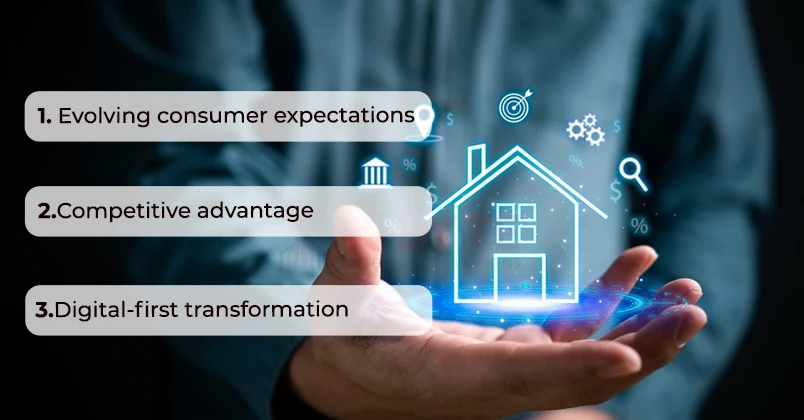
The real estate industry is rapidly adopting AI, with real estate software development at the center of this transformation. Three key factors are driving this shift:
- Evolving consumer expectations – Today’s buyers want instant communication, personalized property recommendations, and immersive digital experiences powered by AI-driven tools.
- Competitive advantage – Brokerages and property managers leveraging AI and advanced real estate software development solutions achieve faster processes, greater accuracy, and significant cost efficiency.
- Digital-first transformation – Since the pandemic, virtual property tours, online transactions, and AI-enabled valuations have become standard practices, further accelerating reliance on intelligent software.
AI in Real Estate Market Trends 2025
- AI chatbots as first-line agents: Handling inquiries 24/7.
- Predictive analytics for investment decisions: Spotting undervalued properties faster.
- Generative AI for marketing: Automated listing descriptions, personalized emails, ad copy.
- Virtual and augmented reality: AI-enhanced tours integrated with metaverse platforms.
- AI in commercial real estate: CRE firms using AI for lease forecasting, rent optimization, and tenant management.
How to Use AI in Real Estate: A Step-by-Step Adoption Framework
Most guides mention use cases, but few explain how to adopt AI successfully. Here’s a practical roadmap:
- Define Business Goals
- Agents: Improve lead conversion?
- Brokers: Optimize pricing strategy?
- CRE firms: Forecast investments?
- Agents: Improve lead conversion?
- Collect and Clean Data
- MLS data, property images, transaction records.
- Ensure compliance with data privacy laws (GDPR, CCPA).
- MLS data, property images, transaction records.
- Choose the Right AI Tools
- SaaS solutions for small brokerages.
- Custom AI development for large CRE enterprises.
- SaaS solutions for small brokerages.
- Run Pilot Projects
- Example: Start with an AI chatbot for customer queries.
- Example: Start with an AI chatbot for customer queries.
- Measure ROI
- Track metrics: lead conversion rates, cost savings, tenant satisfaction.
- Track metrics: lead conversion rates, cost savings, tenant satisfaction.
- Scale Adoption with Governance
- Use MLOps to manage model lifecycle.
- Align with standards like ISO/IEC 42001 (AI management systems).
Key Applications of AI in Real Estate
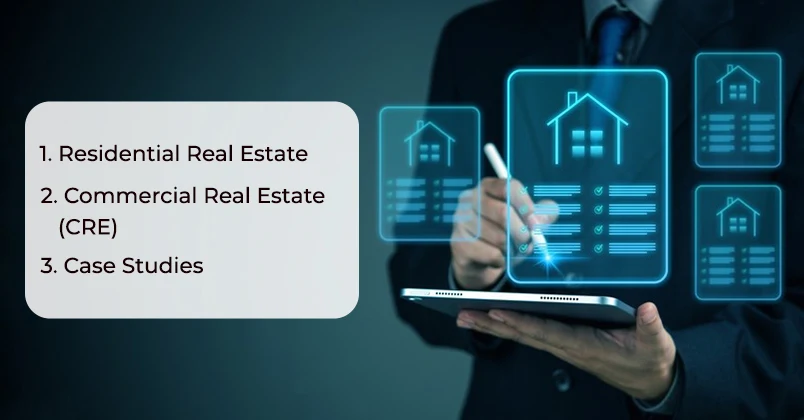
1. Residential Real Estate
- Chatbots & Virtual Assistants: Answer buyer questions instantly (Zillow’s AI-powered bot handles thousands of queries daily).
- Generative AI Listings: Automates property descriptions, saving agents hours.
- AI-powered CRMs: Scores leads based on behavior, improving conversion.
- Virtual Staging with AI: Tools like RoOomy allow buyers to visualize interiors digitally.
2. Commercial Real Estate (CRE)
- Predictive Investment Analysis: AI tools like Skyline AI assess future property values with 20–30% higher accuracy than traditional methods.
- Tenant Screening: AI detects potential fraud or risky rental profiles.
- Smart Building Management: AI + IoT lowers energy costs and predicts maintenance needs.
3. Case Studies
- Zillow Zestimate: AI models estimate property prices using millions of data points.
- Redfin: Uses AI for property recommendations and market analysis.
- CBRE: Invested in AI platforms for commercial property valuation and forecasting.
Benefits of AI in Real Estate
- Efficiency: Automates time-consuming tasks (e.g., lead qualification, listing updates).
- Cost Savings: Reduces marketing expenses through automation.
- Customer Experience: Hyper-personalized recommendations build loyalty.
- Competitive Advantage: Early adopters attract more clients and investors.

Ready to adopt AI in your real estate business? and build your AI adoption roadmap.
Risks, Compliance & Ethical Concerns
AI offers promise, but risks must be addressed:
- Bias in AI models: Risk of discrimination in tenant screening or loan approvals.
- Data privacy issues: Handling sensitive buyer/tenant data requires compliance with GDPR & CCPA.
- Regulatory frameworks:
- EU AI Act (2024) sets global benchmarks for AI safety and transparency.
- Fair Housing Act in the U.S. restricts discriminatory practices.
AI in Real Estate Market Trends 2025
- The global AI in real estate market size is projected to exceed $5 billion by 2025 (Statista).
- AI adoption in CRE is expected to grow by 40% annually through 2025 (Deloitte 2024 CRE Outlook).
- AI agents & Small Language Models (SLMs) will disrupt property management with cost-effective, domain-specific solutions.
- Metaverse-ready virtual tours will become standard in luxury markets.
Costs & ROI of Implementing AI in Real Estate
- SaaS AI tools: $50–$300 per month (chatbots, staging software).
- Custom AI solutions: $20,000–$250,000+ depending on complexity.
- ROI Statistics:
- AI chatbots reduce response time by 30% (HubSpot).
- Predictive analytics improves sales forecasting accuracy by 40% (McKinsey).
Want a practical resource? Download our free “AI in Real Estate Adoption Checklist 2025” to get started today.
Comparison of AI Tools for Real Estate
Category | Tool | Key Feature | Best For |
Chatbots | Drift, Tidio, ManyChat | 24/7 lead engagement | Agents & brokerages |
Virtual Staging | RoOomy, BoxBrownie | AI-driven interiors | Realtors & photographers |
Predictive Analytics | Skyline AI, Localize, HouseCanary | Forecasting & investment | CRE investors |
CRM & Automation | Salesforce Einstein, HubSpot AI | Lead scoring, automation | Agencies & teams |
Conclusion
AI in real estate 2025 is more than a trend—it’s a strategic necessity. From personalized property searches to predictive analytics in commercial real estate, AI empowers firms to move faster, serve smarter, and invest more strategically.
FAQ
How much does AI cost in real estate?
SaaS tools can start at $50/month, while enterprise-grade AI projects range from $50K–$250K+.
Can AI replace real estate agents?
No. AI assists with efficiency and insights but human relationships remain critical in negotiations and trust-building.
Is AI useful for small brokerages?
Yes—chatbots, virtual staging, and AI-driven CRMs are cost-effective even for small teams.
What data is needed to start with AI?
MLS data, transaction records, customer interaction logs, and property images are commonly used.
Is AI in real estate secure?
Yes, if platforms comply with GDPR/CCPA and use proper encryption. Always verify vendor compliance.