Key Highlights:
- AI/ML solutions in healthcare enable predictive analytics, early disease detection, personalized treatment pathways, and intelligent clinical decision support.
- AI-driven healthcare platforms optimize hospital operations through automated workflows, resource planning, cost reduction, and real-time performance monitoring.
- The adoption of AI/ML in healthcare delivers measurable improvements in patient outcomes, operational efficiency, regulatory compliance, and long-term cost management.
Healthcare systems worldwide are under increasing pressure to deliver better patient outcomes while managing rising costs, workforce shortages, and exploding data volumes. Traditional digital systems alone are no longer sufficient to meet these demands. The World Health Organization (WHO) has reported that there will be a global shortage of 18 million healthcare workers by 2030, further emphasizing the need for AI to support the healthcare workforce. Artificial intelligence and machine learning are now playing a central role in transforming how healthcare organizations operate and deliver care.
AI/ML solutions for the healthcare industry enable providers, payers, and life sciences organizations to move beyond reactive decision-making toward predictive, data-driven care models. From early disease detection and clinical decision support to operational optimization and personalized treatment planning, AI and ML are reshaping both clinical and administrative workflows.
For healthcare leaders like CEOs, CTOs, founders, and digital health decision-makers, the question is no longer whether to adopt AI/ML, but how to implement it securely, responsibly, and at scale while maintaining compliance and trust.
What Are AI/ML Solutions in the Healthcare Industry?
AI/ML solutions in healthcare refer to intelligent systems that analyze medical, operational, and patient data to support decision-making, automation, and predictive insights. These systems learn from historical and real-time data to improve accuracy, efficiency, and outcomes across healthcare operations.
Rather than replacing clinicians, AI/ML solutions act as intelligent assistants, augmenting human expertise, reducing manual workload, and enabling proactive care delivery.
1. Understanding Artificial Intelligence in Healthcare
Artificial intelligence enables healthcare systems to interpret medical images, process clinical notes, detect anomalies, and support diagnosis and treatment planning. AI systems excel at handling complex datasets at scale, helping healthcare organizations move toward preventive and value-based care models.
2. Role of Machine Learning in Medical Decision-Making
Machine learning models continuously learn from patient records, lab data, imaging, and monitoring systems. These models support early disease detection, risk stratification, outcome prediction, and treatment optimization, enhancing clinical consistency and accuracy.
3. Difference Between Traditional Healthcare Software and AI/ML Systems
Traditional healthcare software relies on fixed rules and predefined logic. AI/ML systems are adaptive, learning from data patterns and improving over time, making them better suited for complex, data-rich healthcare environments.
Why the Healthcare Industry Is Rapidly Adopting AI/ML Solutions?
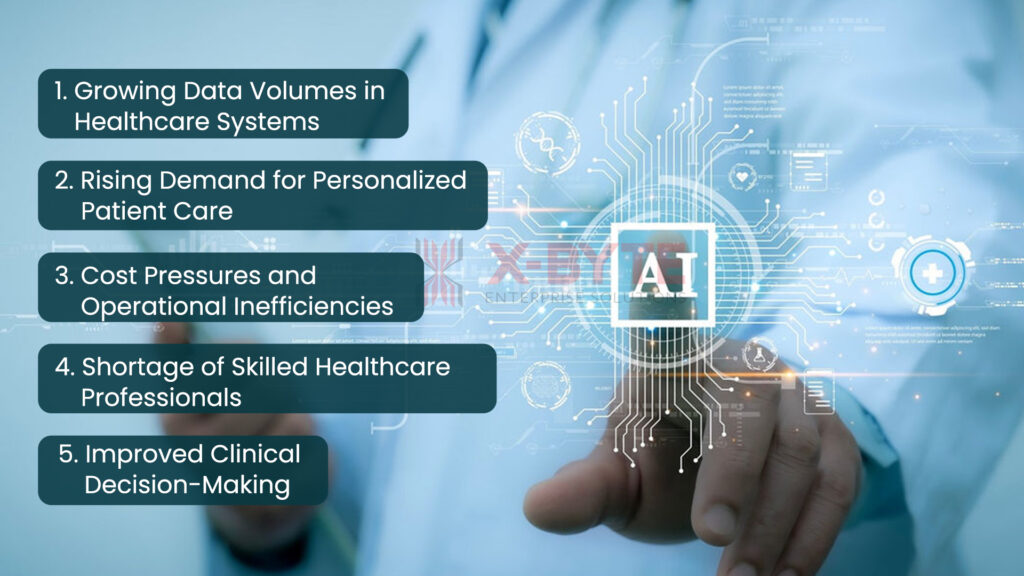
Healthcare systems are rapidly adopting AI/ML solutions to manage data growth, personalize care, and address cost pressures. AI-driven automation boosts operational efficiency, reduces clinician workload, and enhances patient outcomes. These technologies also help tackle workforce shortages and rising operational costs, especially when implemented through a specialized ai development service tailored to healthcare environments.
1. Growing Data Volumes in Healthcare Systems
Healthcare generates massive amounts of structured and unstructured data. AI/ML solutions enable organizations to process and analyze this data efficiently, transforming information overload into actionable intelligence.
2. Rising Demand for Personalized Patient Care
Patients expect personalized, outcome-driven care. AI/ML supports precision medicine by tailoring treatments based on individual health data, improving effectiveness and satisfaction.
3. Cost Pressures and Operational Inefficiencies
AI/ML automates administrative tasks, optimizes workflows, and improves resource utilization, helping organizations control costs without compromising care quality.
4. Shortage of Skilled Healthcare Professionals
AI/ML solutions reduce clinician workload by automating routine tasks and providing decision support, allowing healthcare professionals to focus more on patient care.
5. Improved Clinical Decision-Making
From single-brand enterprises to multi-vendor marketplaces, laundry apps can be customized to support diverse business models while ensuring scalability and operational efficiency.
Key Use Cases of AI/ML Solutions for Healthcare Industry
AI/ML solutions are transforming healthcare with applications across early disease detection, medical imaging, clinical decision-making, and personalized care. These technologies enable more accurate diagnostics, improved patient outcomes, and efficient hospital operations, all while reducing costs and resource strain.
1. Predictive Analytics for Early Disease Detection
- Identify early risk indicators from patient data
- Enable preventive interventions for at-risk patients
- Improve long-term patient outcomes through early action
- Reduce complications and associated healthcare costs
2. Medical Imaging and Diagnostics
- Analyze X-rays, MRIs, CT scans, and pathology images
- Detect abnormalities with high precision and speed
- Prioritize critical cases for timely treatment
- Enhance diagnostic accuracy and reduce human error
3. Clinical Decision Support Systems
- Provide evidence-based treatment recommendations
- Generate real-time alerts and actionable insights for clinicians
- Reduce care variability through standardized protocols
- Improve decision-making in complex or uncertain cases
4. Personalized Treatment and Precision Medicine
- Tailor treatments based on genetic, clinical, and lifestyle data
- Optimize therapeutic strategies for individual patients
- Improve treatment outcomes and minimize adverse effects
- Enable more targeted, cost-effective interventions
5. Remote Patient Monitoring and Virtual Care
- Analyze data from wearables and medical devices for real-time insights
- Enable proactive management of chronic conditions
- Enhance patient engagement with continuous monitoring
- Reduce unnecessary hospital readmissions through early intervention
6. AI in Hospital Operations and Resource Optimization
- Optimize staffing levels and improve bed management
- Streamline scheduling to reduce wait times and enhance patient flow
- Improve supply chain management for critical resources
- Forecast demand to better allocate resources and reduce waste
Business Benefits of AI/ML Solutions in Healthcare
AI/ML solutions offer significant advantages for healthcare organizations by improving clinical outcomes, enhancing operational efficiency, and enabling faster, data-driven decision-making. These technologies empower healthcare providers to deliver more personalized, effective care while reducing costs and increasing patient satisfaction. As AI/ML evolves, it strengthens strategic planning and provides a competitive edge in the healthcare industry.
1. Better Clinical Outcomes with Measurable Impact
AI/ML improves diagnostic accuracy and supports early intervention, resulting in a 15–30% improvement in diagnostic precision. This leads to more accurate treatment plans and better patient outcomes.
2. Operational Efficiency and Sustainable Cost Reduction
Healthcare organizations can gain 20–40% efficiency improvements by automating processes and optimizing workflows with AI/ML. This reduces administrative burdens and enhances resource management.
3. Faster, Data-Driven Decision-Making
AI provides real-time insights that accelerate decision-making, helping healthcare professionals make quicker, more informed decisions on patient care, operational planning, and resource allocation.
4. Enhanced Patient Experience and Engagement
AI-driven predictive monitoring helps identify potential health issues early, while personalized communication improves patient satisfaction. This supports value-based care initiatives focused on long-term health outcomes.
5. Stronger Strategic Planning and Competitive Advantage
AI/ML enables predictive analytics in healthcare that assist in planning, prioritizing investments, and fostering innovation. This boosts ROI on digital health initiatives, making healthcare organizations more competitive in an evolving market.
6. Improved Resource Allocation
AI/ML helps optimize staffing, inventory, and bed management, ensuring that healthcare resources are utilized efficiently, reducing waste, and improving patient care quality.
7. Scalability and Flexibility
AI/ML solutions can be scaled to meet the needs of both small clinics and large hospitals, offering flexible solutions that can grow with the organization’s requirements.
How AI/ML Solutions for Healthcare Industry Are Implemented
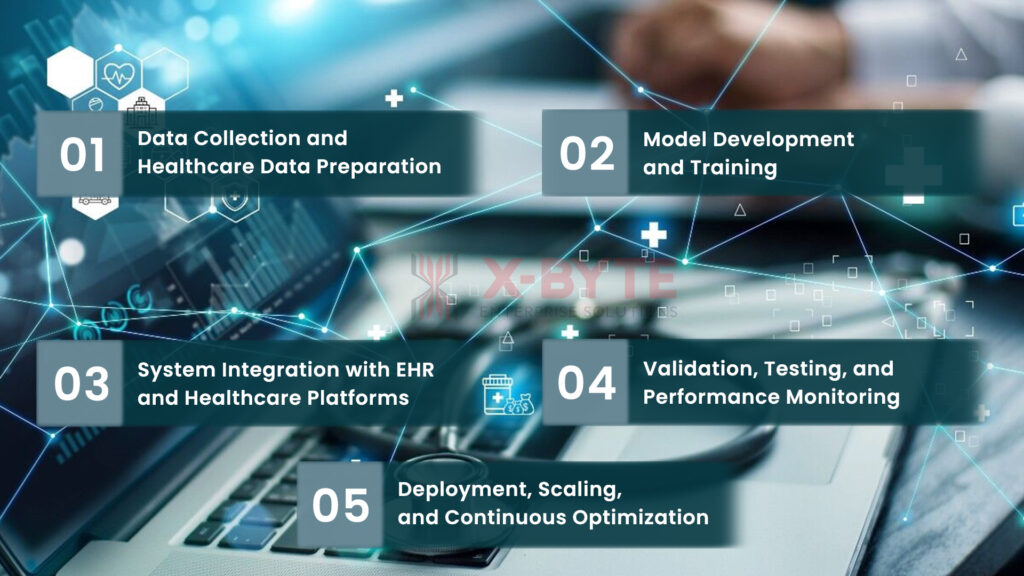
AI/ML solutions in healthcare are implemented through a structured process that includes data collection, model development, system integration, and continuous optimization. These steps ensure the effectiveness and scalability of AI solutions in real-world healthcare settings, providing reliable insights and long-term value.
1. Data Collection and Healthcare Data Preparation
High-quality data is gathered from Electronic Health Records (EHRs), imaging systems, wearables, and operational platforms. This data is cleaned, standardized, and governed to create a reliable foundation for model development.
2. Model Development and Training
AI/ML models are trained using healthcare-specific datasets, with a focus on ensuring accuracy, explainability, and clinical relevance. This ensures the model’s applicability and trustworthiness in real-world healthcare scenarios.
3. System Integration with EHR and Healthcare Platforms
Seamless integration of AI/ML systems with existing Electronic Health Records (EHR) and healthcare platforms ensures that insights are delivered directly into clinical workflows, improving ease of use and adoption.
4. Validation, Testing, and Performance Monitoring
Rigorous validation and continuous monitoring are conducted to ensure that the AI models are performing as expected. This helps in preventing issues like model drift and bias, maintaining high-quality performance.
5. Deployment, Scaling, and Continuous Optimization
AI/ML systems are gradually scaled across the healthcare organization and continuously optimized to maintain long-term value. This process ensures that the technology evolves and adapts to future needs.
Role of AI/ML in Advanced Healthcare Technologies
AI/ML is playing a pivotal role in advancing healthcare technologies by integrating with immersive technologies like AR/VR, and automating healthcare workflows. These innovations are shaping the future of medical training, surgical planning, patient education, and operational efficiency.
1. AI/ML and AR/VR in Healthcare Innovation
AI/ML combined with AR/VR enhances medical training, surgical planning, and patient education. These technologies enable realistic simulations and data-driven visualization, improving training outcomes and patient care.
2. AI-Driven Automation in Healthcare Workflows
AI-driven automation simplifies administrative tasks like documentation, scheduling, and other operational processes. This reduces clinician burden and improves efficiency, allowing healthcare professionals to focus on patient care.
3. AI in Predictive Analytics and Diagnostics
AI/ML solutions help predict patient outcomes and diagnose conditions early. These solutions assist clinicians in making timely, data-backed decisions for better patient outcomes.
4. Robotic Process Automation (RPA) in Healthcare
The development phase involves building front-end and back-end components of the application. Core functionalities such as service booking, order management, payment processing, GPS tracking, and notifications are implemented. Third-party integrations are added to enhance functionality while maintaining data security and system stability.
5. Personalized Patient Care and Treatment Plans
AI/ML can analyze patient data to create tailored treatment plans based on individual needs. This leads to more precise, effective treatments and improved patient satisfaction.
Challenges and Limitations of AI/ML in Healthcare
The implementation of AI/ML in healthcare is not without its challenges. Issues like data quality, system integration, and clinician adoption can hinder the effectiveness of AI solutions.
1. Data Quality and Interoperability Issues
Inconsistent data formats and fragmented systems limit the effectiveness of AI models, making it difficult to achieve accurate and comprehensive insights.
2. Model Transparency and Explainability
Black-box AI models reduce clinician trust if their decision-making process cannot be easily understood or explained.
3. Integration with Legacy Healthcare Systems
Older systems require careful integration planning to ensure AI/ML solutions can work seamlessly without disrupting existing workflows.
4. Adoption and Change Management
Successful AI adoption requires proper clinician training, governance, and cultural readiness to ensure smooth transitions and ongoing acceptance.
5. Regulatory Compliance
Meeting healthcare regulations such as HIPAA and GDPR while implementing AI/ML systems is a significant challenge.
6. Data Privacy and Security
Ensuring patient data is protected while using AI/ML technologies is critical, as breaches or misuse could erode trust and violate regulations.
Despite the significant benefits of AI/ML in healthcare, challenges such as data quality, system integration, model transparency, and clinician adoption must be addressed to fully realize their potential. Ensuring smooth implementation while meeting regulatory and security standards is crucial for success.
When Should Healthcare Organizations Invest in AI/ML Solutions?
Healthcare organizations should invest in AI/ML solutions when they face rising operational costs, inefficiencies, and the increasing complexity of data. These technologies streamline workflows, improve decision-making, and optimize resource use. Early adoption helps ensure scalability, compliance, and a competitive edge, while enhancing patient care and reducing costs.
- Rising healthcare costs and operational inefficiencies demand more intelligent, data-driven solutions.
- AI/ML enables better decision-making through real-time data analysis and predictive insights.
- Growing data complexity can be managed with AI/ML, improving accuracy and efficiency in operations.
- Early investment ensures compliance with evolving healthcare regulations and standards.
- Personalized care becomes more achievable, allowing healthcare organizations to meet patients’ unique needs.
- Additionally, cloud computing allows data security in healthcare, ensuring that sensitive patient information remains protected and accessible only to authorized personnel.
Why Choose X-Byte Solutions for AI/ML Solutions for Healthcare Industry?
X-Byte Solutions offers secure, scalable, and compliant AI/ML solutions tailored for the healthcare industry. Our approach ensures technical precision while meeting strict regulatory standards, enabling smooth AI/ML implementation from strategy to deployment. We focus on delivering solutions that improve patient care and operational efficiency.
Our end-to-end support helps healthcare organizations quickly integrate and optimize AI/ML, ensuring long-term success and faster time-to-value. With X-Byte, healthcare providers gain a strategic partner in navigating the complexities of AI in healthcare.
Conclusion
AI/ML solutions are essential for healthcare organizations aiming to improve care delivery, streamline operations, and reduce costs. Early adoption ensures healthcare providers remain competitive and compliant, driving long-term success in a data-driven world.
X-Byte Solutions empowers healthcare organizations with secure, scalable AI/ML technologies that meet regulatory standards. Our solutions deliver measurable improvements in care and efficiency, ensuring sustainable growth and innovation.