
Key Highlights:
- AI-powered taxi booking app development enables predictive demand forecasting, smart taxi dispatch systems, dynamic pricing algorithms, and real-time route optimization.
- AI-driven ride-hailing business models go beyond commissions to include subscriptions, fleet partnerships, multi-mobility revenue, and data-driven monetization.
- The development cost of AI-powered taxi booking apps in 2026 varies by scope, with clear differences between MVP, mid-scale, and enterprise-grade platforms.
Introduction
A few years ago, building a ride-hailing app was about one thing: getting a driver to a rider. Today, that’s just the starting point. What really matters now is how smart the app is behind the scenes.
This shift is quietly shaping the future of ride-hailing apps.
- Now, users expect faster pickups and smoother rides.
- Drivers expect better use of their time.
- And businesses need platforms that can grow without becoming complicated to manage.
That’s where AI-powered taxi booking app development starts to come into the picture.
Did you know, more than 85% of modern ride-hailing platforms now integrate AI for features like route optimization, surge pricing, and predictive analytics.
AI isn’t about making ride-hailing feel complex. In fact, it’s the opposite. It helps apps make better decisions automatically, so everything feels simple to the user.
If you are wondering where ride-hailing is headed, what AI taxi booking app trends 2026 are pointing toward, and how the taxi booking app tech stack and AI ride-hailing business models are evolving. If you’re thinking about building a ride-hailing app, then this blog is all you need.
What is an AI-Powered Taxi Booking App?
An AI-powered taxi booking app is a ride-hailing platform that uses artificial intelligence and machine learning to make smarter decisions automatically. Instead of only matching riders and drivers, the app analyzes real-time and historical data to predict demand, adjust pricing, assign drivers efficiently, and optimize routes.
The result is faster pickups, fairer pricing, less driver idle time, and a smoother experience for everyone. This is the same intelligence layer used by leading global ride-hailing platforms to manage millions of daily trips.
Why AI-Powered Taxi Booking App Development Matters in 2026?
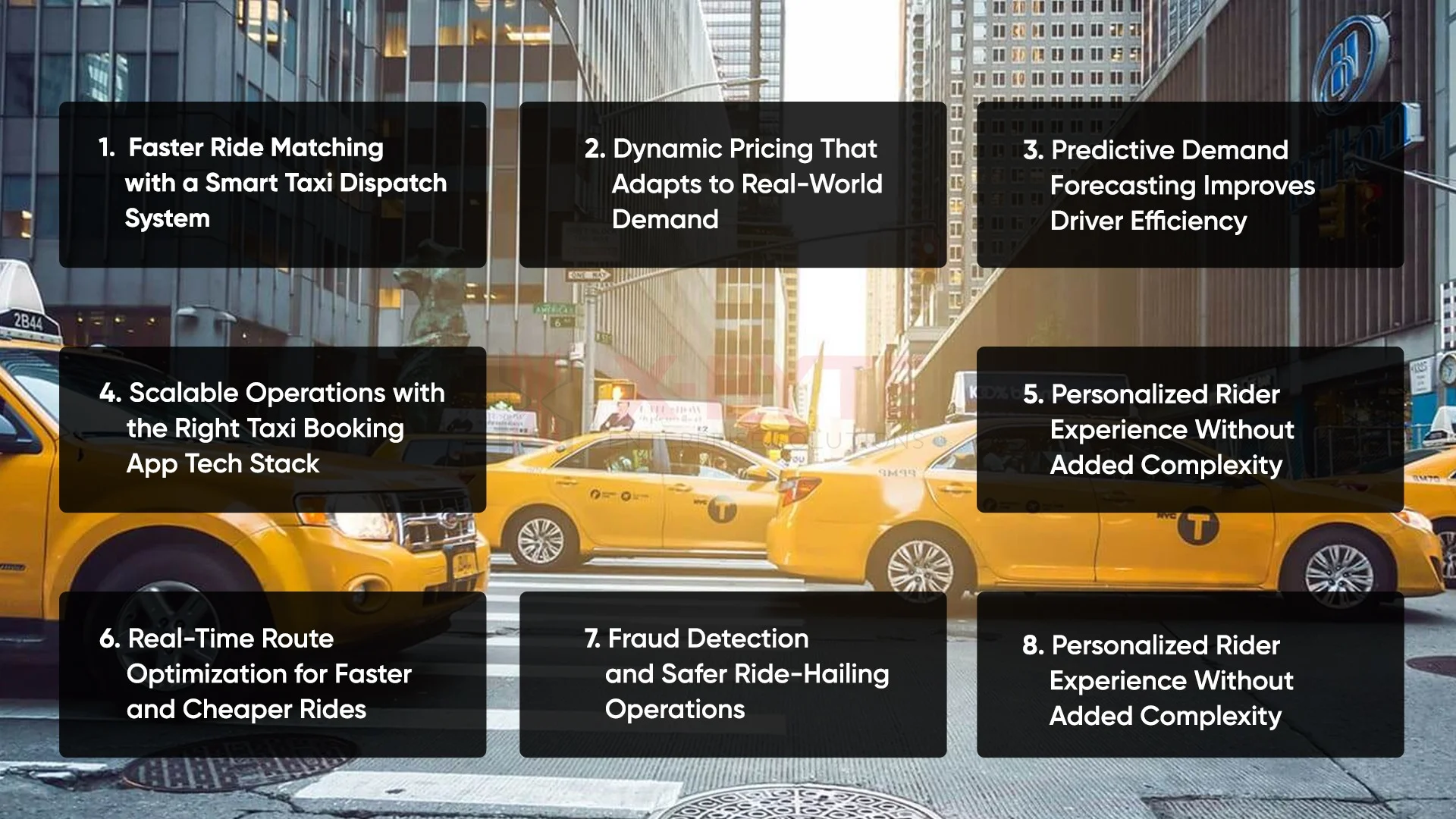
1. Faster Ride Matching with a Smart Taxi Dispatch System
In 2026, speed defines the success of any ride-hailing platform. With AI-powered taxi booking app development, platforms use a smart taxi dispatch system to match riders and drivers in real time.
By analyzing location, traffic, and availability instantly, AI-based ride-hailing solutions can reduce wait times by 15–20%, leading to better user experience and higher ride completion rates.
2. Dynamic Pricing That Adapts to Real-World Demand
AI-driven dynamic pricing algorithms allow ride-hailing apps to adjust fares based on demand, time, traffic conditions, and rider behavior. Unlike rule-based pricing, machine learning in ride-hailing apps learns continuously and improves over time.
Platforms using AI-based pricing models report 10–15% revenue improvement, while maintaining pricing transparency.
3. Predictive Demand Forecasting Improves Driver Efficiency
Every minute a driver remains idle translates into lost revenue and lower marketplace efficiency. Using predictive demand forecasting, AI-powered taxi booking apps can anticipate demand hotspots and guide drivers proactively.
This improves driver utilization by 20–25%, reduces idle time, and increases driver earnings. It is even critical for maintaining driver retention and marketplace balance.
4. Scalable Operations with the Right Taxi Booking App Tech Stack
As platforms grow across cities and regions, manual operations don’t scale. A modern taxi booking app tech stack combined with AI automation enables real-time decisions at scale without increasing operational overhead.
Companies using AI-powered systems report up to 30% lower operational costs, making AI ride-hailing business models far more sustainable for long-term growth.
5. Personalized Rider Experience Without Added Complexity
In 2026, users expect ride-hailing apps to feel personal without needing extra effort. With machine learning in ride-hailing apps, platforms can understand rider preferences, such as pickup behavior, preferred routes, or payment choices, and subtly improve the experience over time.
This kind of personalization, powered by an AI-powered taxi booking app development, increases user retention and encourages repeat rides.
6. Real-Time Route Optimization for Faster and Cheaper Rides
Traffic conditions change every minute. Real-time route optimization allows AI-powered taxi booking apps to continuously adjust routes based on traffic, road closures, and live conditions.
This reduces trip duration, fuel costs, and rider frustration. For businesses, this means better ride completion rates and lower operational inefficiencies, making AI-based ride-hailing solutions far more effective in dense urban environments.
7. Fraud Detection and Safer Ride-Hailing Operations
Fraud and misuse quietly drain revenue in ride-hailing platforms. AI helps identify unusual behavior, fake bookings, payment abuse, and driver–rider misconduct patterns early.
Platforms using AI-driven fraud detection report up to 25–30% reduction in fraudulent activity, improving trust across the ecosystem. In the future of ride-hailing apps, safety and trust are just as important as speed.
8. Smarter Customer Support with AI Automation
Customer support can quickly become a cost center as ride-hailing platforms grow. Platforms using AI-based support have reported up to 30–40% faster resolution times, improving user satisfaction while keeping support costs under control.
With AI-powered taxi booking app development, chatbots and AI-assisted support systems can handle common issues like ride status, cancellations, refunds, and driver queries in real time.
Key AI Trends Transforming Taxi Booking Apps
1. Predictive Dispatch That Moves Drivers Before Demand Hits
Instead of waiting for ride requests, modern AI systems are learning to predict where demand will appear next. This shift is one of the biggest changes shaping AI-powered taxi booking app development.
Why this trend matters:
- Uses predictive demand forecasting based on time, location, events, and historical data
- Positions drivers in high-demand zones before ride requests come in
- Reduces rider wait times and missed booking opportunities
- Improves driver utilization without increasing fleet size
2. Driver Intelligence Systems (AI as a Co-Pilot)
AI is starting to work with drivers, not just manage them. New driver-facing intelligence tools guide decisions throughout the day, improving earnings and reducing frustration.
Also, do you know AI-driven driver monitoring and assistance systems are predicted to reduce on-road incidents by nearly 30% by 2026, a direct indicator that driver AI is not only improving efficiency but also safety.
What drivers gain from this trend:
- AI suggestions on where to wait and when to accept rides
- Insights into high-demand time slots and locations
- Reduced idle time and unnecessary driving
- Better earnings consistency and higher driver retention
3. AI-Driven Multi-Mobility Platforms (Beyond Just Taxis)
The future of ride-hailing apps isn’t limited to cars. AI is helping platforms expand into bikes, scooters, rentals, and public transport without breaking the core experience.
What this unlocks for businesses:
- Smart recommendations for the best transport option per trip
- Better asset utilization across multiple mobility types
- New revenue streams beyond traditional taxi rides
- Stronger positioning as a complete urban mobility platform
4. Decision Intelligence for Founders, Not Just Dashboards
Raw data doesn’t help unless it leads to action. AI is transforming ride-hailing analytics into decision intelligence, guiding founders on what to fix, scale, or stop.
Why this matters at a leadership level:
- Highlights demand gaps, pricing issues, and supply imbalance automatically
- Predicts operational risks before they impact growth
- Supports smarter city expansion and fleet planning decisions
- Turns analytics into a real growth lever for AI ride-hailing business models
5. Voice and Conversational AI Inside Ride-Hailing Apps
Tapping screens isn’t always ideal, especially for drivers. Voice-driven AI is quietly entering ride-hailing apps to make interactions faster and safer.
How this improves usability:
- Voice-based ride updates, navigation prompts, and trip actions
- Hands-free support for drivers during active trips
- Faster issue resolution without navigating menus
- More accessible experiences for both riders and drivers
6. AI Supporting Sustainable and Electric Ride-Hailing Models
As cities push toward greener mobility, AI is becoming essential for managing electric and low-emission fleets efficiently. In 2024, over 1.3 million electric vehicles were already integrated into ride-hailing fleets worldwide, and this number is only growing.
Why this trend matters:
- Optimizes EV routing based on battery range and charging availability
- Predicts charging needs to avoid downtime
- Helps platforms meet sustainability goals without hurting performance
- Position ride-hailing apps for future urban mobility regulations
Core Features of AI-Powered Ride-Hailing Applications
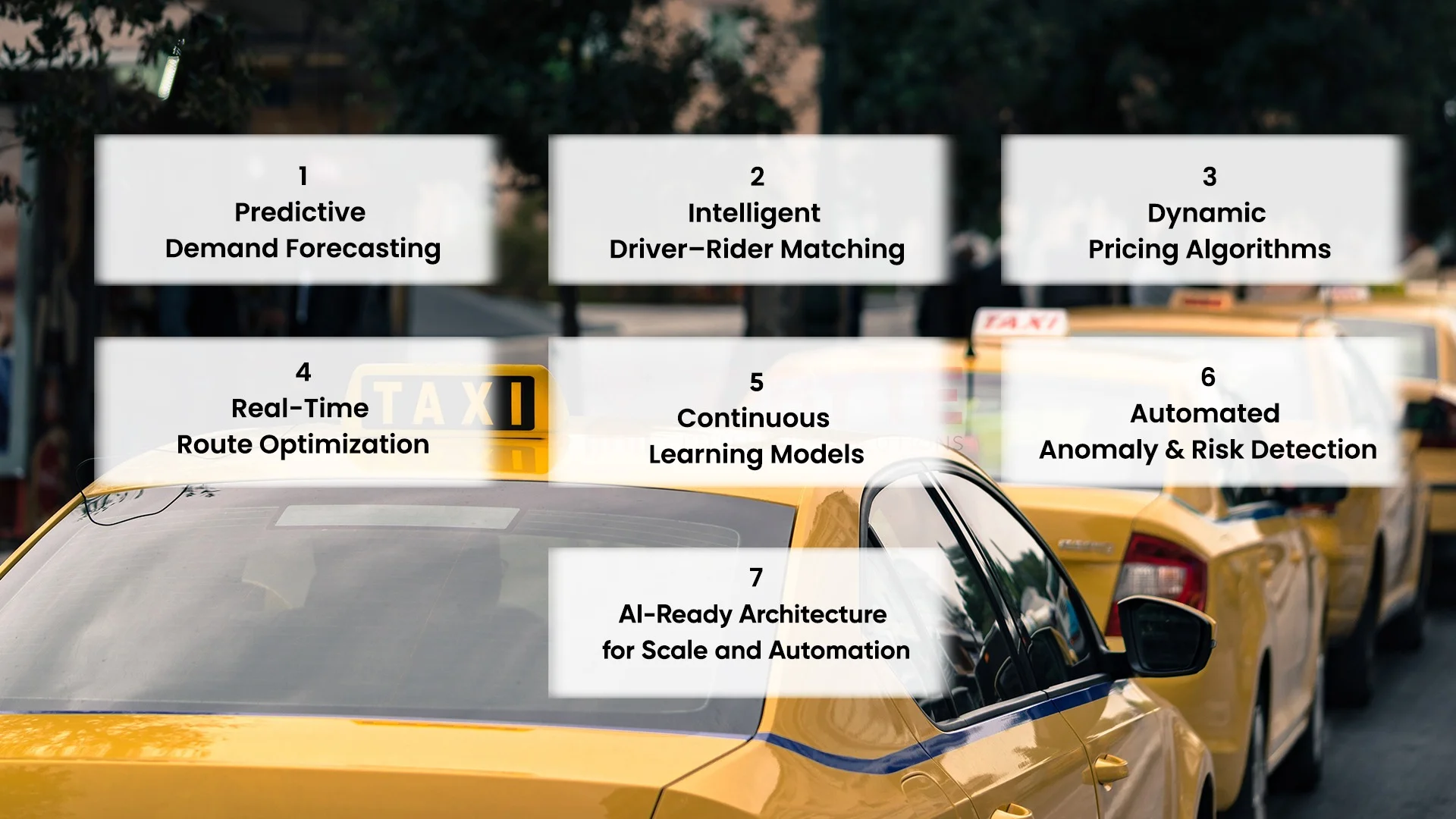
1. Predictive Demand Forecasting
At the core of AI-powered ride-hailing is the ability to predict demand before it happens. AI models analyze historical ride data, time patterns, weather, local events, and city behavior to forecast where and when rides will spike.
Why is this core to AI-powered platforms?
- Anticipates demand instead of reacting to it
- Reduces rider wait times
- Improves marketplace balance
- Enables proactive operations
2. Intelligent Driver–Rider Matching (Smart Dispatch System)
Unlike rule-based matching, AI-powered dispatch systems consider multiple variables at once, including distance, traffic, driver availability, acceptance behavior, and predicted demand.
What makes this AI-driven:
- Matches based on probability, not proximity alone
- Continuously learns from ride outcomes
- Improves trip success rates over time
- Reduces cancellations and idle time
3. Dynamic Pricing Algorithms
AI-powered ride-hailing apps rely on dynamic pricing algorithms that adjust fares in real time based on supply, demand, location, and timing.
Why this is a core AI feature:
- Maintains balance between riders and drivers
- Prevents supply shortages during peak demand
- Protects platform revenue automatically
- Adapts pricing without manual rules
4. Real-Time Route Optimization
Routing in AI-powered platforms is not static. AI continuously evaluates traffic, road closures, congestion patterns, and trip progress during the ride.
Core AI capabilities here include:
- Live route recalculation
- Accurate ETA prediction
- Reduced trip duration and fuel usage
- Better on-time performance
5. Continuous Learning Models
AI-powered ride-hailing apps improve over time because their models learn continuously from new data.
Why this is foundational:
- Dispatch, pricing, and routing improve automatically
- Models adapt to city-specific behavior
- Performance increases without rebuilding logic
- The platform becomes smarter at scale
6. Automated Anomaly & Risk Detection
AI continuously monitors rides, payments, and behavior patterns to detect anomalies in real time.
Core use cases include:
- Fraud and misuse detection
- Unusual route or trip behavior
- Payment and refund abuse prevention
- Safety risk identification
This protects revenue and trust at scale.
7. AI-Ready Architecture for Scale and Automation
AI-powered ride-hailing platforms are built on architectures designed for real-time data processing and automation.
What this enables:
- High-volume real-time decision-making
- Seamless city and fleet expansion
- Integration with EVs and autonomous vehicles
- Long-term platform adaptability
This ensures the platform is future-ready, not just feature-rich.

AI-Powered Taxi Booking App Tech Stack Explained
| Layer | Sub-Component | Purpose of the Ride-Hailing App | AI Involvement | Common Technologies |
| Front-End (Rider App) | Mobile UI | Ride booking, tracking, and payments | AI-assisted UX flows | Flutter, React Native |
| Map Interface | Pickup & drop selection | Smart location suggestions | Google Maps SDK, Mapbox | |
| Notifications | Ride updates, alerts | AI-timed notifications | Firebase, OneSignal | |
| Front-End (Driver App) | Driver Dashboard | Ride requests, navigation | AI driver recommendations | Flutter, Kotlin, Swift |
| Navigation View | Turn-by-turn routing | Real-time route optimization | Google Maps, Mapbox | |
| Earnings & Insights | Trip history, payouts | AI earnings prediction | Custom dashboards | |
| Web Admin Panel | Operations Dashboard | City & fleet monitoring | Decision intelligence | React.js, Angular |
| Pricing Controls | Fare rules & overrides | AI pricing signals | Custom rule engines | |
| Analytics View | Performance insights | AI-driven insights | D3.js, Chart.js | |
| Backend Services | API Gateway | Request handling | Load-aware routing | Node.js, FastAPI |
| Booking Engine | Ride lifecycle management | AI matching triggers | Python, Java | |
| Dispatch Service | Driver–rider assignment | Smart taxi dispatch system | Python, Go | |
| Pricing Engine | Fare calculation | Dynamic pricing algorithms | Python ML services | |
| AI / ML Layer | Demand Forecasting | Predict ride demand | Predictive models | TensorFlow, PyTorch |
| Matching Models | Optimize driver matching | ML optimization | Scikit-learn | |
| Routing Models | ETA & route prediction | Real-time AI models | Custom ML pipelines | |
| Fraud Detection | Detect misuse & anomalies | AI anomaly detection | ML classifiers | |
| Data Layer | Transactional DB | Users, rides, payments | Data for ML training | PostgreSQL, MySQL |
| Real-Time Cache | Live trip & location data | Instant decisions | Redis | |
| Data Warehouse | Historical analytics | Model training & BI | BigQuery, Snowflake | |
| Streaming & Real-Time | Event Streaming | Ride & location events | Real-time AI triggers | Kafka, AWS Kinesis |
| WebSockets | Live tracking updates | Low-latency updates | Socket.io | |
| Cloud Infrastructure | Compute | Scalable processing | AI workloads | AWS EC2, GCP Compute |
| Storage | App & model data | Model versioning | S3, Cloud Storage | |
| Auto-Scaling | Handle peak demand | AI-driven scaling | Kubernetes | |
| DevOps & Deployment | CI/CD | Fast & safe releases | Automated testing | GitHub Actions |
| Containers | App portability | Model deployment | Docker | |
| Monitoring | Performance & errors | AI health monitoring | Prometheus, Grafana | |
| Security Layer | Authentication | User & driver identity | Risk-based auth | OAuth 2.0, JWT |
| Data Security | Protect user data | AI threat detection | Encryption tools | |
| Integrations | Payments | Ride payments & refunds | Fraud prevention | Stripe, Razorpay |
| Messaging | SMS & call masking | AI routing | Twilio | |
| Maps & Traffic | Navigation & traffic data | Live traffic AI | Google Maps API |
AI-Driven Business Models in the Ride-Hailing Industry
Below, each business model is explained in a single, clear paragraph, followed by a practical example illustrating how it operates in the real world.
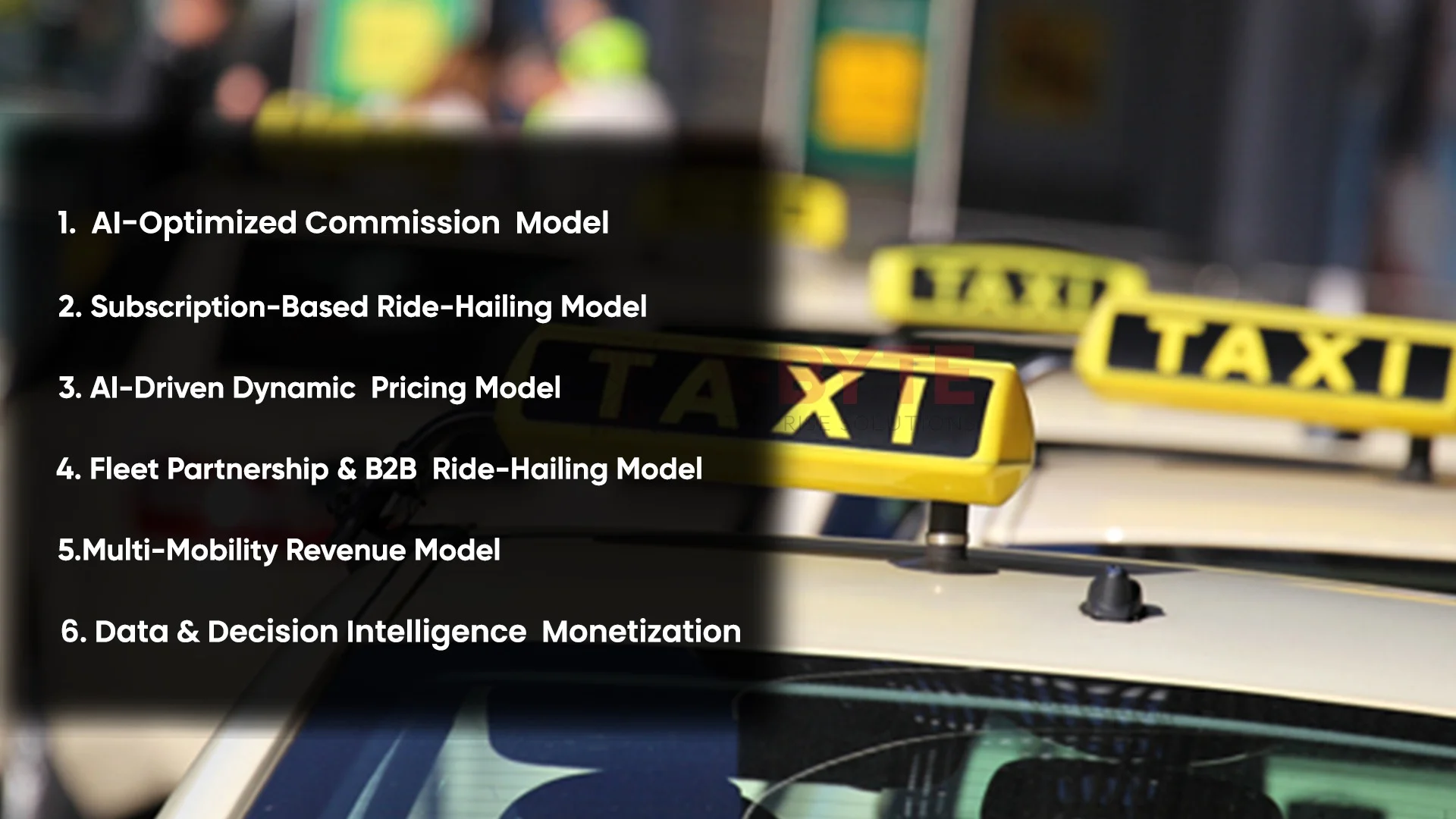
1. AI-Optimized Commission Model
In this model, the platform earns a commission per ride, but AI dynamically adjusts commission rates based on demand, location, time of day, and driver availability. Instead of a fixed percentage, the system optimizes margins while keeping the marketplace balanced.
This makes the model more resilient during peak hours and slow periods, which is critical for scalable ride-hailing businesses.
2. Subscription-Based Ride-Hailing Model
Here, riders or drivers pay a recurring monthly or weekly fee for benefits like discounted fares, priority matching, or reduced commissions. AI plays a key role by personalizing subscription plans based on usage patterns, ensuring the subscription remains profitable for the platform while delivering real value to users.
3. AI-Driven Dynamic Pricing Model
This model monetizes demand fluctuations using AI-powered pricing algorithms rather than blunt surge pricing. Prices adjust smoothly and predictively, responding to expected demand rather than reacting after shortages occur. This improves ride completion rates while protecting user trust.
4. Fleet Partnership & B2B Ride-Hailing Model
Instead of relying only on individual drivers, platforms partner with fleet owners, logistics companies, or enterprises. AI optimizes fleet scheduling, utilization, and maintenance, allowing the platform to earn through long-term contracts and guaranteed usage rather than per-ride uncertainty.
5. Multi-Mobility Revenue Model
AI enables platforms to offer taxis, bikes, scooters, and public transit options within one app. Revenue is generated through commissions across multiple transportation modes, while AI recommends the most efficient option for each trip, thereby increasing overall usage and lifetime value.
6. Data & Decision Intelligence Monetization
Ride-hailing platforms collect large volumes of mobility data every day. AI analyzes and anonymizes this data to uncover clear patterns like traffic flow, demand hotspots, and peak travel times. Platforms can share these insights with city planners, fleet partners, and enterprises to support better decision-making and create a new revenue stream beyond ride bookings.
Development Cost of AI-Powered Taxi Booking Apps in 2026
The cost of building an AI-powered taxi booking app in 2026 depends on three main factors: product scope, AI depth, and scalability requirements. Unlike traditional ride-hailing apps, AI-powered platforms require additional investment in machine learning models, real-time data processing, and cloud infrastructure.
Below is a clear breakdown to understand the development cost of an AI-powered taxi booking app:
| Feature Scope | MVP AI-Powered Taxi Booking App | Mid-Scale AI Ride-Hailing Platform | Enterprise-Grade AI Ride-Hailing Platform |
| Estimated Cost Range | $120K – $180K | $180K – $280K | $300K – $450K+ |
| Rider & Driver Mobile Apps | ✓ | ✓ | ✓ |
| Core Booking & Ride Lifecycle | ✓ | ✓ | ✓ |
| Basic AI Driver–Rider Matching | ✓ | ✓ | ✓ |
| Smart Taxi Dispatch System | ✗ | ✓ | ✓ |
| Predictive Demand Forecasting | ✗ | ✓ (zone-level) | ✓ (city & region-wide) |
| Dynamic Pricing Algorithms | ✓ (rule-assisted) | ✓ (AI-driven) | ✓ (self-optimizing) |
| Real-Time Route Optimization | ✗ | ✓ | ✓ |
| Accurate AI-Based ETA Prediction | ✓ | ✓ | ✓ |
| Fraud & Anomaly Detection | ✗ | ✓ (basic) | ✓ (advanced AI) |
| In-Ride Safety Intelligence | ✓ (standard) | ✓ (AI-assisted) | ✓ (predictive) |
| Admin & Ops Dashboard | ✓ (basic) | ✓ (advanced) | ✓ (decision intelligence) |
| AI Decision Intelligence (Founders) | ✗ | ✗ | ✓ |
| Automated Model Learning & Optimization | ✗ | ✓ (limited) | ✓ (continuous) |
| Event Streaming & Real-Time Data Pipeline | ✗ | ✓ | ✓ |
| Multi-City / Multi-Region Scalability | ✗ | ✓ (regional) | ✓ (global) |
| Fleet & B2B Ride Management | ✗ | ✓ (limited) | ✓ (full-scale) |
| Multi-Mobility Support | ✗ | ✗ | ✓ |
| EV Fleet Optimization | ✗ | ✗ | ✓ |
| Autonomous-Ready Architecture | ✗ | ✗ | ✓ |
Challenges in AI-Based Ride-Hailing App Development and How to Overcome Them
Building an AI-powered ride-hailing app sounds exciting, but once you get into execution, real challenges show up fast.
The good news? Most of these problems are predictable and, with the right approach, solvable. Let’s break them down in a practical, no-fluff way.
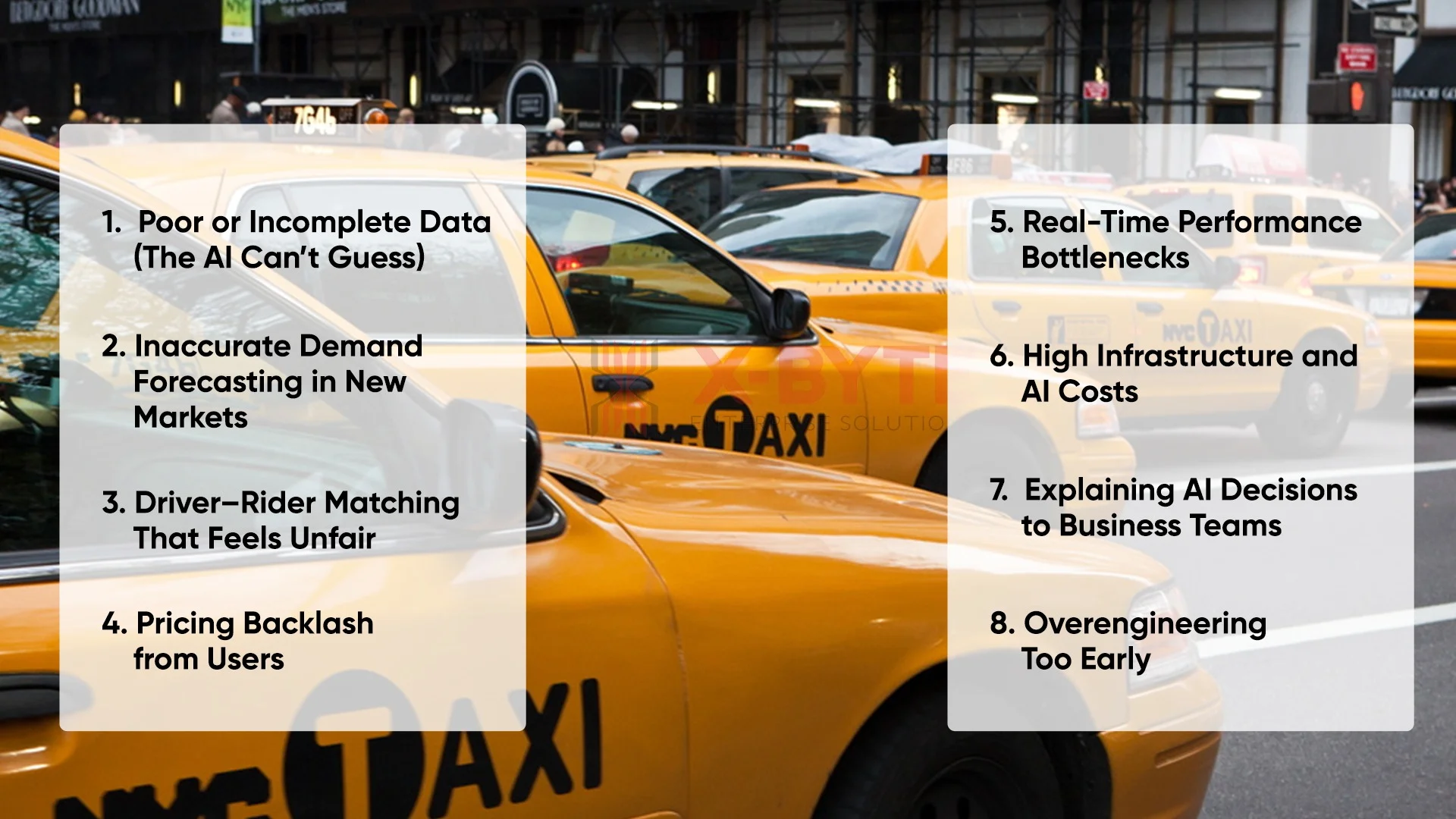
1. Poor or Incomplete Data (The AI Can’t Guess)
AI only works as well as the data it learns from. Early-stage ride-hailing platforms often struggle with sparse, noisy, or inconsistent data.
How to overcome it: Start simple. Combine historical data with rule-based logic in the early phase, and gradually let machine learning take over as data volume grows. Invest early in clean data pipelines and validation, not just models.
2. Inaccurate Demand Forecasting in New Markets
Predictive demand forecasting works well until you enter a city with different behavior patterns, traffic flows, or peak times.
How to overcome it: Train models city by city. Use localized data, seasonal patterns, and continuous retraining. Avoid one-model-fits-all logic and allow the system to adapt regionally.
3. Driver–Rider Matching That Feels Unfair
If drivers feel the system favors some users or riders experience frequent cancellations, trust breaks quickly, even if the AI is technically correct.
How to overcome it: Design matching models with fairness signals, not just efficiency. Balance distance, acceptance behavior, wait time, and driver earnings. Transparency in matching logic also helps reduce friction.
4. Pricing Backlash from Users
Dynamic pricing is powerful, but when users don’t understand why prices change, they push back.
How to overcome it: Use gradual price adjustments instead of sharp spikes. Communicate clearly inside the app why prices change. AI should smooth pricing, not surprise users.
5. Real-Time Performance Bottlenecks
AI-based ride-hailing apps process live locations, routes, pricing, and ETAs, all at once. Latency can kill the experience.
How to overcome it: Separate real-time systems from heavy AI workloads. Use caching, event streaming, and asynchronous processing so the app stays fast even when models run in the background.
6. High Infrastructure and AI Costs
AI models, cloud computing, and real-time systems can quickly inflate costs, especially if overbuilt too early.
How to overcome it: Build in phases. Start with essential AI features, then layer advanced intelligence as usage grows. Optimize models for performance, not complexity, and monitor cloud usage closely.
7. Explaining AI Decisions to Business Teams
Founders and operations teams often struggle to trust AI recommendations they can’t explain.
How to overcome it: Add explainability layers. Show why the system recommends certain actions, pricing changes, dispatch decisions, or alerts, so humans stay in control.
8. Overengineering Too Early
One of the most common mistakes is building enterprise-grade AI before the product proves demand.
How to overcome it: Focus on impact, not hype. Start with AI features that directly improve wait times, pricing balance, and driver utilization. Scale intelligence as the business scales.
How to Choose the Right AI Taxi Booking App Development Partner?
Choosing the right partner for AI-powered taxi booking app development comes down to clarity, not complexity.
Here’s how to evaluate a development partner without getting lost in buzzwords.
1. Expertise in taxi booking app development
Choose a partner with hands-on experience in building real-time taxi booking platforms, including dispatch systems, pricing logic, live tracking, and scalable back-end architecture.
2. Strong AI development services
The right partner should offer practical AI development services, not just theory, covering predictive demand forecasting, smart taxi dispatch systems, dynamic pricing algorithms, route optimization, and fraud detection.
3. Experience beyond ride-hailing
A team with experience in car rental app development brings added value, as it shows they understand fleet management, availability logic, pricing automation, and multi-vehicle operations, skills that directly strengthen taxi platforms.
4. Clear MVP-to-scale roadmap
Look for a partner who helps you launch fast with essential AI features and then scales the platform intelligently, without overengineering early stages.
5. AI-first and data-driven architecture
Ensure the partner designs clean data pipelines, real-time systems, and cloud-ready infrastructure that allow AI models to improve continuously as usage grows.
6. Long-term support and optimization
AI systems need continuous tuning. A reliable partner offers post-launch support, model optimization, and performance improvements as usage grows.
We bring together taxi booking app development, advanced AI development services, and car rental app development expertise to build intelligent, scalable mobility platforms. Our approach focuses on practical AI, clean architecture, and long-term growth, helping you launch faster and scale smarter.
Final Thoughts
AI is no longer an add-on in ride-hailing; it’s becoming the foundation that decides how efficiently platforms grow, adapt, and compete.
As this space evolves, the real advantage will come from building thoughtfully: choosing the right features, the right architecture, and the right partners at the right time.
But keep in mind that platforms that approach AI with purpose, not pressure, are better positioned to create sustainable mobility businesses that last.
If you’re exploring how AI can shape your taxi booking platform or want a clearer view of what to build next, our team at X-Byte Solutions can help. We work with teams to turn ideas into scalable, AI-ready mobility platforms without overengineering or guesswork.