Artificial Intelligence (AI) has moved beyond experimentation and proof-of-concepts. In 2025, enterprises are adopting AI development services to build scalable, secure, and high-performing systems that combine multiple technologies into one unified stack.
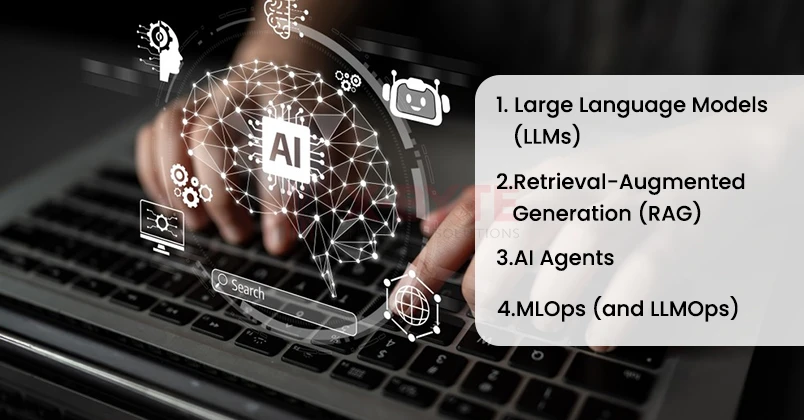
This blog serves as your AI Development Guide—breaking down the AI stack into its essential layers: Large Language Models (LLMs), Retrieval-Augmented Generation (RAG), AI Agents, and MLOps. Unlike many existing resources that explore these pieces separately, we’ll explain how they work together, share practical integration workflows, and highlight best practices for enterprise adoption.
Why Enterprises Need a Complete AI Stack?
Enterprises face challenges beyond model performance:
- Scaling AI across global teams.
- Ensuring compliance with data governance and regional regulations.
- Managing costs of Generative AI development.
- Maintaining reliability through monitoring, versioning, and lifecycle management.
A fragmented approach (e.g., building LLM apps without operational frameworks) leads to brittle systems. Instead, enterprises need a holistic AI stack where LLM development, advanced RAG techniques, agent orchestration, and MLOps pipelines connect seamlessly.
Layer 1: Large Language Models (LLMs)
What They Are
LLMs are the foundation of enterprise AI. They power tasks such as understanding text, generating summaries, categorizing information, and producing human-like content.
Enterprise Considerations
- LLM Development requires fine-tuning on domain-specific data (finance, healthcare, legal).
- LLM Framework Metrics and Best Practices include evaluating accuracy, latency, cost per inference, and ethical considerations.
- Enterprises should adopt LLMOps (an extension of MLOps) for deploying, monitoring, and scaling LLMs.
Layer 2: Retrieval-Augmented Generation (RAG)
Why It Matters
RAG combines an LLM with a retrieval system (like a vector database) to pull facts from enterprise knowledge bases in real-time. This improves accuracy and reduces hallucinations.
Advanced RAG Techniques & Architectures
- Vanilla RAG: Query + LLM + database.
- GraphRAG: Uses knowledge graphs to map entities and relationships.
- Agentic RAG: Combines retrieval with multi-step reasoning agents.
Enterprise Benefits
- Keeps data up to date without constant fine-tuning.
- Improves compliance by restricting output to approved datasets.
Reduces costs compared to training massive custom models.
Layer 3: AI Agents
What They Are
AI agents are self-directed systems that leverage LLMs to analyze, plan, and execute tasks by interacting with various tools and APIs.
Use Cases for Enterprises
- Customer Support Agents – Responding with personalized answers from RAG-powered knowledge bases.
- Compliance Agents – Monitoring transactions for fraud or regulatory breaches.
- Workflow Automation – Orchestrating tasks across ERP, CRM, or HR platforms.
AI Agent Development Best Practices
- Clearly outline what tasks agents may do and where their authority ends.
- Add human-in-the-loop approval for sensitive decisions.
- Integrate with monitoring tools to ensure accountability.
Content Gap Competitors Missed
While some blogs discuss agents, few show how they interconnect with LLM + RAG + MLOps. Your stack should allow agents to trigger RAG retrieval and feed results back to the LLM, all within an MLOps-governed pipeline.
Layer 4: MLOps (and LLMOps)
Why It’s Crucial
MLOps provides the foundation that moves AI projects from concept to production. In generative AI development, it plays a key role in monitoring, updating, and managing models responsibly.
Key Practices for Enterprises
- CI/CD Pipelines for AI – Automate testing, deployment, and rollback.
- Observability – Track latency, error rates, cost per request, and drift.
- Data Governance – Ensure compliance with GDPR, HIPAA, or regional AI acts.
- Model Versioning – Keep track of changes across LLMs, embeddings, and retrieval indices.
The Shift to LLMOps
Traditional MLOps doesn’t fully address LLM challenges. Enterprises should embrace LLMOps, focusing on:
- Prompt Management (tracking changes, testing outputs).
- Cost Optimization (choosing between LLMs and SLMs).
Evaluation Metrics (truthfulness, toxicity, and hallucination rates).
Putting It All Together: The Unified AI Stack
Most enterprises fail because they implement these layers in silos. Here’s how to integrate the complete stack:
- LLM Development – Fine-tuned or API-based models form the foundation.
- Advanced RAG – Connects LLMs to enterprise knowledge bases.
- AI Agents – Orchestrate reasoning and multi-step workflows.
- MLOps/LLMOps – Governs deployment, monitoring, compliance, and scaling.
Example Workflow
- A customer asks a complex query on your portal.
- An AI Agent receives the query and determines it requires retrieval.
- The agent uses RAG to fetch documents from the enterprise knowledge base.
- The LLM generates a contextual response.
- The MLOps pipeline logs the interaction, monitors performance, and triggers retraining if accuracy drops.
Leverage our AI development services to design and deploy LLMs, RAG systems, and AI agents with enterprise-grade MLOps.
Enterprise Use Cases
- Financial Services: AI agents detecting fraud with RAG-backed LLMs, governed by MLOps pipelines.
- Healthcare: RAG ensuring doctors access the latest clinical trials while LLMs summarize findings.
Retail: Agents automating customer service, connected to product catalogs via RAG.
Best Practices for Enterprises
- Start Small, Scale Fast – Begin with one use case (e.g., customer support) before rolling out enterprise-wide.
- Govern Early – Apply compliance standards from day one.
- Use Hybrid Models – Mix LLMs with smaller, task-specific SLMs to reduce costs.
- Measure What Matters – Adopt LLM framework metrics like accuracy, safety, and latency—not just BLEU or ROUGE scores.
Enable Human Oversight – Always keep a human in the loop for high-stakes decisions.
Emerging Trends to Watch in 2025
- SLMs (Small Language Models) – Cost-effective language models designed to handle specialized business or industry needs.
- GraphRAG – Combining graph databases with RAG for better reasoning.
- Autonomous Agent Networks – Agents coordinating with each other across departments.
Unified DevOps + MLOps – Converging into a single software supply chain.
Partner with an Enterprise AI development company specializing in generative AI development and agent-based architectures to accelerate innovation securely and at scale.
Conclusion
The AI Development Guide for 2025 is clear: enterprises can no longer afford siloed solutions. Success lies in adopting a unified AI stack that integrates LLM development, advanced RAG architectures, AI agent development, and MLOps best practices.
By following this framework, enterprises not only build scalable and compliant systems but also unlock real business impact—turning AI from a buzzword into a measurable growth engine.
FAQ
What is the AI stack for enterprises?
The enterprise AI stack refers to the integration of LLMs, Retrieval-Augmented Generation (RAG), AI Agents, and MLOps. Together, they form a unified framework that allows businesses to build scalable, secure, and high-performing AI applications.
How do LLMs and RAG work together?
LLMs provide natural language generation, while RAG connects them to real-time enterprise knowledge bases. This combination improves accuracy, reduces hallucinations, and ensures responses are aligned with business data.
Why are AI agents important for enterprises?
AI agents automate reasoning and decision-making by connecting LLMs with tools, APIs, and enterprise workflows. They streamline processes such as customer support, compliance monitoring, and task orchestration.
What role does MLOps play in the AI stack?
MLOps ensures AI models transition smoothly from experimentation into reliable, production-ready systems. It covers deployment, monitoring, governance, and scaling, enabling enterprises to maintain reliability and compliance in generative AI applications.
What are best practices for enterprise AI development?
Start with small, high-value use cases, enforce compliance early, adopt hybrid models (LLMs + SLMs), use LLM framework metrics to measure performance, and keep humans in the loop for critical decisions.