
Quick Summary:
While computer vision can analyze and process information in images, IoT collects and shares data via the internet. When these technologies are used collectively, they can provide remarkable applications, including warehouse management, smart farming, predictive maintenance, and more. There are some challenges to these, too, that you can learn by reading ahead.
What if, instead of sending product pictures to the cloud for human inspection, an edge-computing system points out product irregularities? It may seem impossible, but with the power of vision‑based IoT systems like cameras & sensors, businesses can process and interpret faster. They can capture visual information in images and videos to generate actionable insights.
As of 2025, the number of connected IoT devices worldwide is expected to reach ~30 billion, pushing enterprises to rethink how data is collected, processed & acted upon. With AI becoming a core technology for almost every industry sector, it can be a game-changer for those leveraging IoT applications. In this blog, we will unravel how computer vision in IoT applications can go hand in hand.
IoT and Computer Vision Solutions Overview
Before we dive into the blog, here is a quick overview of IoT and computer vision solutions.
Computer Vision (CV) is an AI technology that uses cameras to interpret visual input, such as
- Images
- Videos
On the other hand, IoT networks collect and share real-world data via sensors.
When these technologies are used collectively, they create systems that can see, sense, decide, and act automatically.
Some of the common computer vision use cases in IoT include
- Edge-based visual inspection in manufacturing
- Real-time crop health monitoring in agriculture
- Smart surveillance
- Automated retail inventory tracking
And more!
Key Trends Driving Computer Vision and IoT in 2025
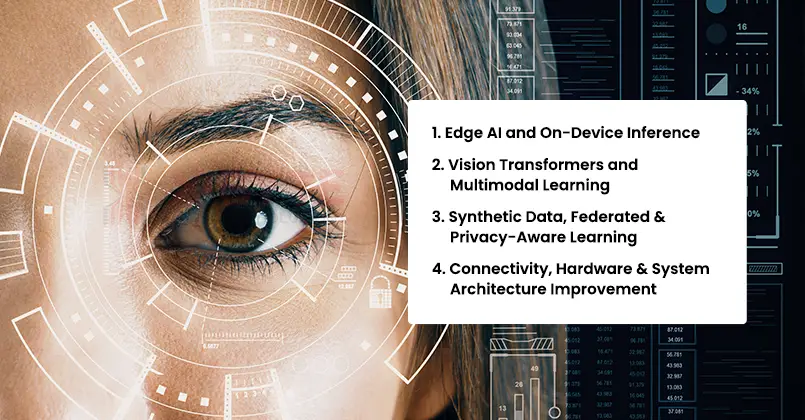
With the culmination of computer vision and IoT, there are several trends that have surfaced. These have helped reduce past limitations (latency, cost, data needs, privacy) and unlock new use cases across industries.
Edge AI and On-Device Inference
Edge AI is a utilitarian computer vision trend of 2025 that is spreading significantly as it offers remarkable benefits. Processing data where it is collected, whether it is on the device or near the sensor, is becoming standard.
Edge AI enables real-time responses, reduces reliance on network connectivity, lowers bandwidth usage, and boosts privacy since raw image/video data needn’t be streamed to a central server. IoT devices these days commonly include specialized inference hardware or AI accelerators that enable vision models to run locally.
Vision Transformers and Multimodal Learning
With the rise of GenAI, traditional convolutional neural networks (CNNs) are being replaced in many use cases by transformer-based architectures, such as Vision Transformers, especially when paired with self- or semi-supervised learning. These models tend to generalize better over varied conditions.
Besides, multimodal integration that combines visual data with text, metadata, audio or other sensor inputs is also rising. This helps systems understand contexts more richly and make more intelligent decisions. For example, using temperature/humidity sensors and video in agriculture.
Synthetic Data, Federated & Privacy-Aware Learning
Ideally, collecting and labeling real images is often expensive, slow, or fraught with privacy/regulatory issues. Therefore, when using computer vision integrated with IoT devices, synthetic data is generated, such as simulations & augmented/virtual environments. This allows creating large, diverse, annotated datasets under different conditions (lighting, angle, occlusion, etc.).
Along with this, federated learning and other privacy-preserving approaches are being adopted more widely. These enable models to learn collectively from many devices without sending raw data to central servers, reducing exposure of sensitive images/video.
Connectivity, Hardware & System Architecture Improvement
With the use of AI computer vision in IoT, the trend or need for better equipment has risen. For example,
- The need for higher bandwidth, lower latency, and more reliable connections has led to the rollout of 5G and 6G.
- Hardware needs that include AI accelerators, including Edge TPUs, neuromorphic chips, and vision-oriented hardware modules, are becoming more resourceful.
- Besides, it is also crucial to balance what is computed locally vs. in the cloud, depending on latency, energy, privacy, and complexity.
Top Use-Cases of Vision‑Powered IoT
Backed by powerful technological trends, businesses across all industries can streamline their operations with AIoT computer vision. From manufacturing to agriculture, the combo of computer vision and IoT has several use cases.
Agriculture & Smart Farming
Farmers can gain a lot from IoT and computer vision. Here are some key applications.
With the use of drones and ground cameras, it becomes easier to detect stress, diseases, and pest infestations, often before they are visible to human inspectors. This allows earlier, targeted interventions. Besides, vision-guided machines distinguish weeds from crops & enable selective herbicide application, reducing chemical use significantly.
Lastly, visual monitoring of behavior, such as movement and feeding patterns, leads to detecting disease or distress early. Farmers can also track whether animals have injuries or abnormal behavior.
Warehouse Management
With the use of real‑time computer vision IoT, warehouse managers can gain better visibility and control. How?
Businesses can use cameras to identify and count items in real time. This ensures accuracy with minimal manual intervention. Trax, a Singapore-based brand, uses shelf cameras and computer vision to track grocery inventory. The computer vision systems can also spot defective or damaged goods before they are shipped. Furthermore, by analyzing customer movement patterns, systems can suggest better layouts for storage and transit zones.
Predictive Maintenance in Manufacturing
Unplanned downtime is one of the key killers of manufacturing productivity. According to stats, unplanned downtime in the U.S. automotive sector can cost $2.3 million per hour. To ensure such hefty losses, it is a smart decision to unleash predictive maintenance procedures.
While computer vision detects outside indications of defects like fractures, leaks, or alignment concerns, IoT sensors collect performance data. These data-driven insights can be sent to maintenance teams proactively, preventing unplanned disruptions.
Retail, Supply Chain & Logistics
The combined use of IoT and computer vision service can help streamline several retail and supply chain operations. For instance, cameras with computer vision can monitor stock levels on shelves and detect empty spots, misplacements, or shrinkage. IoT sensors and computer vision enable automatic restocking or alerts.
Vision systems can also track items that customers pick, allowing them to check out without scanning; objects removed from the shelf are automatically tracked. The same computer vision technology can prevent theft.
Healthcare & Remote Monitoring
In the healthcare sector, AI and machine intelligence in IoT can help in image analysis, remote monitoring, and more. Computer vision is used in radiology, pathology, dermatology, etc., to detect anomalies in X-rays, MRIs, skin lesions, etc. This helps with faster diagnosis and sometimes remote screening.
In elder care homes or hospitals, cameras and sensors monitor patients for falls and abnormal motion & send alerts based on that. This use case is useful, especially when staff can’t constantly supervise. However, there can be issues of privacy and consent here.

Benefits of Computer Vision-Powered IoT
By investing in IoT application development backed by AI and computer vision, businesses can leverage several benefits. While these use cases have some minor implementation challenges, they can power real-time decision-making and save operational costs.
- Real-Time Decision-Making and Reduced Latency
Computer vision and IoT systems, especially when using edge computing, can process image/video data locally rather than waiting for cloud round-trips. This enables immediate action in critical applications. For example, defect detection in manufacturing or obstacle detection for robotics. According to stats, 68% of IoT projects now integrate AI at the edge for enhanced real-time analytics.
- Enhanced Accuracy & Reduced Human Error
Automated vision systems are very good at consistency and can catch visual anomalies that human inspectors might miss, especially over long periods. Pairing vision with sensor data from IoT helps further reduce false positives/negatives.
- Operational Cost Savings & Efficiency Gains
With smart automation of tasks like inventory tracking, shelf monitoring, or quality inspection, businesses reduce labor costs, minimize waste, lower transportation/cloud data costs, and streamline processes. Edge-based CV also cuts bandwidth and storage demand by sending only relevant data.
- Improved Reliability in Poor Connectivity or Remote/Edge Environments
Because processing can happen on or near the device, CV+IoT systems are more resilient when network connections are intermittent or low bandwidth. This makes them suitable for agriculture, remote sites, or mobile platforms.
- Better Visibility, Predictability & Planning
These integrated systems provide continuous, often automated monitoring of parameters like inventory levels, wear & tear, environmental changes, or customer behavior. This automated monitoring of various parameters enables predictive maintenance, better supply chain and stock management, and more informed strategic decision-making.
Challenges & Considerations to Vision‑Based IoT Systems
While the use of computer vision and IoT comes with a number of remarkable benefits, there are some limitations that businesses have to overcome to fully leverage the systems.
- Compute, Power & Resource Constraints
IoT devices often have limited processing power, memory, and battery. Running complex vision models (especially in video or high resolution) demands more resources. Edge devices must optimize (e.g., model compression, quantization, pruning) to balance accuracy and efficiency.
- Standards, Interoperability & Scalability
IoT ecosystems are fragmented. For example, devices from many manufacturers, varied hardware, communication protocols, and firmware versions. Ensuring all components interoperate, adhere to security/privacy standards, and can scale (in number, in geography, and in uses) is complex.
- Cost & Maintenance Over Time
The upfront cost of deploying vision-enabled IoT can be significant. Over time, maintenance costs, such as cleaning sensors/cameras, replacing hardware, updating models, and dealing with environmental wear, accumulate. ROI must account for these.
Conclusion!
If you are a business struggling to keep an eye on your key business processes, computer vision with IoT can be an ideal pick for you. The collaboration between sensors and cameras with powerful AI algorithms can not only provide real-time data, but it can also offer better process efficiency, lower wastage of resources, and higher business revenue.
To leverage these benefits, you need robust backend software. We at X-Byte Solutions have a team of expert developers and visionaries who keep regular tabs on the market for the latest trends. With this, we produce the best and highest-performing IoT and computer vision solutions. If you are up for a demo, contact us today!