
Key Highlights:
- The right food delivery app tech stack forms the foundation of performance, scalability, security, long-term growth & supports multiple food delivery app models.
- A well-planned food delivery app development solution helps control food delivery app development costs by minimizing technical debt and improving maintenance efficiency.
- Future-ready tech choices prepare food delivery apps for AI-driven personalization, smart logistics, and scalable cloud-based growth in the food delivery app development.
Introduction
You open a food delivery app, scroll through menus, place an order, and track it in real time until it reaches your doorstep. That smooth flow feels effortless if you are a user, but for a food delivery startup, a lot is going on behind the scenes.
As on-demand food delivery grows more competitive, users expect fast load times, secure payments, accurate tracking, and zero downtime, especially during peak hours.
And, that’s when choosing the right food delivery app tech stack comes into the picture and becomes important.
Do you know, over 60% of startups face technical debt within their first two years, often due to poor early tech stack choices?
The right tech stack for food delivery app development shapes app performance, scalability, feature flexibility, and your ability to support different food delivery app models.
In this blog, we walk through the must-have technologies behind modern food delivery platforms, key factors to consider while choosing a food delivery app tech stack, food delivery app development cost, etc.
What Exactly Is a Tech Stack?
A tech stack is the combination of technologies used to build, run, and scale an online product. In the context of on-demand food delivery, the Food Delivery App Tech Stack includes all the tools that power the app interface, process orders, manage users, handle payments, and support real-time delivery tracking.
A simple example to understand tech-stack
- Customer-facing area (Front end): This is the mobile app or website users interact with, including menus, search, cart, and checkout. A well-built front end improves user experience and conversions.
- Operations (Back end): This manages orders, user accounts, restaurant listings, delivery partner allocation, and notifications. It keeps everything connected in real time.
- Data storage (Database): This stores critical data such as customer profiles, order history, restaurant menus, pricing, and delivery addresses.
- Support system (Cloud & infrastructure): This ensures the app stays fast, secure, and available, even during peak hours. It also plays a major role in controlling food delivery app development cost and supporting different food delivery app models as the business grows.
Together, these components form the food delivery app tech stack. Choosing the right stack early helps a food delivery startup launch faster, scale smoothly, and prepare for the food delivery app development future without constant rebuilds.
In short, a tech stack isn’t just about technology; it’s the foundation that determines how reliable, scalable, and successful your food delivery app will be.
Why Food Delivery App Development Needs the Right Tech Stack?
Choosing the right food delivery app tech stack is not just a technical decision, but a business-critical one. The tech stack for food delivery app development directly affects performance, scalability, cost, and long-term growth.
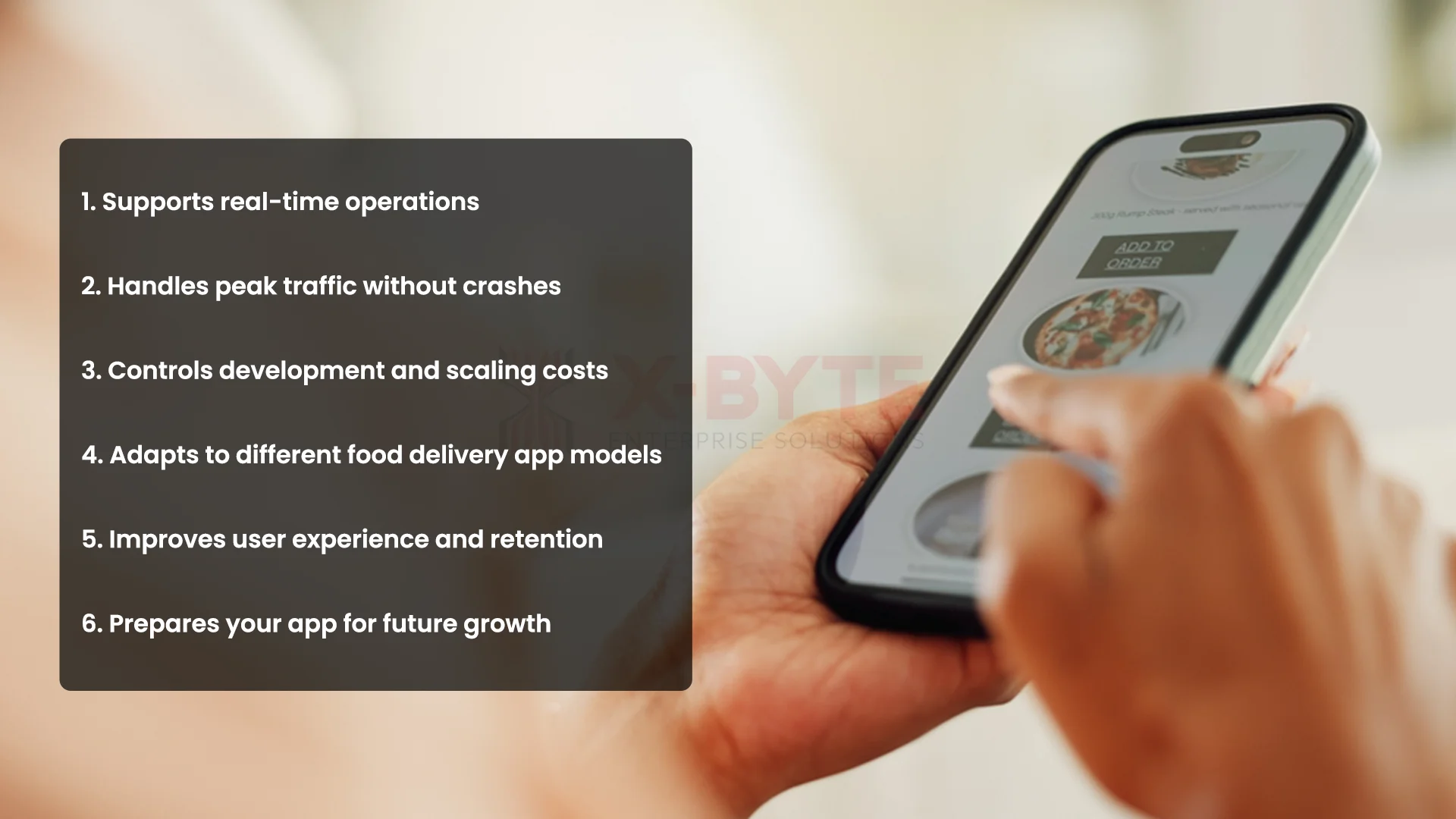
1. Supports real-time operations:
On-demand food delivery app requires instant order processing, live delivery tracking, and real-time notifications. The right tech stack ensures smooth coordination between customers, restaurants, and delivery partners.
2. Handles peak traffic without crashes:
Lunch and dinner rush hours push apps to their limits. A scalable food delivery app development solution keeps your platform fast and stable, even during high-demand periods.
3. Controls development and scaling costs:
Smart tech choices help manage food delivery app development cost by reducing rework, avoiding technical debt, and supporting future growth without major rebuilds.
4. Adapts to different food delivery app models:
Whether you run an aggregator model, a cloud kitchen model, or a hybrid setup, a flexible tech stack lets you support multiple food delivery app models from a single platform.
5. Improves user experience and retention:
In these competitive times, where competitors are looking for that one chance to get your customers, the user experience of your app plays a crucial role. Studies show that 88% of users are unlikely to return after a bad app experience.
And, with the right tech-stack, you can ensure faster load times, smooth navigation, and secure payments, leading to better user experience and improved retention as well.
6. Prepares your app for future growth:
The right food delivery app tech stack makes it easier to add advanced features like AI-based recommendations, smarter logistics, and analytics, helping your food delivery startup stay ready for the food delivery app development.
Key Factors to Consider When Choosing a Tech Stack for Food Delivery Apps
Choosing the right food delivery app tech stack is not just about picking popular technologies; it’s about aligning your tech decisions with how your product will perform, scale, and compete in a fast-moving market.
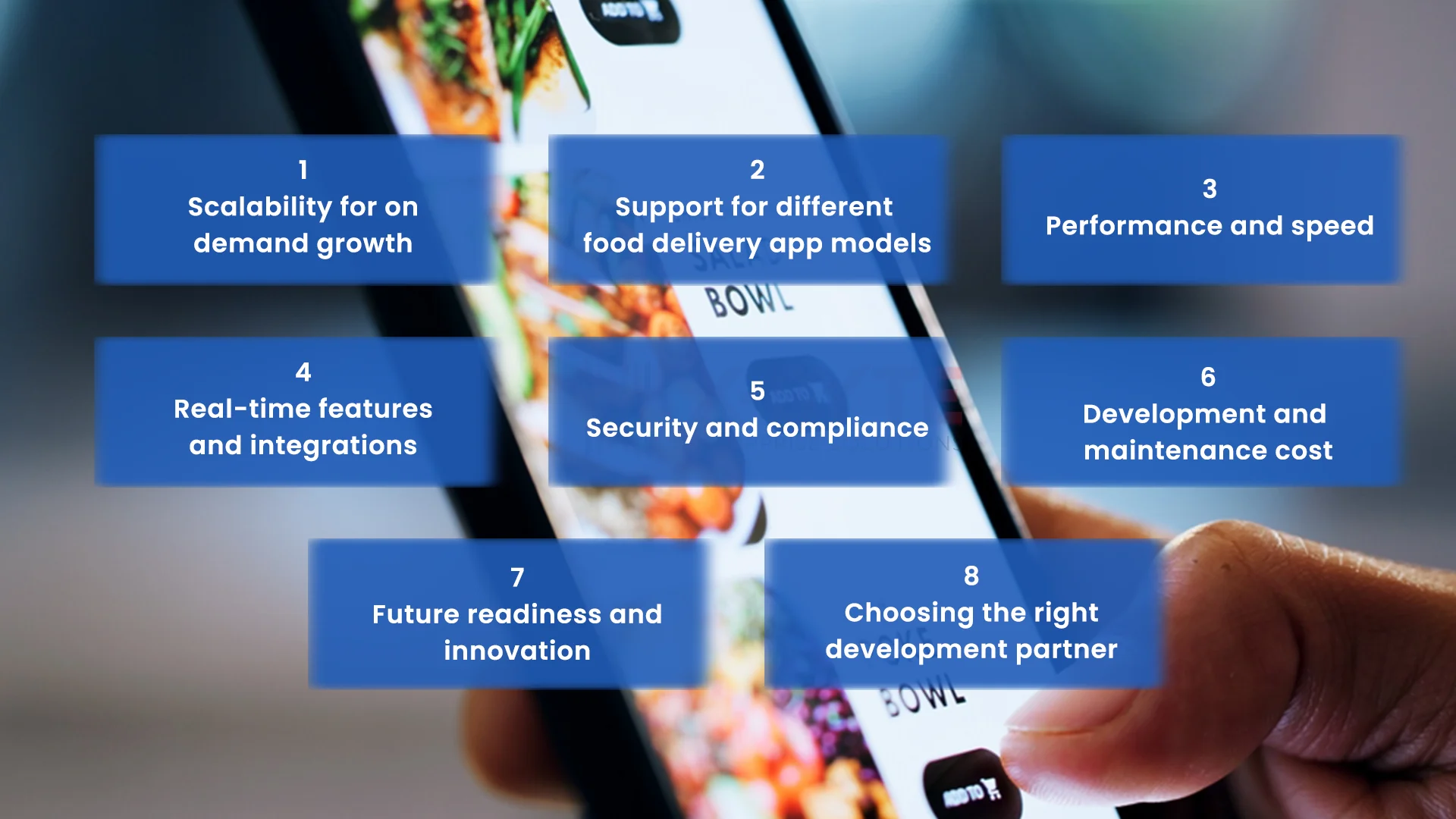
Here are the key factors you should consider before finalizing your tech stack:
1. Scalability for on-demand growth
On-demand food delivery apps experience sudden traffic spikes during lunch hours, weekends, and promotions. Your tech stack should scale easily without performance drops, helping your platform grow across cities, users, and restaurants without constant rework.
2. Support for different food delivery app models
Aggregator, marketplace, cloud kitchen, or hybrid, each model has different technical needs. A flexible food delivery app development solution should support multiple food delivery app models from a single system as your business evolves.
3. Performance and speed
App speed plays a major role in user retention. The right front-end and backend technologies ensure fast load times, smooth navigation, real-time order updates, and accurate delivery tracking, critical for user trust in food delivery apps.
4. Real-time features and integrations
Live order tracking, instant notifications, payment gateways, restaurant dashboards, and delivery partner apps all rely on seamless integrations. Your food delivery app tech stack should handle real-time data flow without delays or failures.
5. Security and compliance
Food delivery apps process sensitive user data and online payments. Choosing secure frameworks, databases, and cloud infrastructure helps protect user information and builds credibility, especially as your platform scales.
6. Development and maintenance cost
The tech stack you choose affects not only initial development but also long-term food delivery app development cost. Technologies that are easy to maintain, widely supported, and developer-friendly reduce future expenses and speed up updates.
7. Future readiness and innovation
The food delivery app development future points toward AI-driven recommendations, smarter logistics, and deeper analytics. A future-ready tech stack makes it easier to add advanced features without rebuilding the entire system.
8. Choosing the right development partner
The best food delivery app development company helps you choose a tech stack based on your business goals, not just trends. The right partner ensures your stack supports growth, stability, and long-term success.
By evaluating these factors carefully, you set a strong foundation for building a scalable, secure, and future-ready food delivery app development solution that supports your business today and adapts as the market evolves.
Essential Tech Stack Options for Building a Food Delivery App
Building a reliable, high-performing food delivery platform starts with choosing the right food delivery app tech stack across every layer of your product, while effectively leveraging food delivery data to optimize performance, enhance user experience, and drive smarter business decisions.
Each component, from what users see on the screen to how data flows in the background, is an essential tech stack option commonly used in modern tech stacks for food delivery app development.
1. Frontend Technologies
The frontend defines how users interact with your app. It directly impacts user experience, engagement, and retention in on-demand food delivery platforms.
Common frontend options include:
- React Native – Ideal for building cross-platform mobile apps faster with a single codebase.
- Flutter – Known for smooth UI performance and visually rich experiences.
- Swift (iOS) & Kotlin (Android) – Best for native performance when building platform-specific apps.
- React.js / Angular / Vue.js – Popular choices for customer-facing and restaurant web dashboards.
2. Backend Technologies
The backend powers everything behind the scenes, including orders, users, payments, delivery logic, and notifications. It forms the backbone of any food delivery app development solution.
Popular backend technologies include:
- Node.js – Great for real-time features like order updates and live tracking.
- Python (Django/FastAPI) – Clean, scalable, and ideal for data-driven features.
- Java (Spring Boot) – Reliable and widely used for large-scale food delivery platforms.
- PHP (Laravel) – Cost-effective and suitable for MVPs and early-stage food delivery startups.
Here’s the tip from Experts: Choose a backend that supports asynchronous and real-time processing early on. Food delivery apps grow fast, and backend limitations are one of the biggest reasons platforms struggle during peak hours.
3. Databases
Databases store and manage all critical data, users, restaurants, menus, orders, delivery status, and payment history.
Common database choices:
- PostgreSQL / MySQL – Reliable relational databases for structured data.
- MongoDB – Flexible NoSQL option for fast-changing data like menus and order statuses.
- Redis – Used for caching and speeding up real-time operations like live tracking.
Experts Tip: Always design APIs with fallback options. For example, having multiple payment gateways or notification services prevents order failures when one service faces downtime.
4. APIs & Integrations (Maps, Payments, Notifications)
APIs connect your app with essential third-party services that make food delivery apps functional and user-friendly.
Key integrations include:
- Maps & location services: Google Maps, Mapbox (for live tracking and delivery routing)
- Payment gateways: Stripe, Razorpay, PayPal (for secure online payments)
- Notifications: Firebase Cloud Messaging, Twilio (for order updates via push, SMS, or email)
5. Cloud & DevOps Stack
Cloud infrastructure ensures your app stays online, fast, and scalable—especially during high-demand hours.
Popular cloud and DevOps tools:
- AWS/Google Cloud /Microsoft Azure – Scalable hosting and backend services
- Docker & Kubernetes – For containerization and efficient deployment
- CI/CD pipelines – Faster updates, bug fixes, and feature releases
A cloud-based setup helps control food delivery app development cost while supporting future growth.
6. Security & Compliance Technologies
Security is non-negotiable for food delivery apps that handle payments and personal data.
Essential security components include:
- SSL encryption – Secures data transmission
- OAuth & JWT – For secure authentication and user access
- PCI-DSS compliance – Required for handling online payments
- GDPR & data protection tools – Ensures user data privacy
A secure tech stack builds user trust and protects your platform as it scales.
Choosing the right combination of these essential tech stack options lays the foundation for a scalable, secure, and future-ready food delivery app development solution. This is also where partnering with the best food delivery app development company can make a real difference, helping you select technologies that align with your business goals and the food delivery app development.
How to Implement and Test Your Tech Stack Effectively?
Choosing the right food delivery app tech stack is only the first step. How you implement and test that stack decides whether your app delivers a smooth, reliable experience in real-world conditions. Here are some of the best tips:
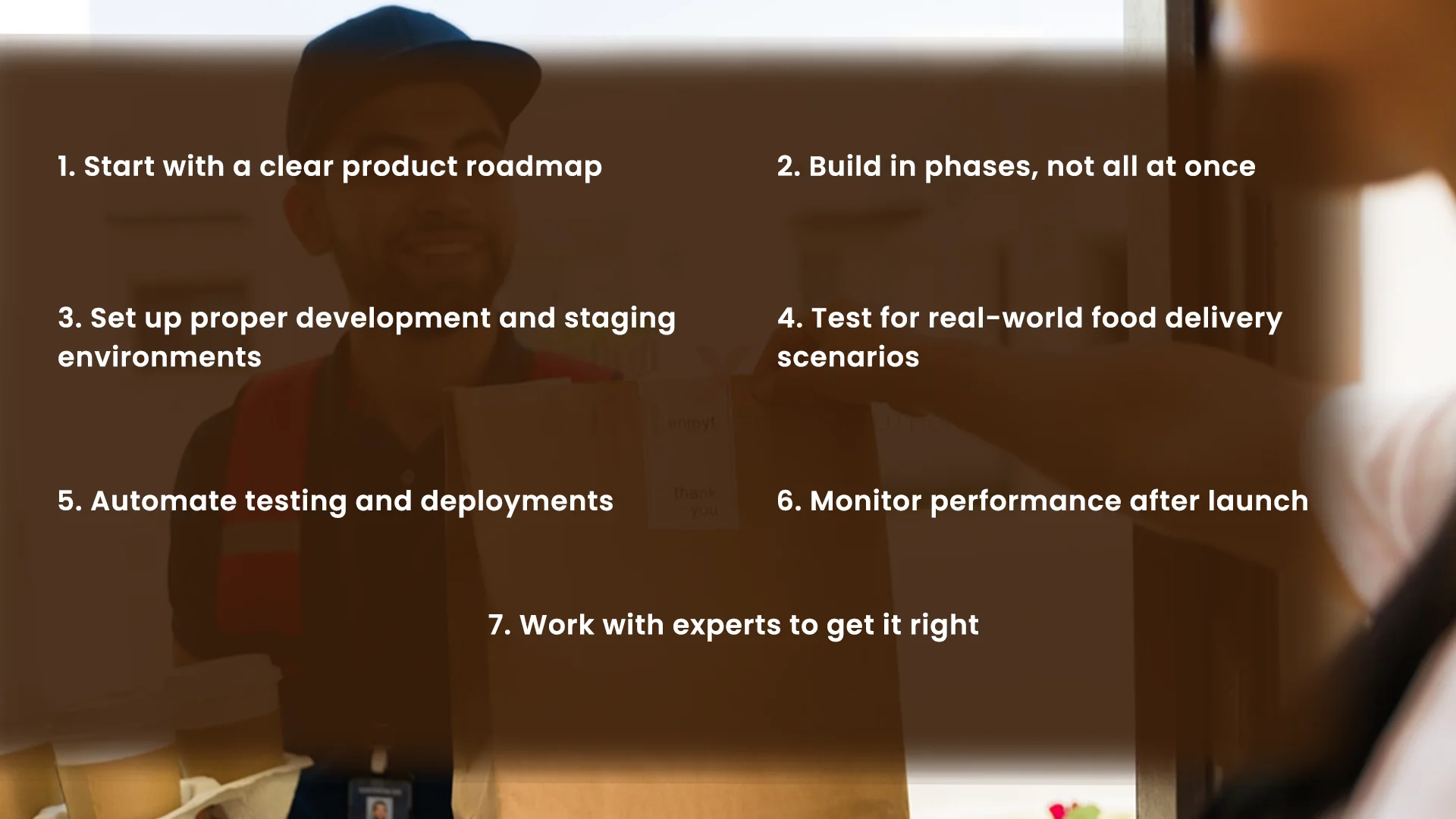
1. Start with a clear product roadmap
Before development begins, align your tech stack with your business goals.
- Define the food delivery app models you plan to support,
- the core features required for launch,
- and the capabilities you’ll add later.
This clarity helps teams implement the right technologies without overcomplicating the system early on.
2. Build in phases, not all at once
Implement your tech stack for food delivery app development in stages.
- Begin with essentials like user onboarding, restaurant listings, order flow, and payments
- Add real-time tracking, notifications, and advanced features once the foundation is stable
- Keep your architecture modular, so updates don’t disrupt the entire platform
This phased approach keeps development flexible and scalable.
3. Set up proper development and staging environments
Avoid testing directly on your live app. Use separate environments for development, staging, and production to test your food delivery app development solution safely.
- Development for building and experimentation
- Staging for real-world simulations
- Production for live users
This setup minimizes deployment risks and performance issues.
4. Test for real-world food delivery scenarios
Food delivery apps operate under unpredictable conditions. Your testing strategy should reflect real user behavior.
Test for:
- High traffic during lunch and dinner hours
- Simultaneous orders from multiple users
- Payment failures and retries
- Delivery delays and rider reassignment
- Slow or unstable network conditions
This ensures your food delivery app tech stack performs reliably when demand peaks.
5. Automate testing and deployments
Automation improves consistency and speeds up releases as your app grows.
- Automate API, payment, and notification testing
- Run regression tests after every update
- Use CI/CD pipelines to deploy features with minimal downtime
Automation keeps quality high without slowing down development.
6. Monitor performance after launch
Post-launch monitoring helps identify issues early and optimize performance.
Track:
- App load speed and API response times
- Server uptime and error rates
- Payment success rates
- Crash reports and user behavior patterns
Continuous monitoring keeps your platform stable as usage increases.
7. Work with experts to get it right
Choosing and implementing the right food delivery app tech stack can be complex, especially as your product scales.
This is where working with a leading app development company adds real value. Experienced teams help you evaluate the right technologies, plan for scalability, and implement a food delivery app development solution that aligns with your business.
A trusted development partner can also handle end-to-end implementation, so you focus on growth while they build the best food delivery app your users deserve, optimized for performance, security, and future expansion.
Also Read: The Ultimate Guide for Food Delivery App Development
Future Tech Trends That Will Power the Next Generation of Food Delivery Apps
The food delivery app development will move far beyond simple ordering and tracking. As competition grows and user expectations rise, food delivery platforms will rely on smarter, faster, and more adaptive technologies. The next generation of food delivery app tech stack choices will focus on intelligence, automation, and real-time decision-making.
Here are the key tech trends shaping what’s next, along with data-backed signals where it matters.
1. AI-Powered Personalization & Recommendations
Food delivery apps will increasingly use AI to recommend dishes, restaurants, and offers based on user behavior, order history, time of day, and location.
AI-driven personalization can increase conversion rates by up to 15-20% by showing users what they are most likely to order.
For any food delivery startup, this means choosing a tech stack that supports machine learning, analytics, and real-time data processing.
2. Smart Logistics & AI-Based Delivery Optimization
Future food delivery apps will rely on AI to optimize delivery routes, assign riders, and predict delays before they happen. AI-based route optimization can reduce delivery times by 20–30%, directly improving customer satisfaction and operational efficiency.
This trend makes backend scalability and real-time processing essential parts of the tech stack for food delivery app development.
3. Voice Ordering & Conversational Interfaces
Voice assistants and chat-based ordering will become more common, especially for repeat users. The global voice assistant market is expected to reach $50+ billion by 2030, driven by smart devices and conversational AI adoption.
Food delivery apps that support voice search and conversational ordering will need flexible APIs and AI-ready infrastructure.
4. Cloud-Native & Serverless Architecture
As traffic fluctuates throughout the day, cloud-native and serverless architectures will power scalability without inflating the food delivery app development cost. This makes cloud-first decisions a long-term advantage for growing food delivery platforms.
5. Hyperlocal & Predictive Demand Forecasting
Future apps will predict demand at a neighborhood level, helping restaurants prepare better and reduce cancellations. Predictive analytics can cut demand forecasting errors by 20–50%, improving supply planning and delivery efficiency.
This trend pushes food delivery apps toward data-driven backend systems and advanced analytics layers.
6. Stronger Focus on Security & Privacy-First Design
Global cybercrime costs are expected to reach $10.5 trillion annually, making secure architectures a priority for apps handling payments and personal data. With rising digital transactions, future food delivery apps will embed security deeply into their tech stack. And, the security-first food delivery app development solutions will gain user trust and regulatory confidence.
Final Thoughts
If there’s one takeaway from this guide, it’s this: a food delivery app is only as strong as the tech stack behind it. The right choices early on make your app faster, easier to scale, and far less painful to maintain later.
You don’t need to overbuild or chase every new tool. Start with a stack that supports real users, real traffic, and real growth. And when you’re unsure, getting the right guidance can save you time, cost, and rework, while helping you build the kind of food delivery app users actually enjoy using.