
Quick Summary: Gen AI is making waves in e-commerce with its use cases for content creation (to write product metas and descriptions), real-time and personalized recommendation capabilities, and empowering customer service teams with virtual assistants that can handle customer queries and orders on their behalf. Gen AI also helps e-commerce businesses deploy virtual shopping assistants with features for virtual try-ons. The benefits of Gen AI-led automation in e-store operations are immense.
In the age where most e-commerce shoppers are super-busy professionals and urban citizens who value bespoke experiences, E-commerce businesses face mounting pressure to deliver personalized product recommendations and custom-made interactions that solve shoppers’ issues quickly.
Generative AI in E-commerce addresses these challenges directly. Gen-AI-powered chatbots improve the speed of customer services like refund queries, and Gen-AI’s personalized recommendations help shoppers in shortlisting the products from thousands of listings.
Early adopters of the tech, like Amazon, eBay, Walmart, and Kroger, are already seeing measurable returns on their investments.
With the help of AI/ML development services for retail and e-commerce, you can build intelligent chatbots featuring generative AI and NLP for deep conversational abilities. Smart e-commerce businesses deploy AI chatbots for customer service, use gen AI for personalized product recommendations, and even take the help of generative artificial intelligence to optimize supply chains.
This article discusses the top use cases and benefits of Gen AI for e-commerce and retail businesses.
Why Generative AI Changes Everything for E-commerce?
Traditional AI analyzed data. Generative AI creates one. Gen AI is powerful enough to create entirely new content, solutions, and experiences that were impossible to achieve at scale.
Consider the numbers from an e-commerce company with 5,000 customer service agents. Generative AI increased issue resolution by 14% per hour and reduced handling time by 9%. These improvements in operations tell the story of how Gen AI transforms e-commerce’s core operations.
Gen AI solves the issue of unsatisfied customers who are not addressed by customer services due to a lack of time or unavailability of customer care representatives due to skill shortage or overburdened scenarios.
Gen AI solves this by creating the availability of chat agents that mimic human behaviors and sometimes are more empathic, knowledgeable, and competent to solve customer issues than their human counterparts.
The technology’s ability to provide immediate, personalized responses to complex customer inquiries in multiple languages changes the game for online businesses.
In e-commerce, now even the millennial marketers are using Gen AI for content creation. show similar patterns. From creating personalized ad campaigns to rewriting product descriptions, Gen AI not only reduces the time involved in content creation but also makes it more standardized. As AI-powered content creation tools can follow instructions for brand style, content writing style, and add brand elements in content, it is now being preferred for content creation over ad copywriters.
Gen AI adoption in e-commerce reveals the real opportunity:
- 71% of consumers surveyed by Capgemini revealed they want generative AI integrated into their shopping experiences (source)
- Gen AI’s customer review summaries help synthesize feedback data.(source)
- Companies like Amazon and Meta are embedding GenAI tools into their offering. (source)
- Amazon uses GPT-3 for product recommendations.(source)
- 40% of shoppers who have used generative AI tools would use a virtual AI shopping assistant for online shopping (source)
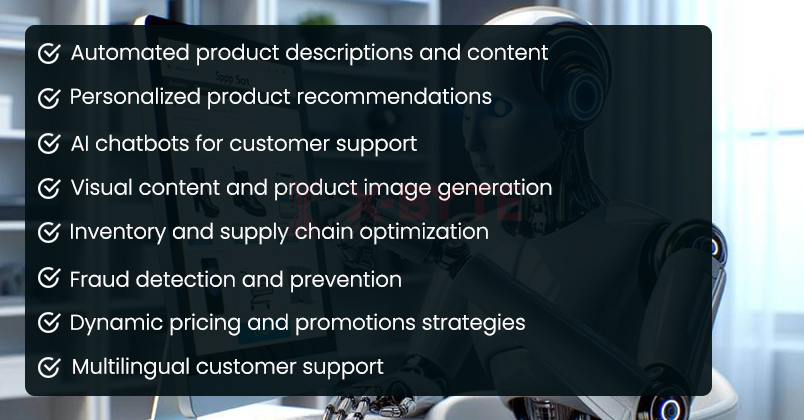
8 Popular Use Cases of Generative AI in E-commerce
E-commerce businesses face the same challenges whether they’re startup marketplaces or established retailers: creating compelling content at scale, personalizing customer experiences, and managing complex operations efficiently. Generative AI provides practical solutions to these persistent problems.
Core areas where Gen AI helps e-commerce businesses include dynamic pricing, product recommendations, customer interactions, product description content generation, and decision-making. (Decision-making in broad areas from supply chain and warehouse layout to stocking and feature decisions).
Here are the eight most meaningful ways AI is changing the game:
1. Automated product descriptions and content
Writing product descriptions for thousands of items is a time-consuming nightmare for most retailers. Also, there are variants and SKUs of similar types of products that again need different product descriptions. Generative AI changes this completely. Gen AI tools let e-store marketers generate quality product descriptions at speed. The real advantage goes beyond speed. AI-generated content maintains brand voice across your entire product catalog. Content creators can instruct AI tools to match specific brand tones.
2. Personalized product recommendations
Another area where Gen AI helps e-commerce business owners is product recommendations. In fact, AI is redefining shopping with product recommendations. By analyzing historical data of shoppers’ baskets, orders, clicks, search queries, and purchases, Gen AI-powered recommendation engines can provide bespoke suggestions to shoppers. These tools are capable of creating detailed customer profiles, noting personas and interests, tastes, and preferences of individual shoppers and applying ML to shoot well-targeted recommendations that translate into conversions.
3. AI chatbots for customer support
Customer service teams are predominantly bombarded with the same issues and provide the same answers to different customers. Only a few resolutions require complex human decision-making by the service agent. Gen AI chatbots can handle the primary queries and free agents from repetitive questions. They can attend to customers transferred by chatbots for human resolution. AI-powered chatbots provide 24/7 support regardless of business hours, holidays, or time zones. The virtual shopping assistants can even book orders on behalf of customers.
4. Visual content and product image generation
Creating product images traditionally requires photographers, models, and extensive editing. Generative AI eliminates much of this complexity by generating realistic product images with custom scenes and backgrounds. Image generation AI models like DALL-E, Stable Diffusion Leonardo AI can create AI-generated “virtual try-on” videos, product images from different angles, and also marketing images/videos.
5. Inventory and supply chain optimization
Predicting demand accurately determines success or failure in e-commerce. AI systems can analyze historical sales data, market trends, and external factors to predict inventory demand and strategize supply chain operations accordingly. The role of AI in inventory management extends to automating replenishment by keeping a record of suppliers, mapping product-wise suppliers, and placing orders without human intervention. E-commerce companies can use predictive analytics to optimize truckloads, delivery routes, etc.
6. Fraud detection and prevention
E-commerce fraud costs businesses billions annually. AI fraud detection systems analyze vast amounts of data to identify irregular patterns and potential fraud, while Data Loss Prevention (DLP) software ensures that sensitive information remains protected from unauthorized access or leakage. These systems monitor transaction patterns for signs like unusually large withdrawals or unexpected overseas transactions. Gen AI’s advanced features, like detecting fraud links and anomalies, accurately identifying fraud patterns, etc., can help detect and mitigate e-commerce fraud.
7. Dynamic pricing and promotions strategies
8. Multilingual customer support
Language barriers cost e-commerce businesses significant revenue. Multi-language AI lets businesses talk to customers in their preferred language, which builds trust and increases online sales. Consumers are more likely to return if websites provide services in their native language.
AI-powered multilingual customer service addresses this by greeting customers in their preferred language at first interaction and providing immediate support, giving shoppers confidence to complete purchases.

Are language barriers costing you international sales and frustrated customers?
Benefits of Generative AI in E-commerce
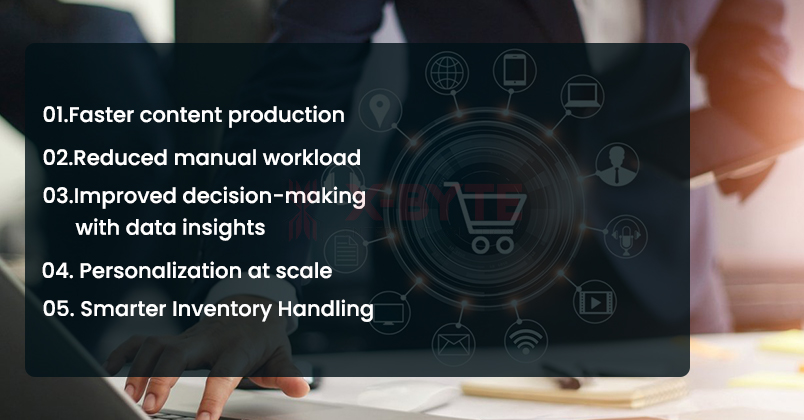
Gen AI in e-commerce delivers substantial operational and experiential improvements that directly affect how e-commerce owners run their day-to-day operations. From rapid content generation to automated processes and superior decision support, AI/ML in retail and e-commerce deliver measurable operational advantages that directly impact the bottom line.
Faster content production
AI systems’ speed gives them a huge edge in e-commerce operations. These systems create content much faster than human teams. Faster content creation expedites the launching of products. It helps in keeping product descriptions fresh and updating descriptions faster. Also, Gen AI can create different content for different listing platforms like creating social media posts for audience etc.
Marketing teams face a constant challenge: producing compelling content at scale while maintaining quality and personalization. The traditional approach meant weeks of creative development, testing, and refinement. Now, companies are shortening their time to market from weeks to days or even hours by using Gen AI.
| Ad Copies Written by Gen AI Creating effective ad copy across multiple platforms used to require extensive A/B testing and considerable guesswork. Generative AI changes this by analyzing your product, brand, and target audience to generate high-converting ad copies in seconds and letting marketers test different versions quickly. | Gen AI for Email Marketing Sophisticated AI systems analyze customer data from multiple touchpoints like browsing behavior, purchase history, and POS to create dynamic email content customized for different customer segments and automatically send emails based on specific customer actions like abandoned carts or post-purchase follow-ups. | Gen AI for Social Media AI content creation tools generate ideas, create visuals, post content, and suggest trending hashtags for social media marketing. Gen Ai tools can create personalized posts (generate copy, images, and video with minimal input) for different social media channels and audiences, capitalizing on current trends. |
Reduced manual workload
Generative AI’s automation cuts down manual work in many areas. Chatbots can show 24/7 for work, handle most routine customer service tasks, and answer customer queries with the same empathetic intensity and knowledge as a human would. E-commerce companies save money through workflow automation and better operations, and see fewer errors with automated processes. Less manual work means companies can put more resources into breakthroughs, new launches, innovations, and promotions.
Improved decision-making with data insights
Gen AI’s biggest strength lies in its ability to improve decisions through better data analysis. From inventory decisions in e-commerce to whether the prices for a product must be reduced or increased, and in what percentage, Gen AI can make decisions based on data, without bias. These tools don’t miss opportunities and are equipped to make decisions in real-time.
Generative AI reshapes the scene in e-commerce operations by creating efficiencies that weren’t possible at scale before.
“The future of sales is to serve, not sell. Generative AI gives us guidance that’s so personal and precise, we’re always presenting the most relevant solutions — no pushing required.” Rob Garf Vice President and General Manager, Salesforce Retail |
Personalization at scale
Generative AI transforms e-commerce personalization from basic product recommendations to truly individualized shopping experiences. AI-powered virtual shopping assistants now provide conversational guidance tailored to individual preferences and past behaviors. These assistants can talk to thousands of customers at once (personalization at scale that was never imagined before).
Smarter Inventory Handling
Abandoned carts are climbing while your customer service team remains busy?
Get built omnichannel AI assistants to work around the clock, guiding shoppers through purchase decisions.
Gen AI Tools Behind E-commerce Success
The practical applications we’ve discussed don’t happen in a vacuum. They’re powered by specific AI tools.
The prominent ones are below:
ChatGPT and Large Language Models
Large Language Models (LLMs) like ChatGPT excel at understanding and generating human-like text. For e-commerce businesses, this capability translates into practical advantages across customer interactions and content creation.
These models handle tasks that traditional technologies struggle with:
- Customer conversations: LLMs can answer complex product questions in natural language, helping customers make purchase decisions
- Content generation: They produce product descriptions, email campaigns, and social media content at scale
- Personalized recommendations: When combined with customer data, LLMs can explain why specific products match individual preferences
DALL-E and Visual Content Generation
Visual content is key to e-commerce success. Product images are the first things that shoppers check before reading descriptions. DALL-E and similar image generators create original visuals from text descriptions, taking visual content generation to the next level. DALL-E 2 produces significantly higher quality images than its predecessor, with evaluators preferring it for both accuracy and photorealism.
How Can You Use Generative AI For Your E-commerce Business?
Getting generative AI working in your e-commerce business isn’t about jumping on the latest trend. It’s about solving real problems that cost you money and customers every day.
Step 1: Find your biggest opportunities first
Start by looking at where your current operations break down. Consider three key questions when evaluating potential use cases: does it add value and drive growth (viability), how complex is the implementation (feasibility), and will it maintain customer confidence (trust)?
Examine your entire commerce operation to spot improvement opportunities. The areas that typically deliver the biggest impact include:
- Product discovery and personalization
- Content creation and optimization
- Inventory management and demand forecasting
- Customer service automation
Focus on processes where you’re losing efficiency or where competitors are already ahead. That’s where you’ll see the fastest returns.
Step 2: Pick the right Gen AI tools for your needs
Once you know what problems you’re solving, choose AI technologies that match your specific requirements.
Think about:
- How well does the functionality align with your business objectives
- Whether the solution can scale as your operations grow
- How easily it integrates with your existing systems
- Total implementation and maintenance costs
For most e-commerce businesses, you’ll decide between building custom solutions or using third-party platforms. Take help from an AI development service to implement applications for content generation, product recommendation engines, etc.
Step 3: Connect everything smoothly
Before you go live, develop a solid data strategy that covers:
- How you’ll collect, store, and process data
- Quality issues and gaps in your current data
- Infrastructure requirements to support AI development
Start with pilot projects in high-impact areas and monitor results closely to refine your approach. Make sure everything connects seamlessly with your existing technology stack—ERP, CRM, PIM, and CMS systems.
Remember, successful integration requires continuous evaluation and improvement. As you gather performance data, keep refining your solutions and expanding to additional use cases.
Conclusion
E-commerce businesses face a defining moment with the advent of Gen AI. Companies that embrace generative AI now will lead the market. Those who deliver personalized experiences at scale will thrive. For e-commerce businesses wanting to use Gen AI, error-free implementation is key.
As challenges exist regarding data privacy, AI bias, and transparency issues, choosing the right implementation partners for Gen AI is critical for reaping its benefits.
We at X-Byte have a team that has helped many retail and e-commerce businesses develop, design, and implement sophisticated AI/ML solutions to solve various operational challenges with Gen AI-led automation.
Implement Generative AI content solutions to create compelling product descriptions and ad copies at scale. Connect to know more about our AI/ML development services.