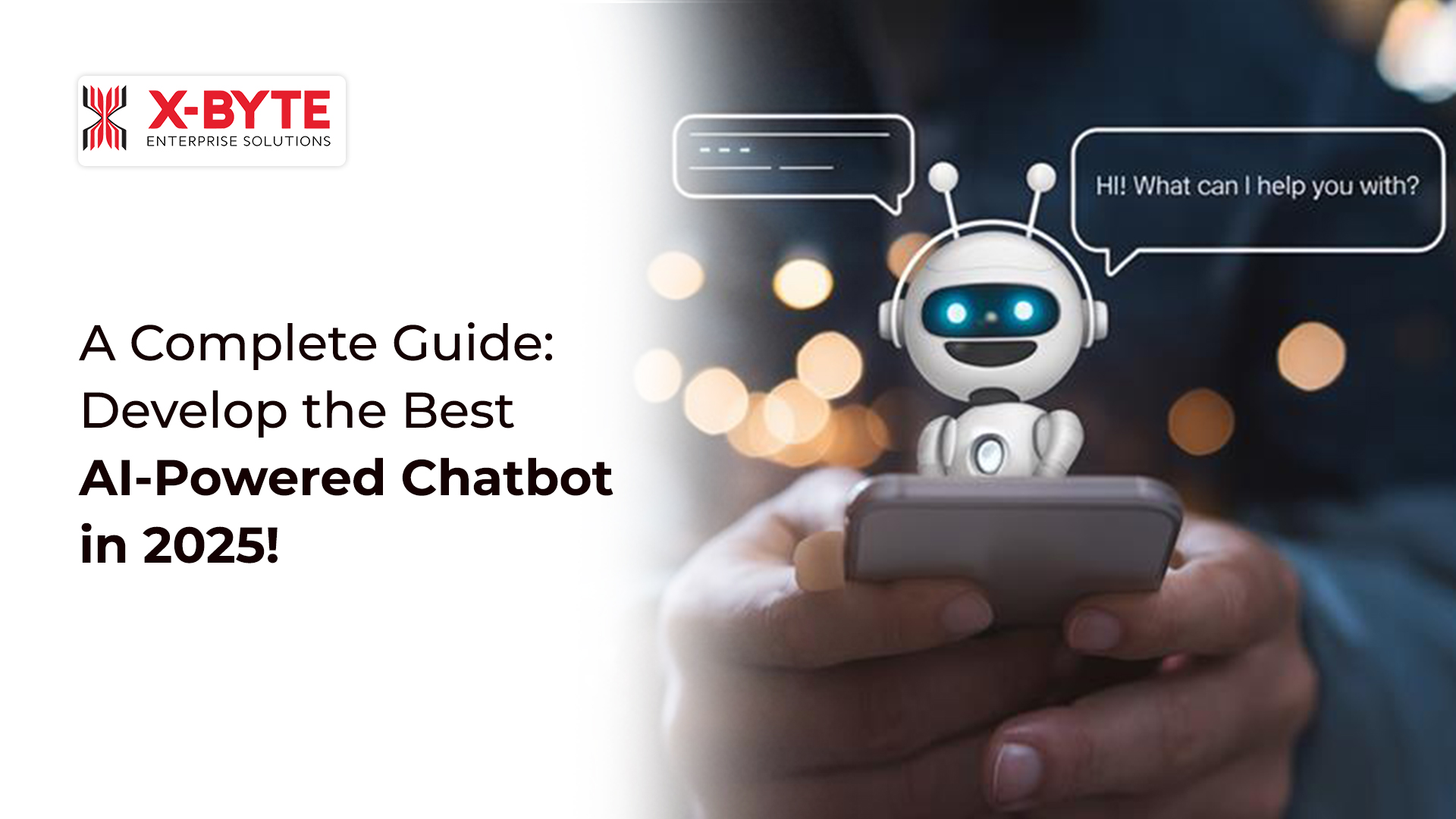
Quick Summary: The development of AI chatbots should be based on a lifecycle design that leverages NLP, ML, and rapid frameworks. In this guide, we’ll learn about the crucial AI chatbot development process, step by step. It includes everything from understanding primary objectives to selecting the proper development platform. We’ll also review the key architectural components and examine the enterprise use cases. Here, we’ll also cover the concept of integrating AI models, such as LLMs, for smart interactions. This blog shall provide you with a detailed insight into how you can transform the conversational AI chatbots. It can help you to start from scratch and even scale up your business needs.
In 2025, customer interactions with AI-powered chatbots are taking a speedy evolutionary leap in businesses. It provides customers with timely support, personal communication, and support available round-the-clock. The AI-driven potential of virtual assistants is too powerful to ignore. It includes a wide range of businesses, from startups seeking to automate their basic support to enterprises aiming to scale up their channel services.
If you’re planning a roadmap with AI chatbot development, exploring its AI-driven version, or implementing a conversational AI chatbot, you’re in the right place. This blog shall guide you through every essential step.
We’ll begin with defining your goals and selecting frameworks, and then take you through the training process. We will also discuss the process of integrating existing systems.
After reading this blog, you’ll know how to build the chatbot in a smart, scalable, and business-driving fashion.
Building an AI-Powered Chatbot: A Step-by-Step Process!
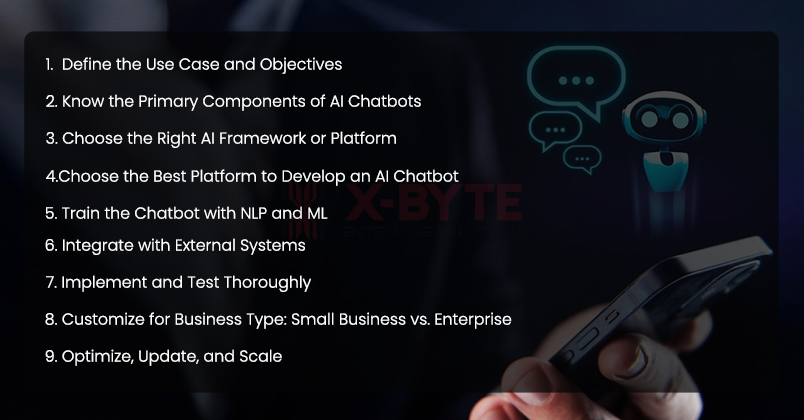
1. Define the Use Case and Objectives
The most logical thing to do in the development of an AI-powered chatbot is to know why you need one. Defining the central role of a chatbot will give you confidence that you are not building features that do not meet the expectations of users and the business.
Common chatbot use cases include:
- Customer support for 24/7 issue resolution
- Sales assistance to guide prospects through buying decisions
- Appointment scheduling across various business sectors
- Lead qualification to filter and segment prospects
- Automated FAQ handling for quick answers
The early identification of objectives helps to design a better workflow, provides proper NLP training, and even yields measurable performance results.
2. Know the Primary Components of AI Chatbots
| Component | Description |
|---|---|
| NLP (Natural Language Processing) | Allows the chatbot to understand user input in natural language |
| Machine Learning | Helps the bot learn from past interactions |
| Dialogue Management | Controls conversation flow |
| Knowledge Base | Stores product information, FAQs, policies, and other relevant details. |
| Integration APIs | Connects chatbot with databases, CRMs, and 3rd-party systems |
| Analytics & Monitoring | Tracks bot performance and user satisfaction |
3. Choose the Right AI Framework or Platform
To get started with an AI chatbot, a proper choice of the tech stack is crucial. Your decision will determine the flexibility, integration capabilities, scalability, and long-term maintenance work. Some well-known AI chatbot frameworks are:
- Rasa
- Microsoft Bot Framework
- Dialogflow
- Botpress
- IBM Watson
Others can be customized to fit any special business process, whereas some have inbuilt NLP engines. Consider aspects such as community support, deployment flexibility, and training simplicity.
As a developer, if you wish to create an AI chatbot using Python, then choose Rasa. It is one of the most adaptable and code-friendly frameworks.
4. Choose the Best Platform to Develop an AI Chatbot
Select a platform based on the complexity of your requirements and the target audience you wish to reach. Look for a tool that suits your needs, whether it’s a no-code, low-code, or custom-made development AI chatbot builder.
Top 4 platforms to develop an AI chatbot:
- Botpress: Offers open-source flexibility and pre-built modules
- Dialogflow: Great for Google Cloud integrations
- Rasa: Fully customizable with advanced ML/NLP capabilities
- Microsoft Power Virtual Agents: Suitable for enterprise-level deployments
The feature capabilities that your platform contains include scalability, analytics, and cross-channel deployment. They are essential as well when you want to concentrate on growth.
Smart, scalable, and trained to drive honest customer conversations from day one.
5. Train the Chatbot with NLP and ML
Training involves feeding your bot with datasets, use cases, and dialogue flows. For enhanced performance, integrate:
- Natural Language Processing for Language Understanding
- Machine learning for chatbots to improve over time
You may need professional support for Machine Learning development to refine responses, intent detection, and contextual accuracy.
6. Integrate with External Systems
For chatbots to work seamlessly, integrate with CRMs, helpdesks, payment gateways, and messaging apps like:
- WhatsApp Business
- Slack
- Facebook Messenger
- Website live chat widgets
When your chatbot is integrated, it can be operated as a distinct unit, rather than an isolated entity. It should also be able to retrieve customer data, start workflows, update tickets, and enable real-time synchronization of systems. It may be connected to Salesforce, HubSpot, or Shopify, and it is both easy to use and business-efficient.
Minimize the time spent on system integration by working with a secure chatbot development service to ensure secure connectivity.
7. Implement and Test Thoroughly
Before launching:
- Test on multiple devices and screen sizes
- Check for error handling
- Validate response accuracy
- Ensure fallback flows are in place
Testing should also cover edge cases, multilingual capabilities, and real-time user behavior. Testing various A/B flows allows you to recognize the most effective ones.
Further, you must also incorporate user feedback and Quality Analysis (QA) auditing into your test checklist. It enables ensuring that the chatbot meets the Service-Level Agreement (SLA) and Customer Experience (CX) requirements.
Monitoring and analytics of ongoing analyses benefit after deployment and optimization of performance. Utilize LLM Model training to enhance the large language model’s conversation accuracy.
8. Customize for Business Type: Small Business vs. Enterprise
Several businesses vary in types and sizes. Hence, it becomes vital that you have customized chatbots that are specific to meet the expectations, capabilities, and support that they will offer to their clients.
For Small Businesses:
Small business Chatbots are affordable, easy to use, and require a bare minimum of automation.
- Basic NLP for handling FAQs
- Lead capture and qualification
- Appointment booking
- Easy website or social media integration
- Minimal infrastructure investment
For Enterprises:
A business chatbot must be built on the same scale, with the same security and orchestration of coherent data, utilizing AI.
- Integration with CRMs, ERPs, and ticketing systems
- Advanced NLP and contextual learning
- Multi-language and geological customer support
- Real-time dashboards and analytics
- Compliance with industry-specific data regulations
When you select an exceptional Enterprise AI chatbot development service, your solution will scale up according to your business requirements. The one-size-fits-all chatbot does not apply. Your plan must be rough with the size of your activities and the maturity of the technology you have in your organization.
Leverage custom NLP and ML to automate your customer experience at scale.
9. Optimize, Update, and Scale
It’s not just about launching your chatbot. To remain relevant and practical, constant optimization is crucial. Updating them regularly enhances performance. Be responsive to the way user expectations are changing and develop the accuracy of implied conversations.
You will be able to make your bot competitive across all market trends and customer feedback, and utilize analytics to track usage. You will also be able to deliver value throughout the asset’s life.
Even after launching, revisit:
- Intent libraries
- Conversation flows
- Integration touchpoints
- Voice and tone alignment
- Language model accuracy
- Personalization rules
An active iteration loop will help your chatbot progress from a simple responder to a powerful business resource repeatedly. Practical tuning is also made to ensure greater user satisfaction as well as customer retention, and to achieve your SLAs.
Hire the best chatbot developers to ensure continuous improvement and smart evolution over time.
Conclusion!
Creating a conversational AI chatbot is not only about how good you are at coding. It requires good focus on strategy, the right technology stack, and continuous optimization. The ability to apply AI chatbot development nuances will help your business succeed in the long term. It comprises two scenarios: use in small businesses and enterprise deployments.
Concentrate on adequate resources and platforms and effective training practices to realize the full potential of AI-powered chatbots. To avail professional assistance, please check our end-to-end AI software development and scalable chatbot development services.