
Quick Summary: Evaluating Large Language Models (LLMs) is crucial to determining their reliability. This ensures they are safe and accurate for use in practice. This blog provides comprehensive coverage, enriched with LLM evaluation frameworks, metrics, and applied techniques and tools. Discover the best practices around benchmarking performance, measuring real-world effectiveness, and borrowing these practices through different development LLM phases. Whether you are developing a new model or need to improve an existing one, this detailed blueprint will help your LLM strategy.
LLMs are revolutionizing business interactions by leveraging data, customers, and internal processes. However, constructing a good language model itself is not a complete task; it is essential to make it act in a way that helps us feel it accurately reflects our world. Additionally, we require an LLM evaluation. This is where having a strong evaluation plan comes in handy.
When choosing an LLM development service, you should be sure to consider the extent to which it uses a comprehensive LLM evaluation framework to assess the quality, safety, and performance of an LLM. All the best models are in vain in the real world without a sound theoretical basis. Today, we would be glad to discuss how to effectively evaluate LLMs with the help of appropriate metrics, tools, or methodologies.
Why Is LLM Evaluation Crucial?
Assessing LLMs isn’t only a question of performance; it’s about making sure they are consistent, safe, and corporate-aligned. Whether you are implementing chatbots, automating support, or driving analytics, appropriate assessment can reduce hallucinations, bias, and waste.
Key benefits of thorough LLM evaluation include:
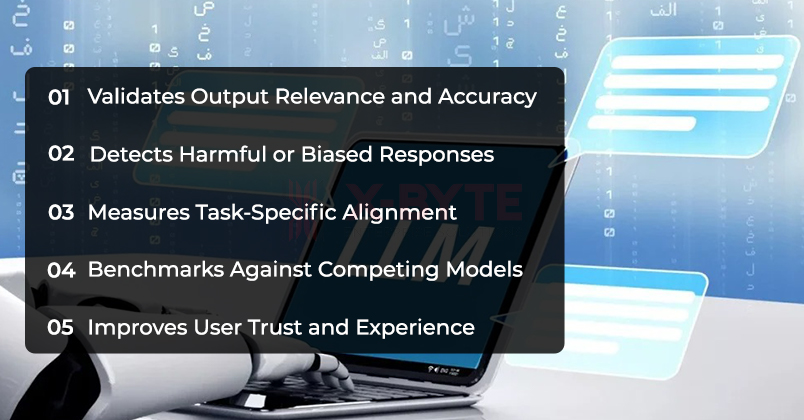
- Validates Output Relevance and Accuracy: The model generates contexts and factually correct responses relevant to tasks.
- Detects Harmful or Biased Responses: It helps you find out bad, harmful, or biased results in your model before implementing it.
- Measures Task-Specific Alignment: Ensure that the large language model is task-specific, i.e., it is oriented towards a specific task, such as fulfilling a specified task (e.g., summarization, QA, classification).
- Benchmarks Against Competing Models: It is applicable in matching performance against widely accessible or commercially available models in a bid to ascertain enhancements or the selection of a model.
- Improves User Trust and Experience: Good ratings lead to more rewarding and reliable interactions, making users feel more secure and satisfied.
With the proper process, organizations can prevent high-risk errors and improve return on investment across NLP applications.
Core LLM Evaluation Frameworks
Effective LLM assessment requires a multi-dimensional framework that captures linguistic quality, task alignment, and ethical behavior under varied real-world conditions. A comprehensive LLM evaluation framework should assess models across three key dimensions:
Evaluation Dimension | Focus Area | Tools/Techniques Used |
|---|---|---|
Intrinsic Evaluation | Language fluency, grammar, and syntax | Perplexity, BLEU, ROUGE, BERTScore |
Extrinsic Evaluation | Task-based model performance | Human scoring, classification metrics |
Behavioral Evaluation | Safety, bias, robustness | Red teaming, adversarial testing, and toxicity detection |
Common Frameworks to Explore:
- OpenAI Evals: Structured tests to evaluate model performance on a range of tasks.
- HELMeTRIC: Evaluates LLMs across helpfulness, honesty, and harmlessness.
- Holistic Evaluation of Language Models (HELM): Benchmark covering generalization, bias, calibration, and efficiency.
Using diverse frameworks ensures a balanced evaluation approach—combining technical metrics, human judgment, and risk assessment for real-world LLM deployments.
Key LLM Evaluation Metrics
The performance by a language model is best measured by several LLM evaluation metrics that take into consideration both accuracy and appropriateness. Both metrics complement each other with different use cases.
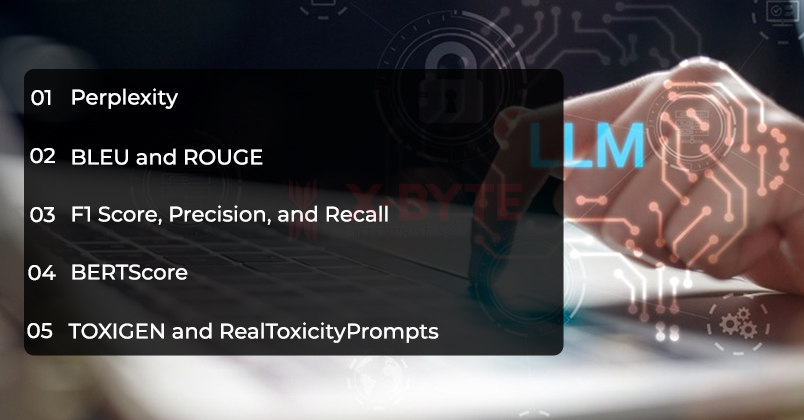
- Perplexity: Calculate the level of certainty that the system exhibits in predicting the next word. The higher the score, the better the fluency and coherence.
- BLEU and ROUGE: These measures help compare machine-produced texts with human references, which typically occur in the cases of translation and summarization.
- F1 Score, Precision, and Recall: Satisfactory for fitting problems that require us to balance false positives and false negatives in classification problems.
- BERTScore: Employ pre-trained contextual embeddings to compute the semantic similarity between model predictions and reference sentences.
- TOXIGEN and RealToxicityPrompts: Evaluate harmful, biased, and toxic output of Large Language Models.
These metrics provide measurable information, but evaluations from humans are still necessary to factor in context, emotional sense, and nuanced correctness.

Validate your LLMs with scalable tools and metrics trusted by global enterprises.
LLM Evaluation Techniques to Consider
Effective LLM evaluation techniques combine automated and human methods. Below are popular approaches:
1. Automated Evaluation
- Prompt-based testing: Evaluate how models respond to standardized prompts.
- Regression tests: Run repeated prompts after updates to ensure consistent output.
- Adversarial testing: Use crafted prompts to detect failure modes.
2. Human-in-the-Loop Evaluation
- A/B testing: Compare model versions to identify preference or performance gaps.
- User testing sessions: Real users rate relevance, clarity, and tone.
- Rubric-based scoring: Assess outputs using predefined scoring guidelines.
Best Practices for Evaluating LLM Systems
Using organized LLM best practices results in scalable and uniform evaluation:
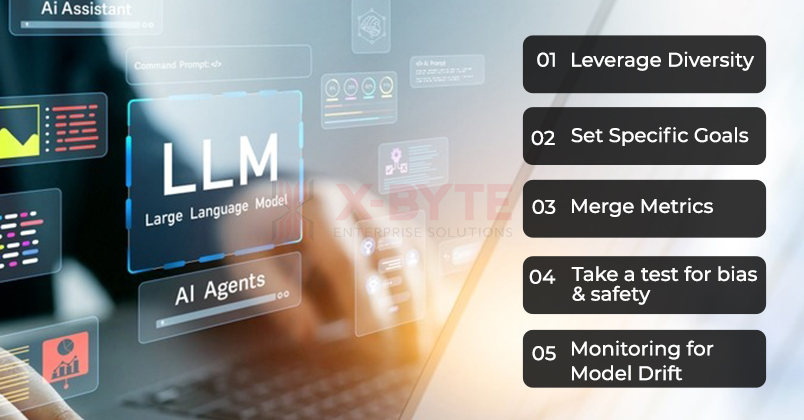
- Leverage Diversity: Test on different themes, languages, and audiences.
- Set Specific Goals: Depart the realm of intelligence and articulate ones (summarization, reasoning, classification) that are easier to rate.
- Merge Metrics: Integrate automated metrics and human feedback for comprehensive evaluation.
- Take a test for bias and safety: Establish a regular habit of checking for toxicity and fairness.
- Monitoring for Model Drift: Monitor for performance changes on an ongoing basis.
Implementing these practices will help ensure that your evaluations truly have meaning, especially when considering the scale of LLM evaluation solutions.
Choosing the Right LLM Evaluation Tool
Choosing the right tool is essential if we are to streamline the analysis process, track improvements, and make LLM performance monitoring viable across various use cases.
- Weights & Biases (W&B): A tool to track experiments in real time and compare the performance of models through interactive dashboards.
- PromptLayer: Specifically designed for prompt-based models, it logs, version-controls, and tracks prompt/response pairs to facilitate prompt engineering and latency analysis.
- Confident AI: This tool is a dedicated AI solution to structured LLM outputs and provides deep insights into classification accuracy, error types, and confidence levels for regulated applications.
- SuperAnnotate: For human-in-the-loop evaluations, it has built features such as custom workflows, feedback loop, and issue tracking, where annotators can spend more time to improve the output quality of LLM.
- TruLens: One possibility is an open-source tool that oversees the outputs of LLMs and explains the results in real-time, meaning measures of usefulness, relevance, and detection of hallucinations on deployed models.
Select tools that complement your process, support automation, and offer insights that lead to actionable improvements in large language model performance at scale.
How to Validate AI Model Performance?
AI model performance metrics go beyond language capabilities and focus on how LLMs behave in production. Always validate based on:
- Accuracy: Does the model generate the correct result?
- Latency: Can it respond in real-time to user prompts?
- Scalability: Does performance hold under high traffic?
- Reliability: Is it resilient against varied or malformed inputs?
This enables teams to reach strong AI model validation before deploying apps in production.
Ensure performance, safety, and reliability with AI-powered evaluation solutions tailored to your needs.
Evaluating LLM Systems in Production
Keep a feedback loop going once your LLM goes live. Continuous monitoring is necessary for evaluating LLM systems at scale. Consider:
- Telemetry & Logs: Report on the use, failure, and fallback triggers of the tokens.
- User Feedback: Add thumbs-up/down or rating widgets to obtain feedback.
- Drift Detection: Detect when there are too wide deviations between outputs and inputs.
A periodic validation is therefore required to maintain the effectiveness of our model in line with business goals and to meet the expectations of its users.
Use Case: X-Byte Solutions’ AI Chatbot for IT Support
Background: X-Byte Enterprise Solution collaborated with an India-based medium-sized IT corporation to develop a chatbot utilizing conversational AI, which helps automate and enhance internal and external support systems. The objective was to expedite ticket resolution, decrease reaction times, and ensure the same quality of support.
Implementation Highlights:
- Human-In-Loop Judgement: Helpdesk staff judged the edge-case responses and gave feedback for refining the model.
- Contextual Prompting & RAG Integration: We incorporated company frequently asked questions, system logs, and docs into the chatbot with Retrieval-Aided Generation (RAG), and this led to the generation of accurate context-based responses.
- Performance Monitoring: The team used telemetry dashboards to track latency, accuracy, and user engagement to improve response quality.
- Safety & Bias Checks: Precautions such as built-in filters captured and corrected any inappropriate or off-brand responses before they were released.
Results:
- 50% reduction in average ticket resolution time.
- 30% decrease in manual workload for the internal support team.
- Consistent, brand-aligned responses, enhancing user experience and trust.
Why This Matters: The X-Byte approach highlights how LLMs powered by RAG can be combined with structured assessment, human supervision, and monitoring to establish scalable, safe, and practical support for clients with unique needs.
Use-Case Source: X-byte Solutions Case Studies
Conclusion
Operational LLM evaluation is not a one-off job; it’s an integral part of your AI lifecycle. From choosing the proper LLM evaluation framework to running LLM evaluation metrics, each step guarantees that your LLM is trustworthy, safe, and ready for the enterprise.
Whether you decide to use your custom model or a service like the LLM development service you’re using now, testing performance early (and continuously) is crucial to future success. The right tools, datasets, and techniques will ensure your LLM deployment creates satisfaction for both the user and the business.
Consider engaging a machine learning development company that is familiar with these details to achieve an even greater outcome. To conduct large-scale deployments, the integration of AI solutions, specifically made, can significantly ease the process of LLM usage and optimization.