
What is Pick Up & Delivery App Development?
Pick-up-and-delivery-app-development is the process of building the mobile apps and web consoles that power local logistics: scheduling pickups, assigning drivers, routing, real-time tracking, proof of delivery, and payments. It serves B2C (retail/BOPIS, groceries, pharmacy, laundry, florists) and B2B/internal (store-to-store transfers, 3PL handoffs, reverse-logistics).
- Why it matters now.
- Customer behavior: Retailers with shopping apps often see ~3× higher conversion than mobile web, which directly improves order volume flowing into delivery operations.
- Cost pressure in the last mile: McKinsey estimates 13–19% of logistics costs come from inefficient mid-/last-mile handovers—avoidable with better digital proof flows and process control.
- Failure is expensive: Up to 20% of e-commerce packages miss the first-attempt delivery, driving re-delivery and support costs and hurting retention.
For implementation details and patterns, see our courier delivery app development guide.
Pick Up & Delivery App Development Features
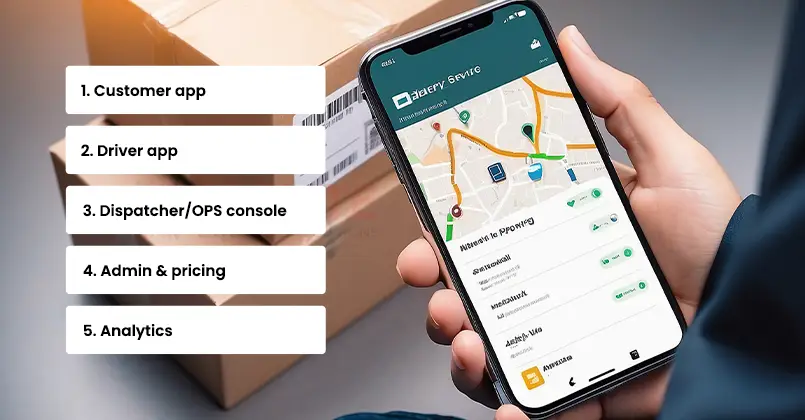
1. Customer app (conversion & convenience)
- Smart address capture + geofence, time-slot selection, live tracking with ETA confidence bands, reschedule/returns, wallet/payments, accessibility (font sizes, contrast, screen-reader labels).
- Business impact: better slots and live ETAs reduce “Where is my order?” tickets and improve first-attempt success.
2. Driver app (speed & reliability)
- One-tap onboarding + KYC, stop list with priorities, navigation hand-off, e-POD (photo + timestamp + geofence + barcode/QR), earnings & instant payouts, device integrity checks (fake-GPS detection).
- Business impact: clean e-POD lowers “not received” disputes and chargebacks by giving verifiable evidence.
3. Dispatcher/OPS console (control & automation)
- Auto-assignment rules, batching/zoning, manual overrides, surge controls, heatmaps, promised-time controls, exception workflows (reassign, re-slot, refund).
- Business impact: higher drop density and fewer late penalties.
4. Admin & pricing (monetization)
- Distance/zone/volumetric pricing, fees/taxes, promos/subscriptions, user/role management, audit trails.
5. Analytics (what to measure)
- Cost/drop, first-attempt success %, OTIF, ETA MAE, orders/hour (driver utilization), cancel reasons, repeat rate. These become your monthly “north-star” review.
Together, these capabilities form the core of on demand courier delivery app development, supporting both instant and scheduled deliveries while protecting margins.
Algorithms on Pick Up & Delivery App Development
Auto-assignment (when each strategy wins):
- Nearest-driver: best for short SLAs; risk of overloading popular zones.
- Capacity-aware: respects payload/time windows; ideal for bulky items and tight slots.
- Batching: consolidates nearby stops to boost density; great for urban peaks.
- Zone-first: predictable SLAs and easier workforce planning across multi-hub networks.
Routing (trade-offs to make explicit):
- Multi-stop routing with time-window constraints, live re-ranking based on traffic/weather/driver state.
- Track ETA MAE at P50/P90 (median and tail error); expose ETA bands to customers to reduce disappointment and tickets.
AI in Pick Up & Delivery App Development
Where AI earns its keep:
- Demand forecasting improves slot inventory and fleet right-sizing.
- Smart routing re-ranking blends historical speeds with live telemetry to cut lateness.
- Dynamic pricing adjusts fees by density/load with guardrails to avoid unfair spikes.
- Fraud & safety: fake-GPS detection, ID/KYC anomaly flags, image-tamper cues in POD.
- LLM copilots for ops and customer support: proactive delay notices, SOP suggestions, and ticket summaries.
Outcome ranges (illustrative, based on real rollouts):
- ETA MAE −10–25%, cost/drop −5–12%, tickets per route −20–35% once forecasting and POD automation settle in.
- External research and case literature continue to show material savings from AI-assisted route optimization in real fleets.
These techniques are central to ai powered courier app delivery app development, helping teams cut lateness, lower cost per drop, and scale reliably.
Cost of Pick Up & Delivery App Development
One-time build (scope bands):
- Discovery & UX; iOS/Android customer + driver apps; dispatcher/admin consoles; dispatch engine; integrations (maps/route APIs, payments, SMS/OTP, KYC); analytics/logging; basic security hardening; QA and UAT. These scope items form the baseline of your courier delivery app development cost.
- Cost drivers: feature depth (pricing engine, multi-hub ops), geography and pay rules, compliance (age-gated/cold-chain), and routing complexity.
Monthly OPEX to budget:
- Cloud/CDN, maps/route API calls, SMS/OTP, push/email, crash/analytics, KYC checks, basic on-call/SRE.
Context for stakeholders (why OPEX matters):
- Failed deliveries are costly—industry surveys commonly cite ~$17.20 per failed first attempt (re-delivery + support + refunds). Reducing failures by even 1–2 pp at scale pays for better slotting and e-POD.
- First-attempt failure rates as high as ~20% in some contexts underline why precise addresses, slots, and confirmations matter.
Volume snapshots (use a simple table in your page):
- 10k orders/month: lean OPEX; white-label/no-code can be a fast start.
- 100k+ orders/month: API and support lines dominate; custom amortization often wins over 18–36 months (see TCO below).
Pick Up & Delivery App Development ROI
Formula
ROI (%) = (Revenueuplift+Costsavings−Totalcost)÷Totalcost(Revenue uplift + Cost savings − Total cost) ÷ Total cost(Revenueuplift+Costsavings−Totalcost)÷Totalcost × 100
Worked example (illustrative):
- Volume: 30,000 orders/month
- Cost per drop improvement: −$0.30 → $9,000/month saved
- Support savings: fewer “Where is my order?” tickets → $3,000/month
- Revenue uplift: better slotting + repeat purchases → $6,000/month
- Total monthly benefit: $18,000
- Monthly costs: cloud/APIs/ops $4,000 + amortized build $6,000 (e.g., $108k over 18 months) = $10,000
- ROI: (18,000 − 10,000) ÷ 10,000 = 80%; payback ≈ 13.5 months on a $108k build.
Why apps help ROI: Shopping apps often convert ≈3× higher than mobile web, which increases order flow into your delivery stack—if you can fulfill reliably. Pair that demand with solid first-attempt success and you compound gains.

Pick Up & Delivery App Development: Security, Privacy & Compliance
What to cover in your build and sales pages (fill the gap competitors miss):
- PII minimization: for e-POD photos; retention windows; masking/redaction in logs and support tools.
- App hardening: jailbreak/root detection, certificate pinning, secure key storage, device integrity checks.
- SOC 2 (Trust Services Criteria): Security, Availability, Processing Integrity, Confidentiality, Privacy—make clear which you audit against and when.
- India’s DPDP Act (and global privacy posture): plain-English consent, rights to access/correction/erasure, children’s data protections, and cross-border transfer rules; keep a “last updated” note on your page as rules finalize.
Industries Using Pick Up & Delivery App Development
1. Retail/BOPIS & local delivery
- Needs: curbside workflows, time-slot inventory, POS/ERP sync, surge throttling during peaks.
- Result to aim for: first-attempt success ↑ via accurate slots and store confirmations.
2. Pharmacy/Healthcare
- Needs: age-gated delivery (ID verification), cold-chain notes, restricted-item SOPs, privacy controls.
- Result to aim for: chargebacks and “not received” disputes drop with geofenced e-POD.
3. Laundry pick-up & delivery
- Needs: bag/weight handling, repeat schedules, stain notes, easy rescheduling.
- Result to aim for: repeat rate ↑ and predictable utilization from capacity-aware assignment.
4. Bulky/furniture
- Needs: 2-person crews, assembly notes, long slots, capacity-aware routing.
- Result to aim for: fewer failed attempts and fewer damages through better slot promises and prep instructions.
5. Reverse-logistics (returns pick-up)
- Needs: pickup scheduling, consolidation hubs, inspection photos, automated refund workflows.
- Result to aim for: lower support load and faster refunds → retention lift.
Pick Up & Delivery App Development Integrations & Tech Stack
Integrations: maps/route APIs, address validation, payments, SMS/email/push, identity/KYC, POS/ERP/OMS, CDP/analytics, support tools, error logging.
Reference architecture: mobile (native or cross-platform), event-driven backend with queues, routing/optimization service, analytics pipeline, and MLOps for forecasting/ranking models.
Why this matters: McKinsey’s research shows vehicle/fuel costs are a surprisingly small share of dense-network last-mile; most savings come from process and digital flow—i.e., the stack choices above. Partnering with a courier delivery app development company that can implement this architecture end-to-end helps you capture those efficiencies sooner.