Quick Summary : AI agents are intelligent systems that sense, learn, and act autonomously. Building one involves defining its role, selecting the right models, developing logic, testing, and refining based on feedback. With growing business demand and powerful tools like LLMs, AI agents offer scalable, efficient solutions across the retail, finance, and healthcare industries.
What are AI Agents?
AI agents are autonomous systems developed to observe the environment, process any given information, and take steps to achieve a goal. These agents can interact with the world, make decisions, and learn from experience. Unlike standard software that follows a fixed set of instructions, AI agents follow a self-directed system that combines sensing, reasoning, and acting. This creates a more adaptable system to understand and respond to real-world scenarios.
Choosing the right partner is very important for businesses leveraging this innovation. Professional AI Development Services can provide you with the expertise to deploy personalized, high-impact systems. They use unique and powerful AI agent development frameworks and tools to develop an effective agent. These frameworks handle complex workflows efficiently and coordinate different instructions between the sub-agents.
How do AI Agents Work?
If you want to understand how AI agents work, let’s break down their fundamental mechanism. The core AI agent functionality continuously senses inputs, interprets them using a decision-making model, and produces relative results or actions. Some systems use LLM-based AI agents to understand advanced natural language and generate capabilities. They mainly rely on large language models like GPT, which helps the agents interact with humans naturally and intelligently.
Developing these agents includes setting up the right environment for data ingestion, choosing the correct algorithm, and training the model according to the problem using the given data. Then these models are evaluated and deployed. Developers then integrate APIs and cloud platforms. Multiple agent systems are developed to share instructions and knowledge to build a more advanced application.
Finally, they are tested in a controlled environment using agent-based modeling to check their performance under various scenarios. This includes rigorous evolution, which ensures the platform’s efficiency.
Furthermore, autonomous AI agents use machine learning techniques to learn from new data, adapt, and develop continuously. This removes the need for constant human oversight and makes them ideal for dynamic sectors like finance and logistics. To navigate the complexities of designing and deploying agents, turn to Machine Learning Development. They offer expertise in data handling, selecting models, and scalability.

Are you unsure where to start building an AI agent for your business?
Get in Touch with our experts in XByte today to get personalized guidance.
How is an AI Agent Developed?
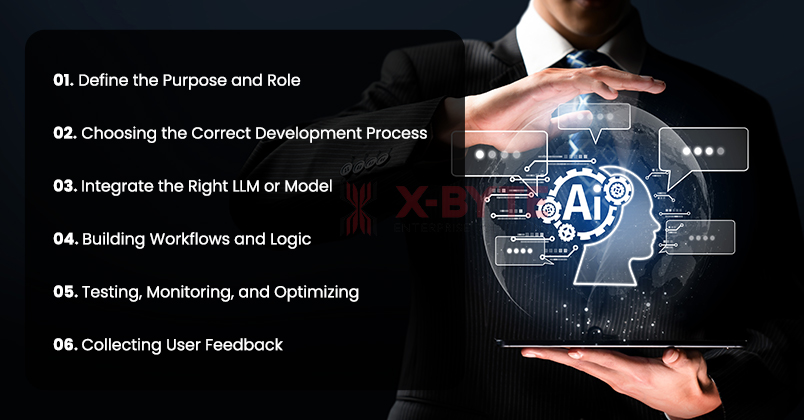
Developing an AI agent is a strategic and complex process. Whether you are building from scratch or want to improve a pre-built platform, each phase is essential to develop a reliable and adaptable agent. Here is a detailed breakdown of each step:
Define the Purpose and Role
First, you must determine your AI agent’s role within the organization. Whether it will act as a customer service assistant, an eCommerce recommendation system, or a fraud detection system, it will create the required workflow and integrations. Otherwise, it can quickly become too broad, leading to insufficiencies. A defined outline can help you streamline the development process and ensure your AI agent delivers value from day one.
Choosing the Correct Development Process
Next, you must decide whether to build the agent from scratch or use an existing framework. Developing from scratch offers the maximum flexibility. You can customize the AI logic, add features according to your platform’s needs, and fully own the data. However, this may require significant technical expertise, time, and budget.
Therefore, you must make the right decisions depending on your customization needs, internal maturity, and budget constraints. A guide to choosing the right AI development company might be helpful.
Integrate the Right LLM or Model
Then select the right large language model like GPT-4 or Claude. These models increase the agent’s ability to interpret language and generate better responses. For deeper insights into model selection and implementation, follow the guide on tools and best practices to AI models. Whether you are building a custom service assistant or a chatbot, integrating the right LLM will make your platform more responsive and easier to scale.
Building Workflows and Logic
In this step, you must implement decision trees, response frameworks, and real-time automation flows. For example, an AI agent in retail automates inventory adjustments according to purchase patterns. This will streamline some steps by directly aligning workflows. They can also help automate, schedule, and prioritize tasks.
This enables your AI to function as digital employees. They reduce the workload while simultaneously maintaining accuracy and efficiency, which leads to fast decision-making and improves the organization’s productivity.
Testing, Monitoring, and Optimizing
Before deployment, your AI agent must undergo various evaluation rounds. This covers everything from response latency to periodically retraining models. You can use dashboards to track metrics and correct mistakes in real time. This is where training AI models becomes essential to ensure optimal results.
To build a successful AI agent, it should continuously learn and evolve with your business processes. This makes your agent smarter, more accurate, and more aligned with your operational goals.
Collecting User Feedback
The last step is to collect feedback to refine the AI agent’s performance and increase user satisfaction. Interaction logs, feedback forms, and usage analysis all provide data. With the help of real user insights, you need to adjust responses, add new features, and resolve any gaps present.
GPT models transform NLP by enabling agents to adapt and evolve constantly according to user needs. This phase ensures that your agent is more intuitive and responsive. GPT models also offer long-term ROI and operational excellence.
Do you need help selecting AI tools, models, and features?
Let XByte help you develop a scalable, high-performing AI agent that fits your company’s needs. Schedule an AI Consultation session with XByte now.
Conclusion
AI agents are now transforming how businesses operate and deliver customer value. These agents are used everywhere, from customer service to e-commerce, finance, and healthcare. They are unmatched in terms of efficiency and intelligent decision-making. They can resolve any complex data and offer real-time insights. Using these agents, businesses provide personalized and responsive experiences to users. They can easily handle large volumes of data and provide custom solutions according to your needs. Thus, AI agents are a one-size-fits-all solution and a strong tool for any business strategy.
Getting the right AI consulting and development services becomes essential as businesses adopt AI-driven solutions to increase productivity. This is where XByte can be handy. It is a leading software development company with a wide global presence. With 12+ years of experience and 250+ skilled IT professionals, XByte is your best partner. We have already worked with 900+ customers and successfully delivered 1150+ projects. Contact us today to bring your next big idea to life.